Time Traveler's Guide to Novgorod, 1200 AD
Your survival guide to Novgorod in 1200: the medieval Russian republic where merchants ruled, literacy was widespread, and democracy came before the Magna Carta.
Read Wikipedia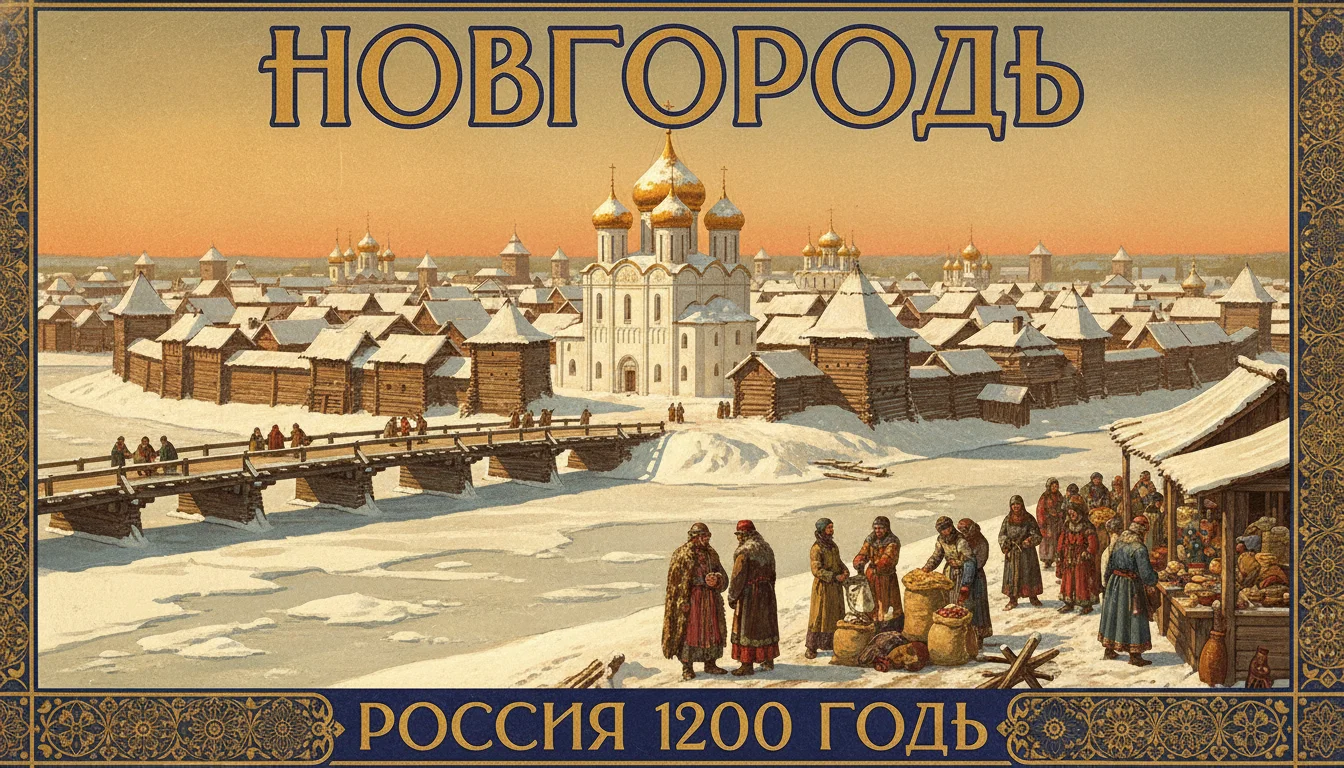
You have arrived in one of medieval Europe's most unexpected places: a democratic republic in the frozen north where merchants elect their rulers, women own property, and common people write letters to each other on birch bark. Welcome to Novgorod the Great, circa 1200 AD - the city that proves medieval Russia was far stranger and more sophisticated than you ever imagined.
First Impressions: A City of Churches and Commerce
The Volkhov River splits the city in two. On the west bank sits the Sofiyskaya Storona (Sophia Side), dominated by the magnificent white-walled Cathedral of St. Sophia, its golden domes gleaming above the wooden cityscape. The Kremlin fortress - they call it the Detinets here - anchors this half of town, its massive wooden walls and towers housing both the archbishop's palace and the meeting hall of the veche, the people's assembly.
Cross the Great Bridge to reach the Torgovaya Storona (Trade Side), where the markets pulse with activity. The scent hits you before the sound does: fish from Lake Ilmen, furs from the northern wilderness, beeswax and honey from forest apiaries, and spices that traveled here from as far as India and China. You have landed in one of medieval Europe's greatest commercial hubs.
What to Wear
Layer everything. Novgorod winters regularly drop below -20°C, and even summer nights carry a chill. The locals favor long tunics (rubakhas) of linen or wool, cinched with leather belts. Men wear loose trousers tucked into leather boots; women layer woolen sarafans over their tunics.
For cold weather, everyone wraps themselves in heavy cloaks lined with fur. If you can afford it, you want beaver or fox. Sheepskin works for commoners. Whatever you do, cover your head - felt caps for men, headscarves for women. Going bareheaded in Novgorod is a social statement you probably don't want to make.
The quality of your clothing immediately signals your status. Merchants and boyars (nobles) wear brightly dyed fabrics - reds, blues, and greens imported from Byzantium. Poorer residents make do with undyed wool and linen. Jewelry matters too. Silver spiral rings, glass beads, and enamelwork mark someone of means.
What to Eat and Drink
Novgorod cuisine centers on what the northern forests and waters provide. Fish dominates: pike, perch, salmon, and especially dried and salted fish that can last through the long winters. Lake Ilmen practically feeds the city.
Bread is the foundation of every meal, usually dense rye loaves that could double as building materials. Kasha - buckwheat porridge - appears at nearly every table, sometimes cooked with butter if you're lucky, plain if you're not. Cabbage, turnips, onions, and mushrooms round out the vegetable options. Fresh meat is a luxury, but dried and salted game appears regularly.
The drink of choice is kvass, a mildly fermented beverage made from rye bread. It tastes slightly sour and yeasty - think very mild beer with a bread aftertaste. Mead (made from the abundant local honey) is more celebratory. For water, stick to what's boiled or fermented. The Volkhov River serves as both water supply and sewer.
Eating customs: meals happen communally from shared bowls. You will receive a wooden spoon - keep track of it. Refusing food insults your host. When offered bread and salt (a traditional welcome), accept with both hands and taste some immediately.
The Veche: Medieval Democracy in Action
Here is where Novgorod gets genuinely strange by medieval standards. The city governs itself through the veche, a popular assembly where free male citizens vote on everything from war and peace to the hiring and firing of their leaders.
The assembly meets in the main square, announced by the ringing of a great bell. When you hear that bell, the whole city stops. Every free man can speak, though in practice the wealthy merchants and boyars dominate proceedings. Decisions happen by acclamation - whoever shouts loudest wins. Ties are settled, occasionally, by fistfights.
The veche elects the posadnik (mayor) and tysyatsky (military commander). Most remarkably, they even control the prince. Unlike most of medieval Europe, Novgorod's prince is essentially a hired mercenary - invited to command the army and settle disputes, but prohibited from owning land within the city or making decisions without veche approval. Princes who overstep get expelled. It has happened.
The Archbishop of Novgorod holds enormous influence but serves at the veche's pleasure. Between elected mayors, hired princes, and a controlled church, this is medieval democracy at its most developed - and it works. Novgorod has been running this system for over a century.
Social Structure: Who's Who
The boyars sit at the top - landowning nobles who control the northern wilderness where furs and forest products originate. They form the core of the veche leadership and provide the candidates for major offices.
Below them come the zhityi lyudi, the "substantial people" - wealthy merchants who may lack noble birth but possess enough silver to matter. Foreign trade flows through their hands. Many have connections to the Hanseatic League, the German trading confederation whose merchants maintain a permanent quarter (the Gotenhof) in the city.
Artisans and smaller traders form the middle ranks - leather workers, smiths, potters, icon painters. Novgorod's archaeology reveals an astonishingly literate population. Hundreds of birch bark documents have been unearthed: personal letters, shopping lists, debt records, even a schoolboy's homework. Your average Novgorodian can read and write at a time when Western European kings often cannot.
At the bottom work the smerdy (peasants in the surrounding countryside) and the kholopy (slaves, though slavery here is relatively limited compared to elsewhere).
Religion: The Church of St. Sophia
Orthodox Christianity permeates everything. The great Cathedral of St. Sophia - modeled on its namesake in Constantinople but adapted to northern conditions - stands as the spiritual heart of the city. Its bronze doors, plundered from somewhere in the West, feature biblical scenes worked in relief.
Churches proliferate throughout Novgorod - one for virtually every neighborhood, each funded by merchant families or craft guilds. Their icons blaze with gold leaf and intense colors. The Orthodox liturgy fills these spaces with incense, chanting, and the flicker of countless candles.
Religious observance is not optional. The church calendar structures the entire year: feasts, fasts, and holy days determine when you can eat meat, when you must abstain, and when work stops entirely. The Christmas and Easter cycles bring the city to a halt. During Great Lent, even the markets go quiet.
Cross yourself from right to left (the Orthodox way, opposite to Roman Catholics). When entering a church, bow toward the iconostasis. Do not extend your hand to kiss an icon unless you see locals doing the same. Remove your hat immediately upon entering any sacred space.
Trade: Why Novgorod Matters
Geography made Novgorod rich. The city controls the northern trade routes linking the Baltic Sea to the Black Sea and beyond. Furs flow south - beaver, sable, ermine, fox - while silver, cloth, and luxuries flow north.
The Gotenhof, the German trading compound, operates as essentially a self-governing foreign enclave. Hanseatic merchants from Lübeck, Hamburg, and other German cities maintain permanent agents here, trading salt, cloth, and metalware for Russian furs and wax. The arrangement benefits everyone: Novgorod gets goods it cannot produce, and the Germans get access to commodities that fetch premium prices across Europe.
The marketplace operates on weights of silver - the grivna (about 200 grams) and its subdivisions. Coinage exists but remains secondary to weighed metal. Honest scales matter; fraud is punished harshly.
Foreign merchants enjoy legal protections but face restrictions. They cannot trade directly with the Russian interior - all goods must pass through Novgorodian intermediaries. They must conduct business in the designated market areas. Winter forces most to return home when the rivers freeze, though some maintain year-round operations.
Dangers and Survival
Fire tops the list. The city is almost entirely wooden, and conflagrations sweep through regularly. When the alarm sounds, everyone fights the flames - it is a civic duty. Watch for bucket brigades and do not get in the way.
Political violence occasionally flares. The veche's shout-democracy system means disputes sometimes escalate to street fights between rival factions. The Sophia Side and Trade Side have their own local loyalties. During heated assembly meetings, stay on the periphery.
The law protects you if you follow the rules. Novgorodian justice involves a complex system of fines, oaths, and ordeals. For serious crimes, the veche can order drowning in the Volkhov. For lesser offenses, monetary compensation prevails. Merchants receive special protections, so keep your trading credentials visible.
Health hazards parallel other medieval cities. Sanitation is primitive, disease spreads easily, and medical care relies heavily on prayer, herbs, and hope. Avoid the tanners' district if you can - the smell and chemicals are genuinely hazardous.
Wildlife presents challenges if you venture beyond the city walls. Bears, wolves, and other predators roam the surrounding forests. The wilderness that supplies Novgorod's wealth is not domesticated.
Must-See Experiences
Attend a veche assembly. Find a spot at the edge of the great square and watch direct democracy in action. The shouting, the debates, the occasional violence - it's medieval politics with no filter.
Visit the Cathedral of St. Sophia during liturgy. The combination of architecture, icons, chant, and incense creates an overwhelming sensory experience that helps explain why the Orthodox faith took such deep root in these lands.
Walk the Great Bridge at dawn. Fishermen hauling their catches, merchants setting up stalls, the city waking to commerce - the bridge offers the best view of Novgorod's dual nature.
Explore the Market Side at peak hours. The sheer variety of goods - local, Byzantine, Islamic, German - passing through this one city illustrates how connected medieval trade networks really were.
Watch birch bark letters being written. Find a merchant's office or a craftsman's workshop and you may catch someone scratching letters into bark with a bone stylus. This everyday literacy remains one of Novgorod's most distinctive features.
Final Advice
Novgorod operates differently from most medieval places you might visit. Power is negotiated rather than inherited. Commerce matters more than conquest. Literacy extends far beyond the church elite. The city runs on pragmatism: what works, continues; what fails, gets voted out.
Respect the local customs, keep your trading honest, and remember that the frozen wilderness that seems so hostile is actually the source of all this wealth. The furs that keep Novgorod rich come from lands where few choose to venture.
Most importantly: this is a city of survivors. Novgorod has fought off Swedes, negotiated with steppe nomads, and maintained its independence through cunning rather than force. The people here are traders first, warriors second - but make no mistake, they know how to defend what is theirs.
Lord Novgorod the Great, they call this place. After a few days here, you will understand why.
Safe travels, time traveler. Mind the ice.
For related guides to medieval merchant cities, see Time Traveler's Guide to Medieval Venice, 1300 and Time Traveler's Guide to Carolingian Aachen, 800.

Need Advice from Someone Who Lived There?
Get firsthand accounts from people who actually lived through these moments in history.
Create your free account →No card required. Some figures and features require a paid plan.
Join the HistorIQly Club
Get smarter about the past.
Weekly stories, deep dives, and exclusive content straight to your inbox.