A Time Traveler's Guide to Old Kingdom Memphis, 2500 BC
A guide to old kingdom Egypt daily life: the pharaoh is a living god, the pyramids are freshly built, and there is no safe way to decline an invitation from either.
Read Wikipedia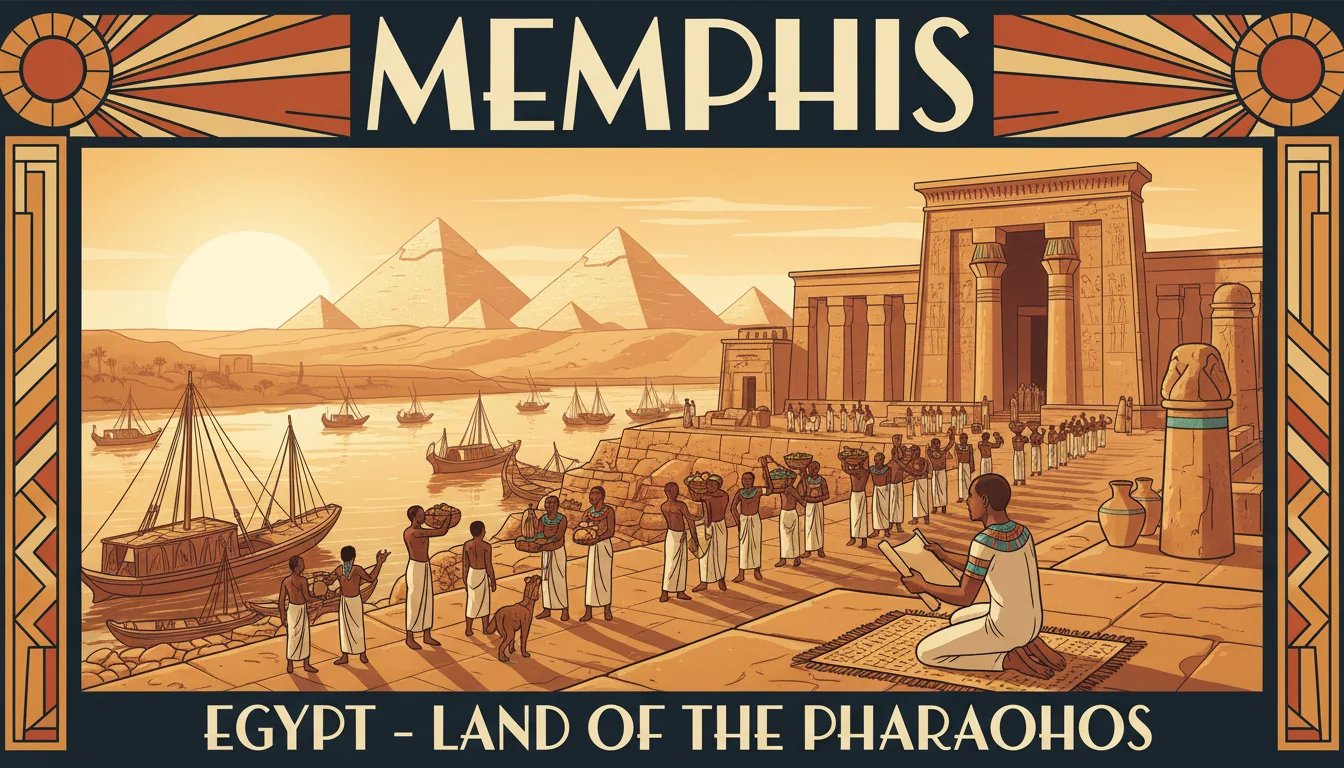
The pyramids of Giza were not ruins in 2500 BC. The Great Pyramid of Khufu had been completed perhaps sixty years earlier; Khafre's pyramid and the Sphinx were fresh limestone, gleaming white under the Egyptian sun with their granite casing still intact. Menkaure's pyramid was either nearing completion or recently finished. Standing on the Giza plateau and looking south, you could see the Step Pyramid at Saqqara - already two centuries old, already a monument to a monument. Egypt in 2500 BC was not in the business of modest ambitions.
Before you arrive, accept one foundational truth about this place: the pharaoh is not a king in any modern sense. The pharaoh is a god. Not metaphorically. Not symbolically. A living divine being whose personal well-being is cosmically connected to the flooding of the Nile, the prosperity of the Two Lands, and the correct rotation of the universe. Behave accordingly.
What kind of city you are entering
Memphis, Ineb-hedj in the local language - "White Walls" - sits at the apex of the Nile Delta, the pivot point where the river begins to spread north toward the sea. It is the administrative heart of the most centralized large state on earth. The White Walls are the palace and royal compound; around them sprawls a working city of workshops, granaries, harbors, temples, and residential neighborhoods stretching for miles along the western bank.
The Nile is the city's bloodstream. Everything arrives by boat - grain from Upper Egypt, cedar from Byblos in the Levant, gold and animal skins from Nubia, turquoise from the Sinai, copper from the Eastern Desert. The harbor districts are perpetually chaotic and perpetually busy.
Your safest identity is that of a foreign trader or a skilled craftsman attached to a trading mission. Egypt in 2500 BC does not receive casual foreign tourists - the concept does not exist - but it does receive foreign merchants, diplomats from Nubian chiefs, and occasionally Levantine craftsmen whose skills are valued. Pick a profession and rehearse its basic vocabulary. An ignorant trader is plausible. An ignorant nobody is suspicious.
The first thing that will disorient you
Time here runs by the Nile. The Egyptian year has three seasons: Akhet (inundation, when the Nile floods), Peret (emergence, when the fields appear from the receding waters), and Shemu (harvest). In 2500 BC there is no clock in any familiar sense. The day is divided by the position of the sun, the night by the stars. Officials and temple scribes use water clocks for indoor timing. Most people use the sun and trust their own sense of routine.
The flooding determines everything. When the Nile rises in late summer, agricultural work stops and the large corvee labor projects begin: moving stone, digging canals, constructing temple complexes and royal tombs. This is not forced labor in the sense of brutality - it is the state calling on its workforce during the season when that workforce cannot farm anyway. Workers receive rations, medical care, and a social status not available to anonymous farming households.
If you arrive during the inundation season, the fields around Memphis will be underwater. The city will smell of mud and the festival energy that comes with the annual miracle of renewed fertility.
Dress and appearance
Linen. Everything is linen. White is the color of purity and the correct choice for any occasion where you might interact with official Egypt. Upper-class Egyptians wear fine white linen, sometimes pleated, sometimes draped rather than sewn. Officials and priests shave their heads and wear wigs on formal occasions. Manual workers wear a linen kilt that stops above the knee.
Children in most households wear nothing until adolescence. This is not a social issue; the climate makes it practical.
Both men and women use kohl - black eye paint made from ground galena - applied around the eyes. This is not merely cosmetic; in a country of intense sun and sand, eye paint reduces glare and may have some antiseptic properties. If you show up without it you will look foreign. You are foreign, but you need not advertise it.
Sandals are made of papyrus or leather and are extremely simple. Upper-class Egyptians may wear leather sandals; most people go barefoot most of the time. Go barefoot when entering any temple precinct. Never wear sandals into a sanctuary. This rule has no exceptions.
Getting around
Memphis has no grid. Orientation is relational: you are upstream or downstream from a landmark, toward the river or toward the desert. The Nile is always your compass.
Foot travel is universal. Donkeys carry loads. Cattle pull agricultural equipment. The wheel exists in Egypt in 2500 BC - primarily on potter's wheels - but wheeled vehicles for transport will not be common for another few centuries. If you need to cross the Nile or travel any significant distance, you need a boat. Reed boats for local crossings, wooden cargo vessels for anything serious.
Do not try to enter the active construction zones west of the pyramid plateau without authorization. Access is controlled by scribes who maintain worker lists. An unauthorized presence near the pyramid construction sites will attract attention from people carrying staves.
Three things worth seeing
The Temple of Ptah
The great temple of Ptah in the center of Memphis is the spiritual axis of the city. Ptah is the patron of craftsmen and architects - the god who created the world through thought and the words he spoke. The temple complex is large, active, and largely off-limits to non-initiates. You can approach the outer courts. You cannot enter the inner sanctuary. A priest will prevent you. Do not argue with the priest.
What you can see from the outer courts is already extraordinary: stone columns, painted relief carvings in brilliant color, offerings being processed in constant rotation, and the sound of ritual chanting at dawn and dusk.
The harbor markets
The western harbor district is where the actual commerce of Egypt concentrates. Goods arrive from everywhere Egypt reaches - lapis lazuli from Afghanistan by way of Byblos, raw copper ingots from Sinai, dried fish from Lower Egypt, grain coming down from the nome capitals of Upper Egypt. Scribes check and record everything. Foremen argue over weights.
You can buy food here without attracting suspicion, provided you have something to trade. Silver by weight works. So does copper. A pile of lentils is currency. There is no coinage in Egypt in 2500 BC. Everything is measured in units of weight and exchanged by calculation.
The sunset over the Giza plateau
Walk west of Memphis in the late afternoon and find an unobstructed view of the plateau. The pyramids catch the setting sun on their white casing stones and become something that photographs from the 21st century will never adequately reproduce. They are not ruins. They are new. They are still being worked.
This is the primary temporal advantage of this particular destination: you can see what two thousand years of sandstorms, pillaging, and gradual casing-stone removal will hide from every future generation.
What to eat and drink
Bread and beer are the foundation of existence at every social level. Egyptian beer in 2500 BC is thick, nutrient-dense, and only mildly alcoholic - closer to a fermented porridge than a modern ale. It is nutritious and relatively safe because the fermentation process kills waterborne pathogens. Drink it.
Avoid raw fish from urban waters near the city's working districts. The Nile near the harbor carries a great deal of organic waste. Fish that has been salted or dried is generally safe. Fresh fish from cleaner sections of the river, prepared the same day by an established cook, is fine.
Onions, garlic, leeks, lentils, cucumbers, and figs are available at most markets. The onion is ubiquitous - it appears in rations records for pyramid workers, in ritual offerings, and in daily meals across every class. If you are unsure what to eat, eat bread, drink beer, and add onions. You will be consuming exactly what most of Egypt consumes.
What not to say or do
Do not speak disrespectfully of the pharaoh. Not even ambiguously. Not even in what you think is a private conversation. The concept of private conversation barely exists in a world where walls are thin, servants are present, and officials are rewarded for loyalty.
Do not touch anyone who appears to be a priest in a state of ritual purity. You will not necessarily know who is in that state. When in doubt, step back and let them pass first.
Do not walk into water in the Nile's channels without checking first. Crocodiles are common, well-fed on the fish that concentrate around the harbor waste, and fast. The Egyptians worship the crocodile god Sobek, which does not make the crocodiles less dangerous.
Do not attempt to photograph or sketch the interior of any royal or divine structure. Your intentions are irrelevant. The act of copying sacred images without ritual authorization will be interpreted as theft of divine power.
The experience you should not miss
Old Kingdom Egypt daily life is most vivid at the worksite, where labor of thousands shaped monuments that will outlast every civilization that follows. On any morning during the inundation season, go to the embankment and watch the work gangs come off the river. Boats arrive in the pre-dawn dark, carrying limestone blocks from the Tura quarries across the river. Teams of workers move the blocks on wooden sledges, pouring water ahead of the runners to reduce friction. Overseers with papyrus rolls track the loads. Scribes argue about measurements. Work songs carry across the water in the cool air before the heat begins.
These are the people building what will eventually be called the Wonders of the Ancient World - and they know it. The gang names they leave on the blocks include things like "Friends of Khufu" and "Drunks of Menkaure." They have opinions about their work. They are proud.
For more guides to ancient civilizations, see our time travel editions covering ancient Sparta in 450 BC and Hittite Hattusa in 1300 BC.
Pack light, dress in linen, and do not stare at the priests.
Quick Answers
Common questions about this topic
What was Memphis like in ancient Egypt?
Memphis, known in ancient Egyptian as Ineb-hedj ('White Walls'), was the administrative capital of Old Kingdom Egypt, located at the apex of the Nile Delta where the river begins to branch. In 2500 BC it housed the royal court, the great temple of Ptah, major workshops, and the bureaucratic apparatus that managed an empire stretching from the Mediterranean to Nubia.
Were the pyramid builders slaves?
No. Archaeological excavations near Giza have found the workers' village with bakeries, breweries, and medical facilities. Graffiti from the pyramid workforce show team names and expressions of pride in their work. The builders were state employees paid in food rations, beer, medical care, and a burial near the pyramid if they died on the job. That was a significant privilege in Old Kingdom Egypt.
What gods were worshipped in Old Kingdom Memphis?
The patron of Memphis was Ptah, the craftsman god associated with creation through thought and speech, whose great temple stood at the city's center. Ra, the sun god of Heliopolis, was increasingly important as pharaohs aligned themselves with his cult - the title 'Son of Ra' became standard for pharaohs of the Fourth and Fifth Dynasties. Osiris, Horus, Hathor, and dozens of regional deities were also worshipped throughout Egypt.
What would a visitor eat in Old Kingdom Memphis?
Bread and beer were the staples of every social class - the average worker received daily rations of both. Fresh fish from the Nile, vegetables including onions, garlic, leeks, and lentils, and fruit like figs and dates were widely available. Upper-class households added beef, goose, and goat. Honey sweetened food and doubled as medicine. Wine was available but expensive, imported primarily from the Levant.

Need Advice from Someone Who Lived There?
Get firsthand accounts from people who actually lived through these moments in history.
Create your free account →No card required. Some figures and features require a paid plan.
Join the HistorIQly Club
Get smarter about the past.
Weekly stories, deep dives, and exclusive content straight to your inbox.