A Time Traveler's Guide to Ottoman Istanbul, 1555
Your guide to Ottoman Istanbul in 1555: survive the bazaars, bathhouses, and bureaucracy of the world's most cosmopolitan city under Suleiman the Magnificent.
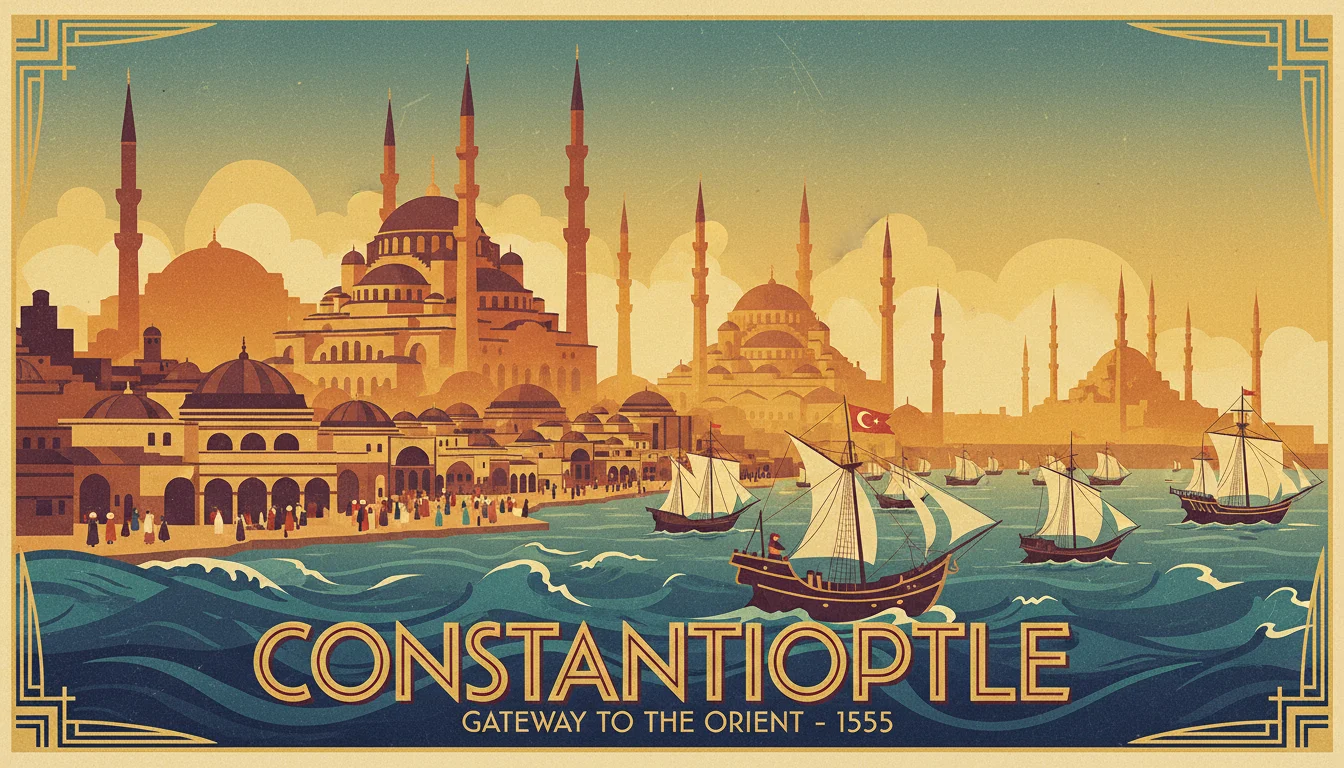
You open your eyes, and the first thing that hits you isn't the view. It's the smell. Woodsmoke, roasting kebabs, rosewater, and the unmistakable tang of salt air drifting up from the Golden Horn. Welcome to Istanbul, 1555, the jewel of three continents and capital of the most powerful empire on Earth.
Sultan Suleiman I sits on the throne, and his subjects number roughly 25 million. The city itself holds around 400,000 people, making it the largest metropolis in Europe (sorry, Paris). You've landed during the Ottoman golden age, when art, law, architecture, and military might have converged into something genuinely extraordinary.
Here's how to not die.
What to Wear (And What Will Get You Stared At)
Ottoman Istanbul runs on a strict dress code, and it's not optional. Your clothing broadcasts your religion, social rank, and occupation to everyone on the street. Get it wrong and you'll attract the wrong kind of attention.
If you're posing as a visiting merchant (your safest cover story), wear a long kaftan over loose trousers called shalvar. A simple turban is essential for men. The color matters enormously. White turbans are for Muslims. Christians wear dark blue or black. Jews wear yellow. Violate this and you'll have a janissary asking uncomfortable questions within the hour.
Women should wear a loose outer robe called a ferace and a head covering. A thin veil called a yashmak covers the lower face in public. Ottoman women actually have significant legal rights in this era, including property ownership and divorce, but public modesty rules are non-negotiable.
Skip the shoes you arrived in. Get yourself a pair of soft leather boots or pointed slippers from the bazaar immediately.
What to Eat (Spoiler: You'll Eat Very Well)
Ottoman cuisine in 1555 is genuinely world-class, and you won't need a sultan's budget to enjoy it. The empire stretches from Hungary to Yemen, and all those trade routes funnel ingredients straight into Istanbul's kitchens.
Street food is your best friend. Look for kebab sellers near the bazaars grilling lamb over charcoal. Simit, the sesame-crusted bread rings, are sold on every corner for almost nothing. Borek, those flaky pastry parcels stuffed with cheese or meat, will become your breakfast obsession.
For something heartier, find an imaret, a charitable soup kitchen funded by wealthy donors. These aren't sad charity meals. Imperial imarets serve pilaf, stewed lamb, and fresh bread to hundreds daily, free of charge. No questions asked.
Drink ayran (salted yogurt drink) or sherbet, which here means a chilled fruit syrup drink, not the frozen stuff. Coffee has just arrived from Yemen and is taking the city by storm. The first coffeehouses, called kahvehane, are popping up everywhere. They're part social club, part news hub, part debating society. Find one and sit for a while.
Do not drink the water unless it comes from a public fountain connected to the aqueducts. Seriously. Suleiman's architect Mimar Sinan has built an impressive water system, but stick to the marked fountains.
Customs That Will Save Your Neck
Remove your shoes before entering any mosque or private home. This is absolutely non-negotiable.
Greet people with your right hand over your heart and a slight bow. The left hand is considered unclean, so eat, gesture, and hand objects with your right hand only.
Bargaining is expected, even required, at the Grand Bazaar. Paying the first price offered is considered odd, almost rude. Start at about half the quoted price and work your way up with tea and conversation. Speaking of which, never refuse tea. It's offered as hospitality, and declining is a social offense.
Friday is the holy day. Major mosques will be packed for noon prayers, and the sultan himself processes to the Suleymaniye Mosque with full military escort. It's the best free spectacle in the city. Find a spot along the route early.
The hammam (public bathhouse) isn't just about hygiene. It's where business deals happen, gossip circulates, and social bonds form. Visit one. Men and women have separate hours. Bring a copper bowl and a towel, or rent them at the door. Tip the attendant generously.
The Biggest Dangers
The Janissaries. These elite soldiers are the sultan's personal army, recruited as children from Christian families and trained into fearsome warriors. They patrol the streets and enforce order. They're disciplined, well-paid, and you absolutely do not want to cross one. Stay polite, stay out of their way, and never insult the sultan within earshot.
Fire. Istanbul in 1555 is largely built of wood. Fires break out regularly and can consume entire neighborhoods in hours. Know where the nearest stone building (a mosque or a han) is at all times. If you hear the fire drums beating, move fast.
Plague. The Ottoman Empire experiences periodic plague outbreaks. If you hear rumors of illness in a neighborhood, avoid it completely. Ottoman medical practice is actually quite advanced, with functioning hospitals called darushifas, but plague is plague. There's no cure in any century before the 20th.
Getting lost. Istanbul's street layout follows no grid. The alleys twist, dead-end, climb hills, and occasionally dump you into someone's courtyard. Memorize landmarks: the minarets of the Suleymaniye Mosque, the dome of Hagia Sophia, and the waterfront are your compass points.
Must-See Experiences
The Grand Bazaar. Over 3,000 shops under one roof, making it the largest covered market in the world. Silk from China, spices from India, leather from North Africa, weapons from Damascus. You could spend a week here and still miss entire sections. The jewelers' street alone will make your jaw drop.
The Suleymaniye Mosque. Mimar Sinan's masterpiece, freshly completed just a few years ago. The interior is breathtaking, all soaring domes, stained glass, and perfect acoustics. When the muezzin calls to prayer, the sound fills the entire space without any amplification. It's one of the greatest buildings ever constructed by human hands.
Hagia Sophia. Nearly a thousand years old and still awe-inspiring. Originally a Byzantine cathedral, it's been a mosque since 1453. The sheer scale of the dome will make you feel very small in the best possible way.
The Hippodrome. The old Byzantine chariot-racing arena is now At Meydani, the public square where festivals, celebrations, and the occasional public execution take place. The Egyptian obelisk still stands, already 3,000 years old.
A sunset from Galata Tower. Climb the old Genoese watchtower across the Golden Horn for a panoramic view of the entire city. Minarets, domes, the Bosphorus glittering in the evening light, ships from every corner of the Mediterranean. This is what 1555 looks like at its absolute finest.
Your Survival Cheat Sheet
- Dress according to your supposed religion. Colors matter.
- Eat street food and visit an imaret for free meals.
- Coffee is new and trendy. Try it.
- Right hand for everything. Left hand is rude.
- Never refuse tea. Bargain at the bazaar.
- Avoid janissaries, fire, plague, and getting lost.
- Mosque visits require shoe removal and modest dress.
- When in doubt, be polite, bow slightly, and keep moving.
For other capitals of medieval Islamic civilization, our guide to Mamluk Cairo in 1400 covers the city that preceded Ottoman dominance in Egypt, and our guide to Nasrid Granada in 1360 shows the last great Moorish court in Iberia.
Istanbul in 1555 is a city of staggering ambition and beauty. Suleiman's empire is at its peak, the architecture is legendary, the food is outstanding, and the energy of 400,000 people from dozens of cultures crammed onto a peninsula between two seas is something no modern city can quite replicate. Just watch the dress code, keep your right hand busy, and whatever you do, don't insult the coffee.

Need Advice from Someone Who Lived There?
Get firsthand accounts from people who actually lived through these moments in history.
Ask Them YourselfJoin the HistorIQly Club
Get smarter about the past.
Weekly stories, deep dives, and exclusive content straight to your inbox.