Time Traveler's Guide to Vijayanagara (Hampi), 1500
Your survival guide to visiting Vijayanagara Hampi in 1500 - the richest city on Earth, where elephants parade through streets of gold and temples touch the sky.
Read Wikipedia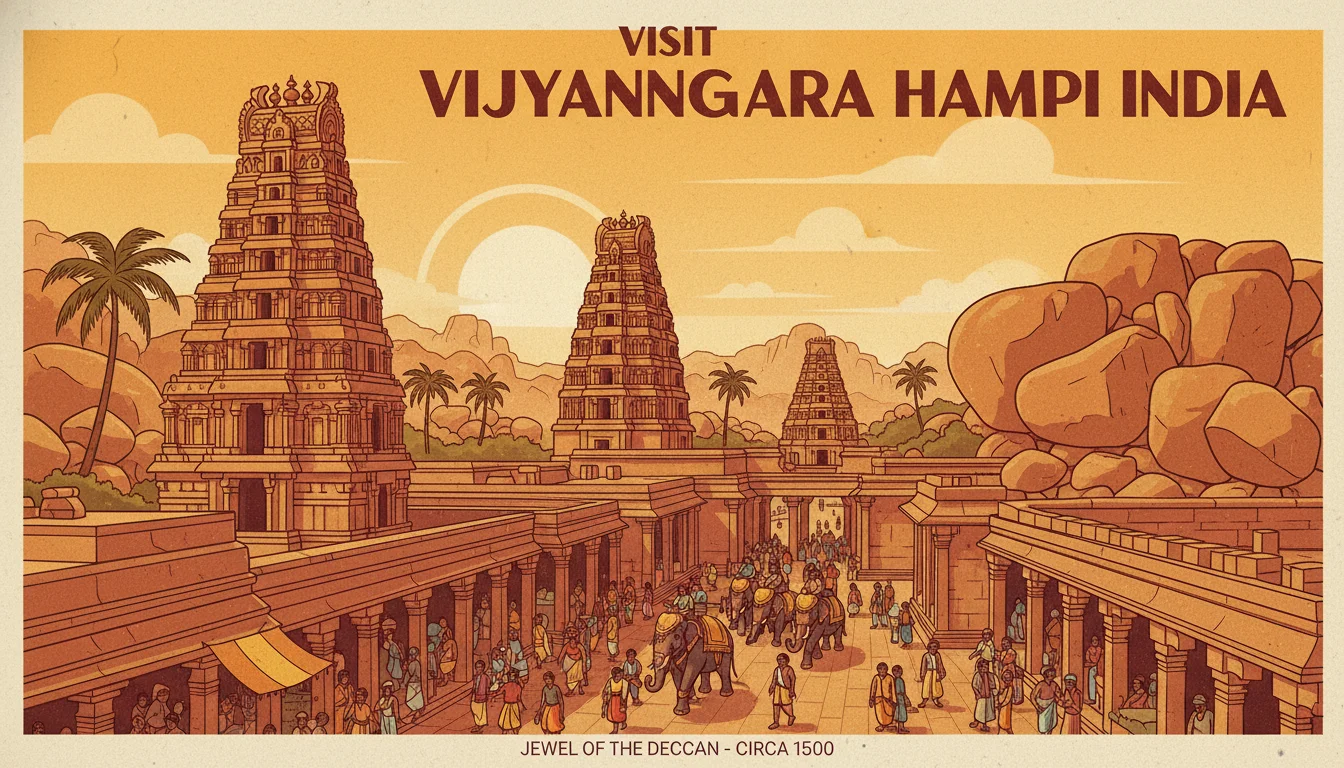
You've set your time machine to 1500 AD and typed in "Vijayanagara." Good choice. You're about to visit the largest and richest city on Earth - bigger than Paris, wealthier than Venice, more magnificent than anything you've seen in a history book. Why haven't you heard of it? That's a story for another time. Right now, let's focus on keeping you alive and amazed.
Where Exactly Are You?
You've landed in South India, in the heart of the Deccan Plateau. The city sprawls across 650 square kilometers of boulder-strewn landscape along the Tungabhadra River. Those massive granite boulders everywhere? The locals have carved temples, fortifications, and entire neighborhoods into and around them. It's like someone dropped a magnificent civilization into a giant's rock garden.
The empire at its peak rules most of South India - from sea to shining sea. Under King Krishnadevaraya, who's currently on the throne, this is the golden age. Enjoy it. This city has about forty years left before it's destroyed so completely that Europeans will refuse to believe it ever existed.
But that's future talk. Right now, you're standing in a wonder of the world.
What to Wear (Critical Information)
Men: You'll need a dhoti (a length of cloth wrapped around your waist and legs) and ideally an angavastra (upper cloth) draped over one shoulder. Quality matters here - the cotton trade is huge, and people can spot cheap fabric immediately. For the royal court, go for silk. The local Vijayanagara style includes elaborate turbans for formal occasions.
Women: A sari is essential, preferably silk or fine cotton. The draping style here is different from what you might know - it's called the "kacche" style, with the fabric pulled through the legs. Gold jewelry isn't optional; it's practically mandatory for anyone of status. Even middle-class women wear gold nose rings, bangles, and earrings.
Everyone: Go barefoot in temples (absolutely non-negotiable). Carry footwear for the streets - the granite can be scorching hot. And get used to sandalwood paste - you'll be offered it for your forehead constantly. Accept it.
The Money Situation
The currency is the gold pagoda (also called the varaha), and it's accepted from the Red Sea to the Malay Peninsula. Bring plenty of trade goods if you can - Arabian horses are worth their weight in gold here (literally), and the king will pay outrageous prices for them. Pearls, coral, and copper also trade well.
For everyday purchases, you'll use smaller denominations called fanams (silver) and jitals (copper). A meal at a street stall might cost a few jitals. A night's lodging in a decent choultry (rest house) runs about a fanam. If you're carrying gold pagodas, don't flash them around - thieves exist in every century.
What to Eat
Welcome to one of history's great food scenes. The local cuisine is a precursor to what you know as South Indian food, but richer and more varied:
Must-try:
- Rice preparations with coconut, tamarind, and an orchestra of spices
- Idlis and dosas (yes, they exist already, and they're delicious)
- Incredible vegetarian dishes at temple kitchens - some feed thousands daily
- If you eat meat, mutton and chicken dishes prepared in Portuguese-influenced styles near the trading quarters
Drink:
- Toddy (palm wine) is everywhere and socially acceptable
- Coconut water is the safe hydration choice
- Tea and coffee haven't arrived yet - those come later
Warning: The chili pepper has just arrived from the Portuguese traders, and local cooks are experimenting enthusiastically. If something looks red, proceed with caution.
Daily Dangers to Avoid
The Elephants: There are hundreds of war elephants in the city, plus countless working elephants. They have right of way. Always. When you hear the bells and shouts of an elephant procession, get off the street immediately. Elephant handlers (mahouts) won't stop for you.
The Sun: South India in the dry season is brutal. The locals know to conduct business in the morning and evening. Midday is for rest. Follow their example or risk heat stroke on the hot granite streets.
Religious Transgression: This is a devoutly Hindu kingdom surrounded by Muslim sultanates. The Vijayanagara kings protect all faiths (you'll find mosques and temples side by side), but temple protocols are strict. Never enter the inner sanctum unless you're Hindu. Never point your feet at deities or holy men. Never wear leather in temple precincts.
The Justice System: It's... efficient. Public punishments happen in the main bazaars. Don't steal anything - the penalty is amputation. Capital crimes mean execution, often by elephant trampling. The king's word is absolute law.
Must-See Attractions
The Royal Palace Complex: You can't enter the private quarters, but the public areas are staggering. The Mahanavami Dibba platform hosts the nine-day Dasara festival - the biggest celebration you'll ever witness. Thousands of dancers, musicians, wrestlers, and those elephants, all in procession.
The Vitthala Temple: Still under construction during your visit, but already one of India's architectural marvels. The stone chariot out front is carved from a single boulder. The musical pillars produce actual musical notes when struck (ask a priest for a demonstration).
The Hampi Bazaar: Over a kilometer of covered marketplace stretching to the Virupaksha Temple. You can buy anything here - Persian silks, Chinese porcelain, African ivory, Arabian horses, diamonds from the nearby mines. The gem trade alone is worth more than most European kingdoms.
The Riverside: Where the city meets the Tungabhadra. Watch the sunrise from the ghats. Pilgrims bathe here; priests perform rituals. Coracle boats ferry people across. It's timeless (or as timeless as 1500 gets).
Customs That Will Save Your Life
The Head Wobble: You'll notice people doing a distinctive side-to-side head movement. It means everything from "yes" to "I understand" to "continue." Learn it. Practice it. It's essential communication.
Gift-Giving: Never visit anyone of status empty-handed. Bring betel leaves and areca nut at minimum. For officials, think bigger - fruit, sweets, or fabric.
The Caste System: It's complex, it's everywhere, and you cannot navigate it as an outsider. Position yourself as a foreign merchant or scholar. Foreigners exist somewhat outside the system, which gives you unusual freedom of movement. But never pretend to be something you're not - locals will see through it immediately.
Greeting Royalty: If you somehow end up in the presence of the king (not impossible - he holds public audiences), prostrate yourself fully on the ground. Don't speak unless spoken to. Back away when dismissed - never turn your back to royalty.
Getting Around
The city is huge, but there's a system. Main roads connect the major areas - the royal center, the sacred center (temples), and the urban core (bazaars and residences). You can rent a palanquin (carried chair) if you have the funds. Otherwise, walk - just start early and rest during the heat of the day.
For travel outside the city, you'll need to join a caravan. Solo travel is possible but risky due to bandits. The roads are good (the empire maintains them for military movement), but distances are vast. The port of Goa is about a week's journey, where you'll find Portuguese traders and European goods.
The Local Language
Telugu and Kannada are the main languages, with Sanskrit for religious and court business. Tamil and Portuguese traders add to the linguistic mix. Learn basic Telugu phrases:
- "Namaskaram" - Hello/Goodbye (formal)
- "Baagunnara?" - How are you?
- "Emi?" - What?
- "Enduku?" - Why?
The trading districts have multilingual merchants who can help translate. Arabic-speaking traders are common, and a few Portuguese speakers can be found near the horse markets.
When to Visit
You're here in 1500 - excellent timing. King Krishnadevaraya takes the throne in 1509 and launches the golden age. If you can adjust your arrival:
Best time: 1510-1529 (Krishnadevaraya's reign) - maximum prosperity, minimum warfare, incredible building projects
Avoid: Post-1565 - the Battle of Talikota ends everything. The city is sacked so thoroughly that it never recovers.
Weather: Visit during winter (November-February) for bearable temperatures. The monsoon (June-September) makes travel difficult but the countryside turns magnificently green.
What to Bring Home
- Diamonds from the Golconda mines (many famous European diamonds originated here)
- Silk and cotton textiles - among the finest in the world
- Bidriware - that distinctive silver-inlaid metalwork
- Sandalwood and spices - always valuable, always tradeable
- Temple bronzes - masterpieces of sculpture
A Final Warning
Appreciate every moment. This magnificent civilization - with its temples and markets and elephant processions - will be reduced to ruins within a lifetime. Portuguese traveler Domingo Paes, who visits around your time, writes that Vijayanagara is "the best-provided city in the world." He's not exaggerating.
What happens is both simple and catastrophic. In 1565, the Deccan sultanates unite against Vijayanagara. After the Battle of Talikota, the city is abandoned and systematically destroyed over six months. Today, you can still visit the ruins - those granite boulders protected some structures - but the living city, the wealthy markets, the elephant parades... those exist only in your time machine's destination field.
So watch the sunrise over the temple spires. Eat the dosas. Listen to the temple musicians. You're witnessing one of history's great vanishing acts, frozen in its moment of glory.
If you enjoy these guides, see also our time-travel visits to Edo Tokyo in 1700 and Mughal Delhi in 1650 - two other great Asian capitals at their peak.
Safe travels, time traveler. May Virupaksha bless your journey.

Need Advice from Someone Who Lived There?
Get firsthand accounts from people who actually lived through these moments in history.
Create your free account →No card required. Some figures and features require a paid plan.
Join the HistorIQly Club
Get smarter about the past.
Weekly stories, deep dives, and exclusive content straight to your inbox.