Time Traveler's Guide to Timurid Samarkand, 1400 AD
Your survival guide to Timurid Samarkand at its 1400 peak - where to find the best plov, how not to end up on a skull tower, and why the blue domes will change you.
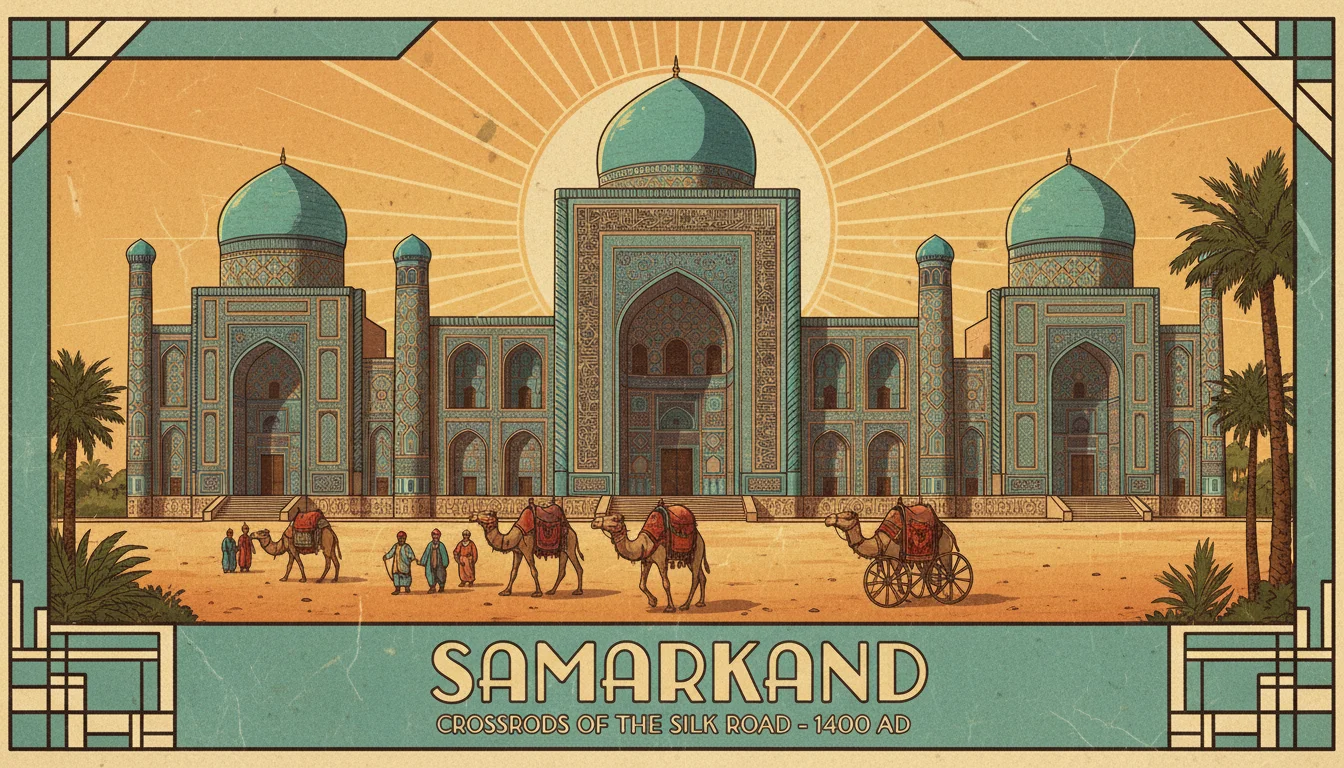
The year is 1400, and you've just materialized outside the gates of Timurid Samarkand - the jewel of Central Asia, seat of the terrifying conqueror Timur (known to the West as Tamerlane), and arguably the most cosmopolitan city on Earth. Congratulations on your excellent timing. The city is experiencing a building boom that would make a modern real estate developer weep with envy, and the Silk Road trade is flowing like wine at a royal banquet.
But before you wander into Timur's capital with wide-eyed wonder, let's discuss how not to end up decorating one of those famous skull towers the conqueror is so fond of constructing.
First Impressions: The City That Puts Your Hometown to Shame
As you approach Samarkand, the first thing you'll notice is that it's enormous - roughly 100,000 people call this place home, making it one of the largest cities in the world. The second thing you'll notice is the color blue. Everywhere. The famous turquoise-tiled domes and minarets catch the Central Asian sunlight in a way that seems almost supernatural.
Timur has spent decades gathering the finest craftsmen from every conquered territory - Persian architects, Indian stonemasons, Syrian tile-makers - and putting them to work beautifying his capital. The result is a city that makes contemporary Paris look like a provincial backwater (sorry, France).
What to Wear: Dressing for Survival
The Central Asian climate is no joke - scorching summers and bitter winters - so layer appropriately. Men should wear a long chapan (quilted robe), loose trousers, and sturdy leather boots. A sash around the waist is essential; it's where you'll tuck your eating knife (everyone carries one) and small purse.
Women have more elaborate requirements: ankle-length dresses with embroidered panels, a headdress that indicates marital status, and possibly a face veil depending on which neighborhood you're visiting. The Timurid court is relatively relaxed about veiling compared to other Islamic societies of the era, but it's best to observe what local women are doing and follow suit.
Color matters. Scholars and religious figures wear white or green. Blue is associated with mourning in some contexts, so maybe save that outfit. Rich people wear silk; everyone else wears cotton or wool. Don't show up in synthetic fabrics - people will assume you're some kind of djinn.
What to Eat: A Silk Road Feast
Good news: Samarkand's food scene is absolutely phenomenal. The city sits at the crossroads of Persian, Turkic, Chinese, and Indian culinary traditions, and the results are spectacular.
Your essential Samarkand eating experiences:
Plov - The king of Central Asian cuisine. Rice cooked with lamb, carrots, onions, and a carefully guarded blend of spices. Every neighborhood has its own variation, and passionate arguments about whose is best can last for hours.
Samsa - Flaky pastries stuffed with spiced meat and onions, baked in a tandoor oven. Street vendors sell them fresh throughout the day. They're addictive; budget accordingly.
Shurpa - A hearty lamb soup with vegetables that's perfect for cold desert nights. Often served with fresh flatbread for dipping.
Manti - Steamed dumplings stuffed with meat, a clear influence from the Mongol/Chinese culinary sphere. Served with sour cream or yogurt.
Dried fruits and nuts - Samarkand sits in an oasis fed by mountain rivers, producing legendary apricots, grapes, melons, and almonds. Timur is so proud of the local melons that he packs them in ice and sends them as diplomatic gifts.
The bazaars also offer an incredible variety of spices - saffron from Persia, pepper from India, cinnamon from points east. If you've got room in your time-traveling luggage, stock up.
Customs and Etiquette: Not Getting Executed
Here's where things get serious. Timur is one of history's most successful - and most brutal - conquerors. His campaigns have killed an estimated 17 million people (roughly 5% of the world's population at the time). He builds towers of skulls at conquered cities as a warning. He is not a man you want to offend.
Essential survival tips:
Learn some Persian. It's the language of the court, poetry, and high culture. Turkic languages are spoken on the streets, but Persian opens doors. Memorize a few appropriate verses from Hafez or Saadi - poetry recitation is practically a competitive sport here.
Remove your shoes when entering homes or mosques. Always. No exceptions.
The right hand is for eating and greeting; the left hand is for... other purposes. Never offer someone food with your left hand.
When meeting important people, bow from the waist. If you're presented to Timur himself (unlikely but not impossible), full prostration is expected. Kiss the ground in front of his throne. This is not the moment for Western democratic ideals.
Don't discuss Timur's limp. A childhood injury left him with a withered leg (hence "Timur the Lame," corrupted to "Tamerlane"). He's somewhat sensitive about it. Many people who mentioned it are no longer people.
Avoid the topic of succession. Timur's various sons, grandsons, and generals are in constant competition for favor. Taking sides could be fatal.
Must-See Attractions
Registan Square - The heart of the city, surrounded by stunning madrasas (religious schools) covered in intricate blue tilework. In 1400, Timur's wife Bibi-Khanum is building her famous mosque on the square - you might catch it under construction.
The Royal Palace - Good luck getting in, but even viewing the exterior is worth the trip. Timur has decorated it with loot from a dozen conquered civilizations.
The Bazaars - Multiple covered markets specialize in different goods: silk, carpets, spices, metalwork, ceramics. The covered passages protect shoppers from the fierce sun and create a wonderfully atmospheric shopping experience.
The Paper-Making District - Samarkand produces some of the finest paper in the world, a technology brought from China after Arab armies captured Chinese paper-makers in 751 AD. Watch artisans transform mulberry bark into sheets that will carry Persian poetry across continents.
Shah-i-Zinda - The "Living King" necropolis, a stunning avenue of mausoleums where Samarkand's elite are buried. The tilework here is some of the most exquisite you'll ever see.
Dangers to Avoid
Political intrigue - Everyone at court is scheming. Keep your mouth shut and your ears open.
Religious disputes - Samarkand has Muslims, Christians, Jews, Buddhists, and others, and they mostly coexist peacefully. Don't disturb this balance by getting into theological arguments.
Disease - Timur's armies have spread plague along the Silk Road. Avoid sick people and questionable water sources.
Timur's mood - The conqueror is 64 years old, increasingly paranoid, and planning one final campaign - against China. If he seems irritable, make yourself invisible.
The desert - Don't wander outside the oasis without a guide. The surrounding steppe will kill the unprepared very quickly.
Practical Information
Currency: Silver tangas are standard, with gold dinars for larger transactions. The bazaars also operate on barter, especially for Silk Road goods.
Language: Persian for official business and poetry, Chagatai Turkic on the streets. Arabic for religious contexts.
Best time to visit: Spring (April-May) or autumn (September-October). Summers are brutally hot; winters are harsh.
Getting around: On foot within the city, by horse or camel for longer distances. The Silk Road caravanserais (inns) are well-organized for travelers.
When to Leave
If you're still in Samarkand by 1405, you'll witness Timur's death during his Chinese campaign - and the chaotic succession struggle that follows. His empire will fragment among squabbling descendants, though the city itself will remain magnificent for another century.
But for now, in 1400, you're standing in one of history's great cultural crossroads. The blue domes catch the sunlight. The markets overflow with silks and spices from three continents. Scholars debate philosophy in Persian while merchants haggle in Turkic. The greatest conqueror since Genghis Khan holds court in a palace decorated with the treasures of India, Persia, and Russia.
It's not a safe time or place. But by God, it's a spectacular one.
Welcome to Samarkand. Try not to end up on a skull tower.
Curious about other Silk Road capitals? Our guide to Safavid Isfahan, 1680 takes you to the Persian empire's magnificent successor city, while Mongol Karakorum, 1250 shows the steppe capital that preceded Samarkand's golden age.

Need Advice from Someone Who Lived There?
Get firsthand accounts from people who actually lived through these moments in history.
Ask Them YourselfJoin the HistorIQly Club
Get smarter about the past.
Weekly stories, deep dives, and exclusive content straight to your inbox.