Time Traveler's Guide to Umayyad Damascus, 715 AD
A practical survival guide to Umayyad Damascus, the glittering capital of the Caliphate, where silk, citrus, scholarship, and court politics all arrive in equal abundance.
Read Wikipedia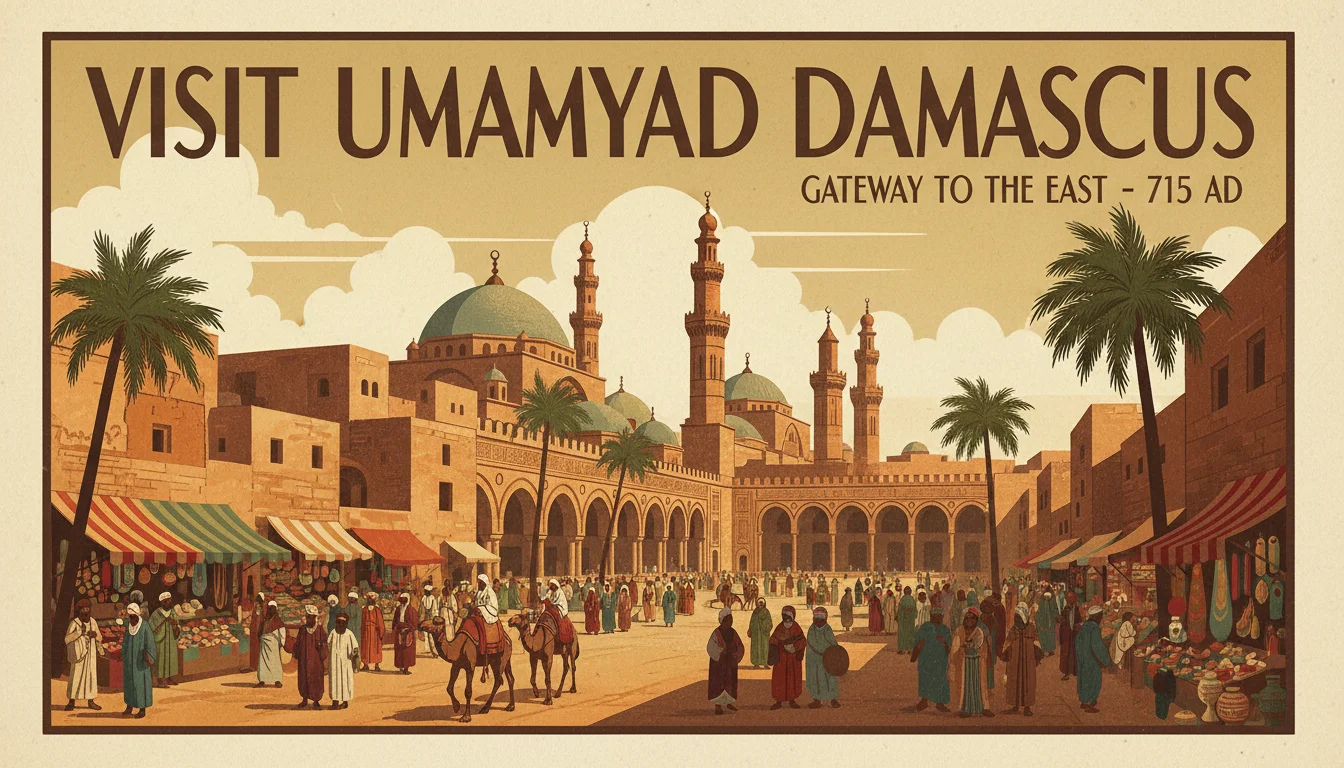
So, you have decided to visit Damascus in 715 AD. Excellent choice. Instead of some muddy village where dinner is turnips and entertainment is a runaway goat, you are heading to one of the grandest cities on Earth, capital of the Umayyad Caliphate, where caravans arrive with spices, silk, glass, paper, and gossip.
This is Damascus at the height of imperial confidence. The city is rich, busy, beautiful, and cosmopolitan. It is also intensely political, deeply religious, and not forgiving toward visitors who behave like loud idiots. Perfect for historical tourism, if you prepare properly.
First Impressions
Damascus is an old city even in 715. People here know they live in a place with ancient roots. Roman streets still shape the urban layout, markets hum with trade, gardens ring the city, and canals drawn from the Barada River help turn the surrounding oasis into one of the loveliest urban settings in the region. This is not a frontier camp. It is a polished imperial capital.
Your first major stop should be the Umayyad Mosque, newly completed and already one of the wonders of the age. Built on the site of earlier sacred structures, it is enormous, dazzling, and meant to impress. The mosaics shimmer. The courtyards gleam. Even if you are not religious, you should stand quietly for a moment and appreciate that you are watching one civilization layer itself directly on top of another.
What to Wear
Dress modestly, lightly, and expensively enough to avoid looking like a beggar, but not so expensively that you look worth robbing.
For men, a long tunic with a cloak works well. Wool is fine for cooler hours, but linen is better if you value not melting into the pavement. A turban or head covering helps with sun and respectability. Sandals are acceptable, but sturdy leather shoes are wiser if you plan to spend the day in crowded markets full of carts, animals, and things you do not want touching your feet.
For women, loose layered garments with a head covering will draw less attention and better fit local expectations. Fine fabrics are admired, but again, moderation is your friend. This is a city of trade and status, so people notice cloth quality.
Avoid bright synthetic colors, modern stitching, zippers, logos, watches, sunglasses, or anything that suggests you are from the future, which, to be clear, you are. Try to look like a reasonably prosperous traveler from another province, not a wizard from a cursed timeline.
What to Eat
Good news: Damascus is a fantastic food destination.
You can expect flatbreads, olives, dates, figs, grapes, pomegranates, chickpeas, lentils, cheese, yogurt, roasted meats, and fragrant stews. Lamb is common. Chicken appears regularly. Fresh herbs and sour flavors are appreciated. If you are lucky and reasonably connected, you may encounter sweets with honey and nuts that will make you briefly consider abandoning the twenty-first century altogether.
Drink water cautiously unless you trust the source. Diluted wine may appear in some circles despite religious disapproval, but do not assume public enthusiasm for it. Sharbat-style fruit drinks are a safer way to enjoy yourself without starting a theological argument.
Street food is tempting and often worth it, but choose busy stalls with fast turnover. The medieval rule is simple: if everyone else is eating there and no one appears to be dying, odds are decent.
Customs You Need to Respect
First, mind your manners around religion. Damascus in 715 is the center of a powerful Islamic empire, and public behavior matters. You do not need to be a scholar of theology, but you do need basic humility. Dress appropriately, avoid mockery of any faith, and do not wander into sacred spaces behaving like you are reviewing a hotel lobby.
Second, understand hierarchy. Rank matters here: governors, military men, scholars, merchants, clerks, artisans, and laborers all occupy visible positions in society. Speak politely, especially to officials and elders. If someone of status enters a space and everyone else adjusts their behavior, that is your cue to do the same.
Third, do not overtalk. A useful survival strategy in almost any historical era is to ask a short question, listen carefully, and say less than you know. In Umayyad Damascus, this is especially wise because politics runs through everything. The empire is vast, factions exist at court, ethnic and tribal identities matter, and one careless opinion can make you memorable for the wrong reasons.
Your safest cover story is that you are a merchant's assistant or a minor traveler from a distant region. This explains a strange accent, patchy local knowledge, and an interest in prices.
Dangers to Avoid
The biggest danger is not the sword. It is being noticed too much.
Damascus is safer than many cities of the ancient and medieval world, but it is still a city. Crowded markets attract pickpockets. Foreigners can be cheated. Officials can become suspicious. Rumors travel quickly. If you display odd objects, strange coins, or impossible knowledge, you may attract curiosity from exactly the kind of people you do not want testing your story.
There are also ordinary hazards: food spoilage, disease, heat, animals, fire, and traffic of the pre-modern variety, which means donkeys, horses, camels, carts, and human beings all trying to use the same space at once. Walk like you expect chaos. Because you should.
Also, avoid court intrigue. If somebody hints that they can introduce you to a palace insider, smile warmly and become unavailable. Capitals are wonderful until you become a footnote in a purge.
What You Absolutely Must See
Start with the Umayyad Mosque. It is the headline attraction and deserves it.
Next, explore the markets. Damascus is famous for textiles, metalwork, glass, perfumes, and all the minor luxuries that make empires look sophisticated. Spend time watching craftsmen at work. The city is a living machine of commerce.
If you can arrange access, visit the gardens and orchards fed by the Barada. One reason Damascus impresses travelers for centuries is the contrast between the surrounding dryness and the city's cultivated abundance. It feels like a carefully managed miracle.
Watch the people as much as the monuments. You are in a capital where Arab elites, local Syrians, merchants from afar, religious scholars, soldiers, and diplomats all cross paths. The conversations you overhear, assuming you keep your face neutral, may be better than any building.
Final Survival Tips
Carry small trade goods or plausible coinage. Learn a few Arabic greetings before arrival. Keep your curiosity high and your confidence low. If unsure how to behave, copy the calmest respectable person nearby.
Most importantly, remember what Damascus is in 715: not merely old, not merely beautiful, but alive with imperial ambition. This city believes it is at the center of the world, and for many people in this moment, it is.
So go. Admire the mosaics. Eat the bread. Smell the citrus and dust. Listen to the traders. Then leave before anyone asks too many questions about why your shoes are stitched so strangely.
That is usually the ideal ending to a successful time-travel holiday.
For other great Islamic capitals of the same era, our guides to Abbasid Baghdad in 800 AD and Fatimid Cairo in 970 AD cover neighboring civilizations worth adding to your itinerary.

Need Advice from Someone Who Lived There?
Get firsthand accounts from people who actually lived through these moments in history.
Create your free account →No card required. Talk to anyone in history with 8 free credits a day. Some features require a paid plan.
Join the HistorIQly Club
Get smarter about the past.
Weekly stories, deep dives, and exclusive content straight to your inbox.