Time Traveler's Guide to Zanzibar, 1880
Survive Zanzibar at the height of its intoxicating wealth, where Arab sultans rule, cloves perfume the air, and fortunes are made in a single monsoon.
Read Wikipedia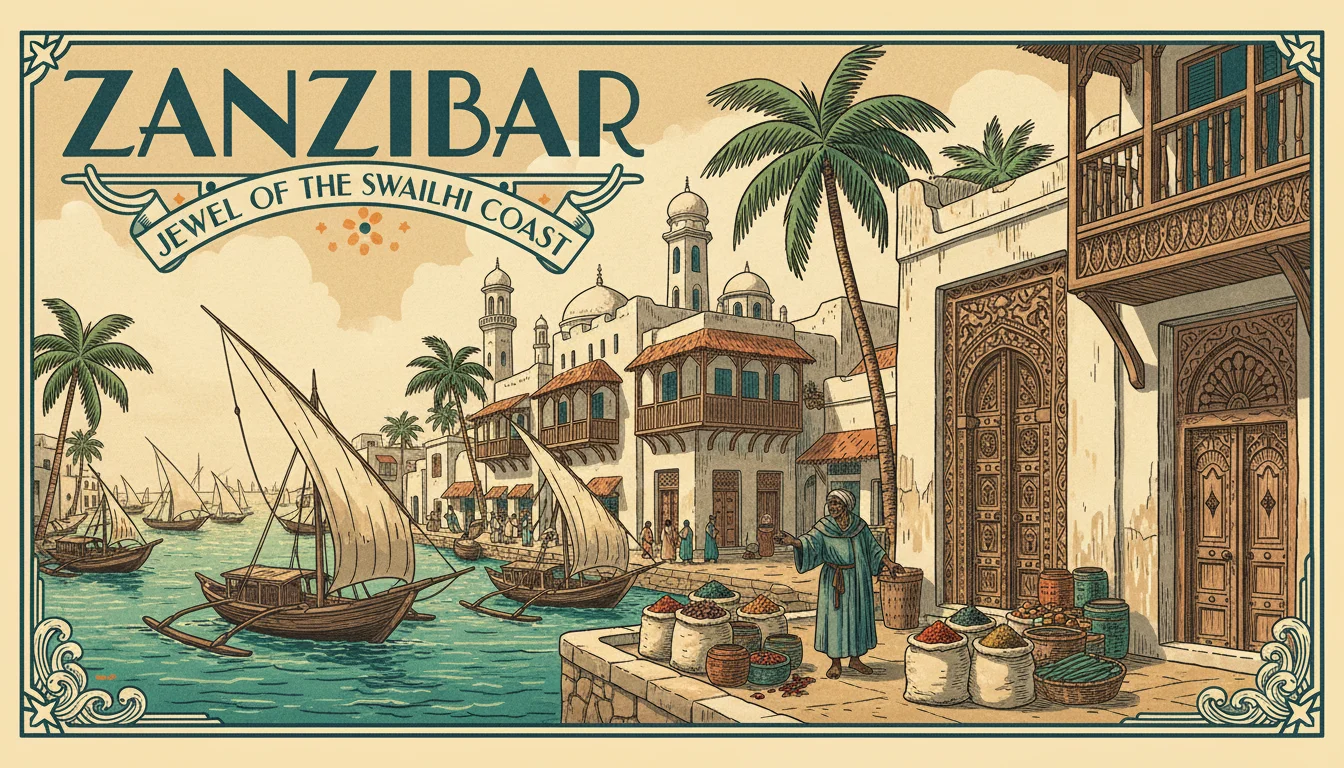
You step off the dhow onto a stone pier that's absorbed five centuries of monsoon salt. The heat hits you like a wet blanket - humid, thick, carrying the unmistakable perfume of cloves, cinnamon, and something else you'll eventually identify as drying shark fin. Welcome to Zanzibar, 1880. You've arrived at the crossroads of three continents during the most profitable decade in the island's history.
Where (and When) You Are
The island of Unguja - what Europeans call Zanzibar - sits 25 miles off the East African coast. In 1880, it's the capital of the Omani Sultanate's African dominions under Sultan Barghash bin Said, arguably the most powerful ruler between Cairo and Cape Town. The population of Stone Town hovers around 80,000 souls: Omani Arabs, Swahili merchants, Indian financiers, European consuls, formerly enslaved Africans, and a swirling mix of everyone in between.
The British have technically pressured the Sultan into ending the slave trade - the markets closed in 1873 - but you'll quickly notice that enforcement is... flexible. The real money now flows from cloves, and Zanzibar produces three-quarters of the world's supply. Every plantation owner is racing to plant more trees, and the island smells like Christmas dinner year-round.
What to Wear
Leave your Victorian finery in the time machine. The humidity will destroy it within hours.
For men: Adopt the local Omani style - a long white kanzu (robe) and an embroidered kofia (cap). If you want to blend with the merchant class, add a bisht (cloak) for evening functions. The wealthy wear silk; you can get away with good cotton from the Indian traders in the bazaar.
For women: A kanga - a colorful printed cloth worn wrapped around the body - works for daytime. For formal occasions, wealthy Swahili and Arab women wear elaborate silk dresses called derra, often with gold embroidery. Cover your head when walking through Stone Town's narrow alleys. If you're European, the modest Victorian dress codes are relaxed here, but sun protection matters more than modesty.
Everyone: Get sandals made by the leatherworkers near the fort. Closed shoes will rot in this climate. Accept that you will sweat through everything.
What to Eat
Zanzibar's cuisine is where Africa, Arabia, and India collide on a plate.
Breakfast: Start with mandazi - fried dough triangles flavored with cardamom and coconut milk. Pair with kahawa (spiced coffee) served in tiny brass cups. The street vendors near the harbor sell the best, starting at dawn.
Lunch: Find a cook shop and order pilau - rice cooked with whole spices (cumin, cardamom, cinnamon) and usually mutton or chicken. The Bohora Indian community runs some of the best food stalls. For something lighter, mchuzi wa samaki - fish in coconut curry sauce - appears everywhere.
Dinner: If you can wrangle an invitation to an Arab household, prepare for majlis dining - seated on cushions around shared platters. You'll encounter biryani (the local style uses more cloves than the Indian version), roasted goat, and elaborate fruit platters. Eat with your right hand only; the left hand is for... other purposes.
Street food: The waterfront comes alive at sunset with vendors selling mishkaki (grilled meat skewers), urojo (a tangy soup with potatoes and crisps), and vitumbua (sweet rice pancakes). For dessert, halwa - a dense, gelatinous sweet made with ghee, sugar, and rosewater - is the prestige gift. Every household has their grandmother's recipe.
Drinks: Fresh coconut water is everywhere. Arabic coffee dominates, served thick and spiced. Alcohol exists - European traders have their clubs - but public drinking is deeply frowned upon in Muslim society.
Customs That Will Save Your Life
Greetings take time. Never rush a greeting. The Swahili Hujambo? Sijambo. Habari gani? Nzuri sana exchange can go on for several minutes, asking after health, family, business, the weather, and your journey. Cutting this short marks you as rude and untrustworthy.
Business happens slowly. Nothing gets done without tea first. Negotiations unfold over days, not hours. Indians extend credit; Arabs want cash; Europeans want contracts. Learn which you're dealing with.
The Sultan's word is law. Barghash bin Said is modernizing the island - building a new palace, installing electricity, creating Africa's first public transit - but he tolerates no opposition. His Baluchi guards (mercenaries from what's now Pakistan) keep order with summary justice.
Religious observance is serious. The call to prayer echoes five times daily from the island's dozens of mosques. During prayer times, business stops. During Ramadan, don't eat or drink in public during daylight. Friday is the holy day - markets close by noon.
The carved doors matter. Stone Town's famous carved wooden doors aren't just decoration - they announce their owner's social position. Pointed brass studs originally meant to protect against elephant charges (a status symbol imported from India). Chains indicate a household's hospitality. Don't knock on a door with a small carved sword above it unless you're expected.
The Dangers
Disease. Malaria is endemic. If you arrived without quinine, find the British consulate immediately - they maintain a supply for "distressed Europeans." Cholera outbreaks hit seasonally. Don't drink unboiled water under any circumstances, and avoid the fruit that's been sitting in the sun.
Heat stroke. The "Spice Island" sits practically on the equator. Work in the early morning and late afternoon. The midday siesta isn't laziness; it's survival.
Getting lost. Stone Town's alleys are deliberately labyrinthine - originally designed to confuse raiders. Hire a guide for your first week. The main landmarks are the House of Wonders (the Sultan's new palace with electric lights and an elevator), the Old Fort, and the waterfront.
The politics. German, British, and French interests are circling. Within ten years, the island will become a British protectorate. For now, tensions simmer under the surface. Don't get involved in succession politics - Barghash eliminated his rivals brutally, and his brothers are waiting.
The darker side. The slave trade may be "officially" closed, but you'll see its legacy everywhere. The clove plantations run on indentured labor that's slavery in everything but name. If this troubles you (it should), there's little you can do except document what you see.
What to See
The House of Wonders (Beit al-Ajaib). Barghash's new ceremonial palace is the most modern building in East Africa. Electric lights. An elevator. Clock towers. It demonstrates that Zanzibar is no backwater - it's a rival to any Arabian Gulf port.
The Old Arab Fort. Built by Omanis in 1699 over a Portuguese chapel, it now hosts an arms bazaar, a prison, and executions. The latter are public. Attendance is expected.
The slave market (now closed). The Anglican Cathedral is being built directly on the site. The altar sits where the whipping post stood. Some of the old holding cells remain. It's a haunting space.
The spice plantations. A day trip into the interior reveals the source of Zanzibar's wealth. Clove trees take seven years to mature but produce for a century. The harvest in November-December employs most of the island. You'll also see cinnamon, nutmeg, vanilla, and black pepper.
The Sultan's fleet. Barghash maintains a modest navy - a steamship, several armed dhows - anchored in the harbor. The real naval power is British, and everyone knows it.
Practical Matters
Money. The Maria Theresa thaler (an Austrian silver coin) is the standard currency throughout East Africa and Arabia. Indian rupees work. British pounds can be exchanged at the European trading houses. Cowrie shells still circulate in the interior markets for small purchases.
Language. Swahili (Kiswahili) is the lingua franca - Arabic-influenced Bantu that serves as the trading language from Mombasa to the Congo. Arabic marks you as upper class. English gets you into European clubs. Indian merchants speak Gujarati or Kutchi among themselves.
Lodging. Europeans stay at the British or German clubs, or with their consulates. Everyone else rents rooms in Stone Town - look for nyumba ya kulala wageni (guest houses). Negotiate hard; assume the first price is triple the real rate.
Getting around. The island is small - about 60 miles long. Stone Town is walkable (slowly, due to heat). Donkeys carry goods. Porters carry everything else. For trips to the plantations, hire a guide with donkeys.
Parting Thoughts
Zanzibar in 1880 exists in a strange twilight. The island has never been richer - clove money is building palaces, importing marble, funding a minor modernization - but the old order is ending. Within a decade, Germany and Britain will carve up the mainland. Within two decades, the Sultan will be a puppet. The mashallah prosperity feels fragile because it is.
But right now, standing on the waterfront as dhows from Muscat, Bombay, and Madagascar bob in the harbor, you're witnessing one of history's great cosmopolitan crossroads. The muezzin's call mixes with church bells, Hindi film songs, and the rhythmic chanting of dock workers unloading ivory. The air smells like money and cloves.
Take a breath. It won't last. But for this moment, you're here.
For other East African and Indian Ocean destinations in the time-travel series, see Visiting Swahili Kilwa, 1300 and Visiting Mali and Timbuktu, 1325.
Want to pack for your next temporal adventure? Check out our other Time Traveler's Guides for destinations across history.

Need Advice from Someone Who Lived There?
Get firsthand accounts from people who actually lived through these moments in history.
Create your free account →No card required. Some figures and features require a paid plan.
Join the HistorIQly Club
Get smarter about the past.
Weekly stories, deep dives, and exclusive content straight to your inbox.