The Wolf of Wall Street vs. History: How Accurate Is Scorsese's Wall Street Satire?
Wolf of Wall Street historical accuracy examined: how much of Belfort's three-hour excess actually happened, and what Scorsese invented for effect.
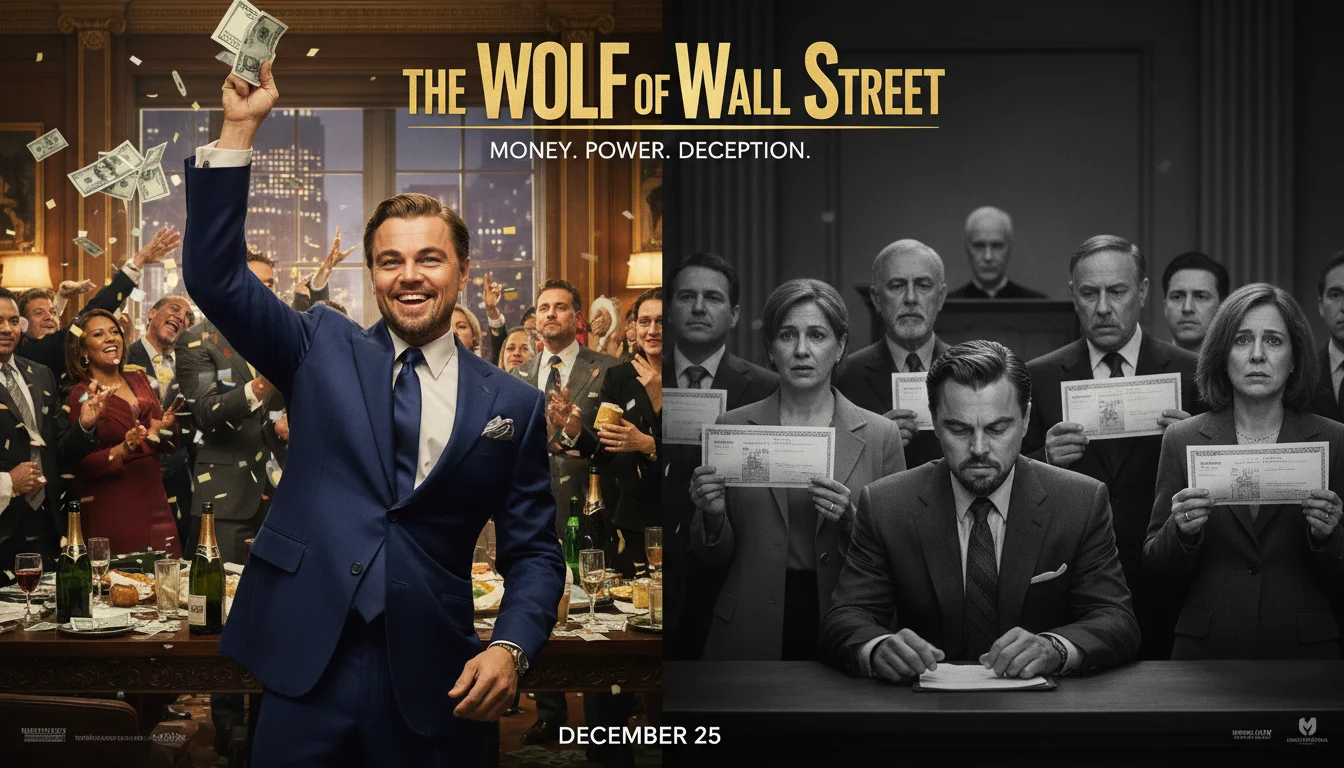
Martin Scorsese's 2013 epic The Wolf of Wall Street runs three hours of relentless debauchery. Leonardo DiCaprio's Jordan Belfort snorts cocaine off bodies, throws dwarf-tossing parties, sinks yachts, and defrauds thousands of investors out of $200 million - all while delivering fourth-wall-breaking monologues about why you should want to be him.
The film earned five Oscar nominations and sparked fierce debate: was Scorsese glorifying financial crime or satirizing American greed? But a more interesting question lurks beneath the controversy. How much of this insanity actually happened?
The answer might surprise you.
What Hollywood Got RIGHT
The Core Crime: Pump and Dump
The film accurately depicts how Belfort's firm, Stratton Oakmont, really operated. The "pump and dump" scheme worked exactly as shown: brokers would buy up penny stocks, then use aggressive cold-calling scripts to convince investors these worthless shares were the next big thing. Once the price rose, Belfort and his inner circle would sell their holdings, leaving investors holding bags of nothing.
Stratton Oakmont defrauded over 1,500 investors out of approximately $200 million between 1989 and 1996. These weren't just wealthy marks - despite what the film implies, Belfort's brokers targeted everyone. One California victim used his home equity line of credit to invest and has been financially devastated ever since.
The Steve Madden IPO
The film's depiction of the Steve Madden Ltd. initial public offering is essentially accurate. Madden was a childhood friend of Danny Porush (renamed "Donnie Azoff" and played by Jonah Hill). Stratton Oakmont controlled large blocks of shares during the IPO, artificially inflated the price, then sold at the peak. Belfort made approximately $23 million from the deal in just two hours.
Steve Madden himself was convicted as an accomplice and served 41 months in prison. However, he never fully left his company - he remained on as a "creative consultant" and was well-compensated even while incarcerated.
The Drug Abuse
If anything, Scorsese understated the drug use. The FBI agent who spent six years tracking Belfort confirmed: "I tracked this guy for ten years, and everything he wrote is true." In his memoir, Belfort claims he had enough drugs "running through my circulatory system to sedate Guatemala."
The Quaalude-fueled car crash? Real - though in reality it was a Mercedes, not a Lamborghini. More disturbing: one of the accidents caused a head-on collision that sent a woman to the hospital, a detail the film omits.
The Helicopter Crash
Belfort really did nearly crash his helicopter while high on drugs. According to his own memoir, he attempted to land in his backyard while completely intoxicated on Quaaludes. The recklessness depicted in the film matches his own account.
The Sinking of the Yacht
The 167-foot yacht "The Nadine" (named after Belfort's second wife) was originally owned by Coco Chanel. Belfort really did insist on sailing through a Mediterranean storm while high, and the yacht really did sink off the coast of Italy. Italian Navy commandos had to rescue everyone on board.
Mark Hanna's Philosophy
Matthew McConaughey's memorable lunch scene - where mentor Mark Hanna explains that the keys to Wall Street success are cocaine, masturbation, and getting clients to keep reinvesting their winnings - is based on a real conversation with an L.F. Rothschild broker. The crude philosophy shocked the young Belfort but would later become the foundation of Stratton Oakmont's culture.
The Head-Shaving Incident
A female employee really did let brokers shave her head for $10,000, which she used to pay for breast implants. Both Belfort and Porush confirm this incident occurred.
Porush Marrying His Cousin
Danny Porush (Jonah Hill's character) genuinely married his first cousin Nancy. According to Belfort's memoir, Porush claimed it was "because she was a real piece of ass." They divorced in 1998 after twelve years of marriage and three children.
What Hollywood Got WRONG
The Dwarf-Tossing Never Happened
The infamous office scene where little people are thrown at a velcro target for entertainment? Complete fiction. Danny Porush himself disputes this: "We never abused or threw the midgets in the office; we were friendly to them." Belfort's own memoir only mentions dwarf-tossing as a possibility, not something that actually occurred.
"The worst we ever did was shave somebody's head and then pay 'em ten grand for it," Porush says.
There Was No Chimpanzee
The scene where DiCaprio pals around with a chimpanzee in the office is pure Hollywood invention. "There was never a chimpanzee in the office," Porush confirms. "There were no animals in the office."
Nobody Called Him "The Wolf"
Here's a detail that undermines the film's entire premise: according to Porush, nobody at Stratton Oakmont ever called Jordan Belfort "the Wolf." The nickname is a marketing invention for his memoir and subsequent brand. "It's just one of a number of exaggerations and inventions in both Belfort's book and the movie," Porush says.
The Money-Taping Scene Is Disputed
The sequence where cash is taped to a Swiss woman's body to smuggle money into European banks was allegedly never witnessed by Porush. "I never taped money to boobs," he says. Belfort claims in his memoir it happened but that Porush wasn't present.
How He Met Porush
In the film, Donnie Azoff dramatically approaches Belfort at a diner after spotting his Jaguar and offers to quit his job on the spot if Belfort shows him a $72,000 pay stub. In reality, the meeting was far more mundane: Porush's wife met Belfort on a commuter bus, noticed he gave up his seat for her every day, realized they lived in the same apartment building, and introduced her husband to him. Porush then decided to get his stockbroker's license after one conversation.
The Violence Was Worse
The film shows Belfort slapping his wife Naomi (Margot Robbie). The reality was more severe. According to his memoir, Belfort kicked his wife Nadine down the stairs while holding their daughter. She landed on her right side with "tremendous force."
Similarly, when the film depicts Belfort crashing through his garage door with his daughter, the real incident was more dangerous: he put his daughter in the front seat without a seatbelt before crashing into a six-foot limestone pillar.
The Victims Are Nearly Invisible
Perhaps the film's most significant distortion is its almost complete erasure of Belfort's victims. Over 1,500 people lost their savings. Bob Shearin lost more than $100,000. Tom Pokorny lost $800,000 and believes the fraud cost him his marriage. These human stories are replaced by scenes of parties and orgies.
By 2013, only about $10 million of the $110 million restitution ordered by the court had been recovered - and much of that came from the liquidation of Belfort's assets, not from remorseful payback. The bankruptcy trustee eventually returned just $3.9 million to investors - pennies on the dollar.
Belfort Informed on His Partner
The film ends with a somewhat sympathetic beat: Belfort seemingly trying to protect his colleagues by tapping a notepad warning Porush. In reality, Belfort had no such noble moment. He became a cooperating witness and informed on Porush and others to secure his reduced 22-month sentence.
The Verdict
The Wolf of Wall Street presents an interesting paradox: the outrageous scenes of drug abuse, yacht-sinking, and helicopter crashes are largely accurate, while the film actually invents some of its most memorable comedic moments (dwarf-tossing, the chimpanzee) from whole cloth.
The deeper inaccuracy is one of framing. By presenting Belfort as a charismatic antihero taking on a rigged system, the film transforms a simple con man who destroyed middle-class retirement savings into a folk hero. The FBI agent who caught him, the victims who lost everything, the woman hospitalized by his DUI crash - they're either supporting characters or invisible.
Danny Porush summarized it bluntly: "The book is a distant relative of the truth, and the film is a distant relative of the book."
Scorsese likely intended satire - a three-hour dark comedy exposing the grotesque excess enabled by American capitalism. But when the real Jordan Belfort makes a cameo at the end introducing DiCaprio at a seminar, the line between critique and celebration becomes dangerously blurred.
Historical Accuracy Score: 6/10
For more Hollywood fact-checks, Argo vs. History examines how Ben Affleck's CIA thriller handled the real events of the Canadian Caper, and Maestro vs. History covers Bradley Cooper's Leonard Bernstein biopic.
The broad strokes of criminality, drug abuse, and extravagance are real. But the film sanitizes domestic violence, erases victims, invents comedic scenarios, and transforms a garden-variety fraudster into a mythic "Wolf" that even his own partners say never existed.

Debate the Accuracy with the Real Figures
Ask the real people what Hollywood got wrong about their lives.
Chat with HistoryJoin the HistorIQly Club
Get smarter about the past.
Weekly stories, deep dives, and exclusive content straight to your inbox.