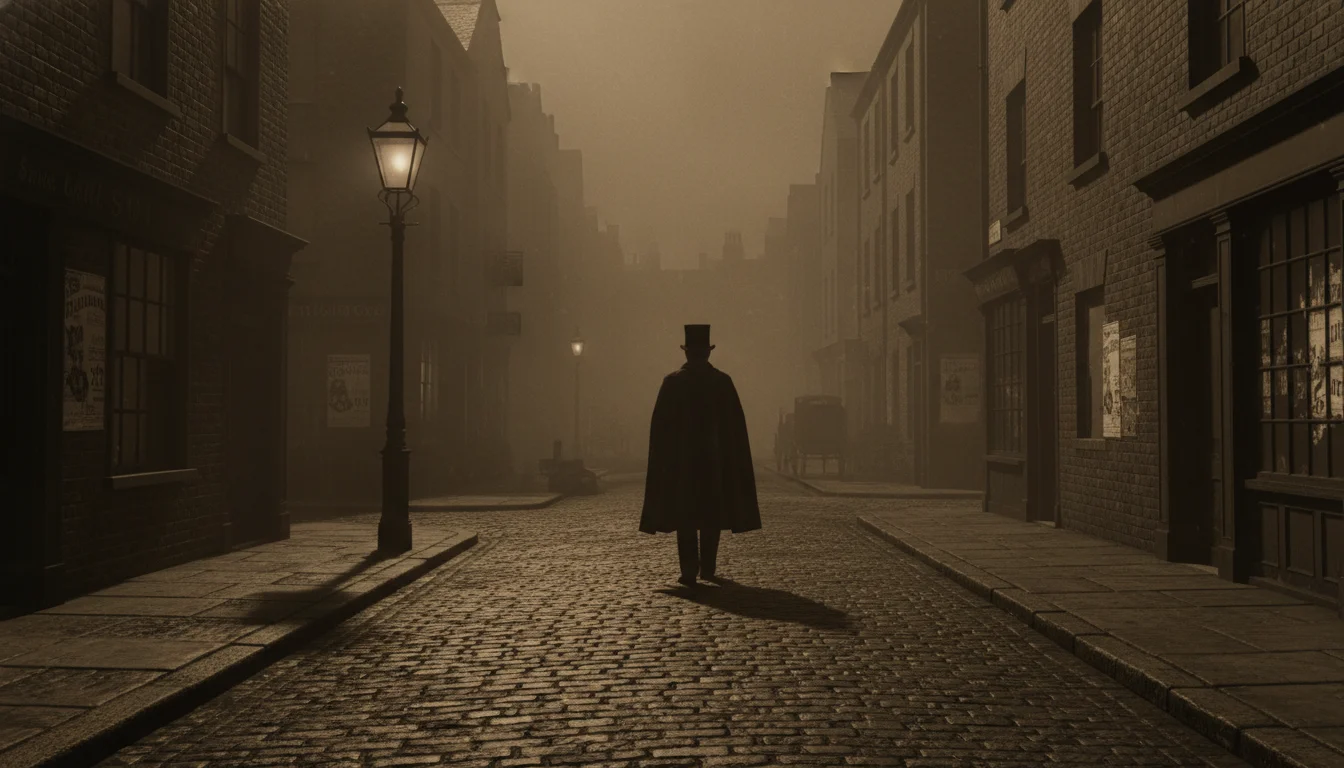
The Atlas Vampire: Stockholm's Most Chilling Unsolved Murder
The Atlas Vampire Stockholm case: in 1932, a woman was found drained of blood in her Stockholm apartment, a bloody ladle beside her, and the killer never caught.
Read Wikipedia
On May 4, 1932, police in Stockholm, Sweden, forced open the door to a small apartment on Atlas Street. What they found inside would haunt Swedish criminal history for nearly a century - and earn the unknown killer one of the most disturbing nicknames in true crime: the Atlas Vampire.
The Victim
Lilly Lindeström was 31 years old, a sex worker known to her neighbors as quiet and unremarkable. She lived alone in a modest one-room apartment in the Atlas district, a working-class neighborhood on Stockholm's north side. She had been born into poverty, drifted through odd jobs, and eventually turned to prostitution to survive. Her life was difficult, anonymous, and - to most of the city - invisible.
That invisibility is what made her death so easy to miss.
Lilly was last seen alive on April 29, 1932. A neighbor named Minnie Jansson had spoken with her briefly that afternoon. Lilly mentioned she was expecting a male visitor later that evening. She seemed calm. Unremarkable. The kind of conversation that evaporates from memory within hours.
When days passed and no one saw Lilly, Minnie grew uneasy. By May 2, she alerted other neighbors. By May 4, they called the police.
The Crime Scene
Officers who entered Lilly's apartment encountered something they had never seen before - and would never see again.
Lilly lay face-down on her bed, fully clothed. She had been dead for several days. Her body showed signs of blunt force trauma to the head, but that wasn't what killed her. The official cause of death was massive blood loss.
Here is where the case crosses from tragic murder into something far more disturbing.
Lilly's body had been almost entirely drained of blood. Not through surgical precision or medical equipment - through raw, crude violence. Yet the apartment itself was remarkably clean. There was no blood splatter on the walls. No pooling on the floor. No trail suggesting the blood had been collected and removed from the scene.
Instead, investigators found a large gravy ladle on the floor beside the bed. It was stained with blood and saliva.
The implication was immediate and revolting. Someone had used the ladle to drink Lilly Lindeström's blood.
The Investigation
The Stockholm police launched what became one of the largest investigations in Swedish history at that time. They had plenty of leads - Lilly's profession meant she entertained numerous male visitors - but turning those leads into a suspect proved maddeningly difficult.
Detectives canvassed the neighborhood extensively. Several witnesses reported seeing a tall, dark-haired man entering Lilly's building on the evening of April 29. One neighbor described him as well-dressed, which was unusual for the neighborhood. Another reported hearing muffled sounds from Lilly's apartment late that night but thought nothing of it.
The police identified and interrogated over 100 men who were known to have visited Lilly or other sex workers in the area. They checked alibis, cross-referenced movements, and pursued every thread. None of it led anywhere concrete.
One suspect who drew particular attention was a man known only as "The Caller" - a regular client Lilly had mentioned to friends. He was never identified. Another was a local man with a history of violence against women, but he had a solid alibi for the night of April 29.
The forensic technology of 1932 was primitive by modern standards. There was no DNA analysis, no advanced blood typing beyond basic ABO grouping, and no way to trace the ladle back to a specific person. The blood on the ladle matched Lilly's type, but that was as far as the science could go.
The Vampire Theory
The press seized on the case with predictable enthusiasm. The bloody ladle, the drained body, the darkness of the act - it was irresistible. Newspapers christened the unknown killer "Atlasområdets Vampyr" - the Atlas Vampire - and the name stuck.
But was the killer truly driven by vampiric compulsion? Criminologists have debated this for decades.
One school of thought holds that the blood drinking was the entire point - that the killer was driven by a rare paraphilia known as clinical vampirism, or Renfield's syndrome. This condition, named after the fly-eating character in Bram Stoker's Dracula, involves a compulsion to drink blood, often beginning with the sufferer's own before escalating to animals and eventually humans. If the Atlas Vampire suffered from this condition, Lilly may have been chosen not out of personal animosity but simply because she was accessible and vulnerable.
Another theory suggests the blood drinking was incidental - that the killer murdered Lilly in a rage, then consumed the blood as part of a psychotic episode or ritual behavior. The blunt force trauma suggests anger, not calculation. The ladle suggests improvisation, not planning.
A third, less popular theory proposes that the killer drained the blood to complicate the investigation - to make identification harder or to remove evidence. But this doesn't hold up well. The body was easily identified, and the method of blood removal was far too crude and incomplete to serve any forensic purpose.
The Suspects Who Got Away
Over the decades, amateur investigators and true crime researchers have proposed various suspects, though none with conclusive evidence.
One recurring candidate is a local man who was known to exhibit disturbing behavior around animals and who left Stockholm shortly after the murder. He was investigated at the time but never charged. Another is a foreign sailor who had been seen in the Atlas district that week but departed Sweden before police could locate him.
In the 1980s, Swedish journalist and crime writer Hasse Schreiner revisited the case and suggested that the killer may have been a member of Stockholm's small but active occult community. The 1930s saw a resurgence of interest in mysticism and blood rituals across Europe, and Schreiner argued that the ritualistic nature of the crime pointed away from a lone psychopath and toward something organized. His theory remains controversial.
More recently, researchers have used modern criminal profiling techniques to build a theoretical portrait of the killer: likely male, aged 25-40, local to the Atlas district, with a history of escalating violence and possible previous psychiatric episodes. But a profile is not a name, and a name is what the case has always lacked.
Why It Still Matters
The Atlas Vampire case endures for the same reason all great unsolved mysteries endure - it defies the comfortable narratives we build around violence.
Murders are supposed to have motives. They are supposed to have suspects, trials, convictions. They are supposed to end with someone in handcuffs. The Atlas Vampire offers none of this. Instead, it offers a dead woman drained of blood, a ladle on the floor, and a killer who walked out the door and into history.
Lilly Lindeström was buried in an unmarked grave. Her killer was never identified. The apartment on Atlas Street was eventually demolished. The neighborhood itself has been gentrified beyond recognition - today it is one of Stockholm's trendiest districts, full of coffee shops and yoga studios.
But the questions remain. Who was the tall, dark-haired man? What drove him to drink the blood of a woman he had just killed? And where did he go when he was done?
Stockholm has moved on. The Atlas Vampire has not been caught. And Lilly Lindeström, who lived most of her life invisible, achieved in death the attention she never received in life - though not the justice.
Ninety-four years later, the case remains officially open. The bloody ladle has never been matched to a suspect. The Atlas Vampire, whoever he was, took his secret to the grave - or perhaps never reached one at all.
For another haunting European cold case from the same era, the Hinterkaifeck farmhouse murders in Bavaria remain equally unsolved. Finland's Lake Bodom murders offer a similar story of campsite violence with no resolution.

Want to Interrogate the Suspects?
Chat with historical figures and uncover the truth behind history's greatest mysteries.
Create your free account →No card required. Some figures and features require a paid plan.
Join the HistorIQly Club
Get smarter about the past.
Weekly stories, deep dives, and exclusive content straight to your inbox.