Catch Me If You Can vs. History: How Much of Frank Abagnale's Story Is Actually True?
Catch Me If You Can historical accuracy check: investigative journalists now say much of Frank Abagnale Jr.'s legendary story may itself be the greatest con of all.
Read Wikipedia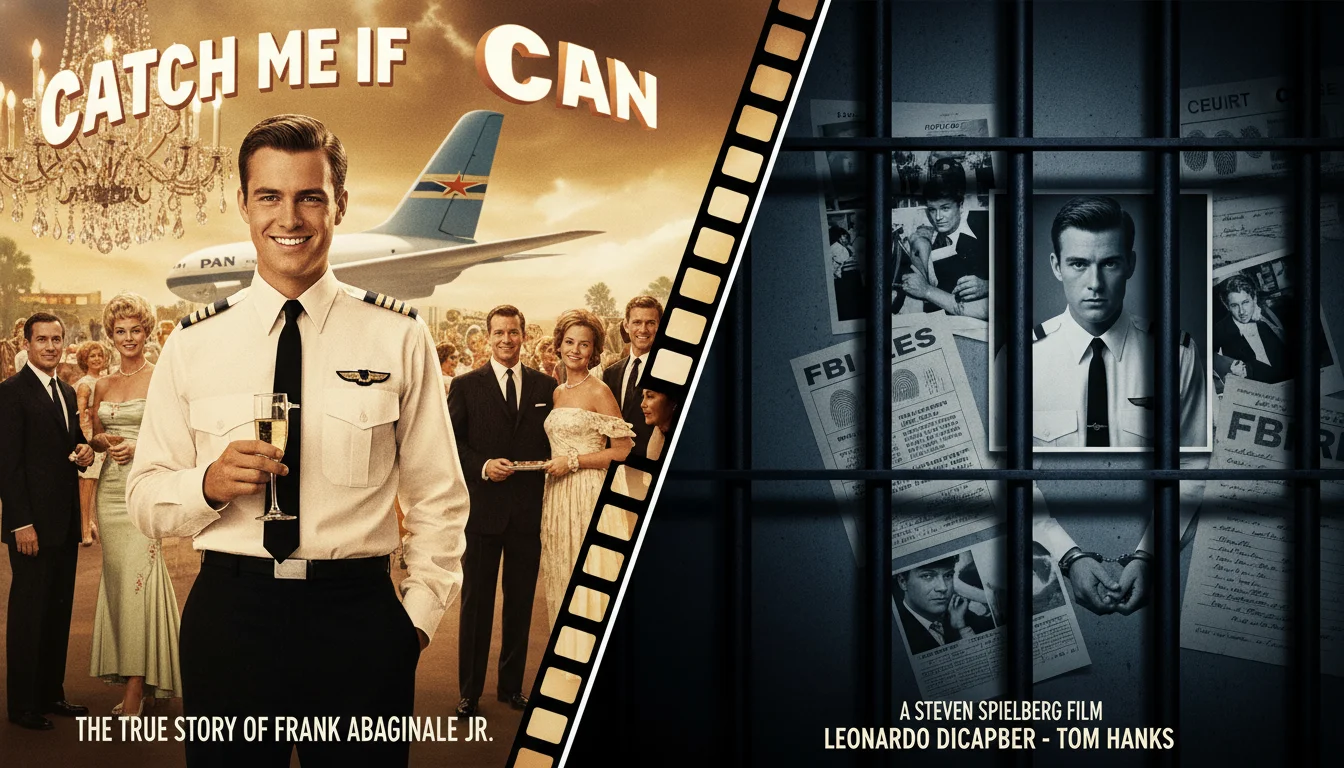
In 2002, Steven Spielberg gave us one of the most entertaining cat-and-mouse thrillers ever made. Leonardo DiCaprio charmed audiences as Frank Abagnale Jr., a teenage con artist who allegedly impersonated a Pan Am pilot, doctor, and lawyer while cashing millions in forged checks - all before turning 21. Tom Hanks played the dogged FBI agent who spent years chasing him across continents.
The film was based on Abagnale's 1980 autobiography, which he's promoted relentlessly through decades of speeches, interviews, and consulting work. There's just one problem: investigative journalists have found that many of his most spectacular claims appear to be fabricated, exaggerated, or impossible to verify.
This makes "Catch Me If You Can" perhaps the most ironic film to fact-check - because the movie may have been conned by its own subject.
What Hollywood Got RIGHT
Abagnale Did Commit Check Fraud
Frank Abagnale Jr. genuinely was a check forger who operated in the 1960s. He did pass bad checks, he was arrested, and he did serve time in prison in both France and the United States. Court records and newspaper clippings from the era confirm he was a real criminal who caused real financial damage.
His father, Frank Abagnale Sr., was indeed a prominent New Rochelle businessman whose marriage fell apart, deeply affecting young Frank. The family dysfunction portrayed in the film - the divorce, Frank's closeness to his father, his mother's remarriage - has basis in fact.
He Did Work for the FBI (Eventually)
After his release from prison, Abagnale did consult with the FBI on check fraud and white-collar crime. He built a legitimate career as a security consultant and lecturer. The film's epilogue stating he's worked with the FBI for over 25 years is accurate - he really did go straight and build a successful consulting business.
The 1960s Setting Is Authentic
Spielberg captured the era beautifully - the Pan Am glamour, the pre-computer banking systems that made fraud easier, the less sophisticated ID verification of the time. The film accurately portrays how much simpler it was to forge documents and assume false identities before digital databases existed.
What Hollywood Got WRONG (Or Couldn't Verify)
The Pan Am Pilot Claims: Highly Questionable
The film's most iconic images show DiCaprio in a Pan Am uniform, flying as a "deadheading" pilot on over 250 flights across 26 countries. Abagnale claims he flew for two years, from ages 16 to 18.
Investigative journalist Alan C. Logan spent years investigating Abagnale's claims. His research, published in 2020, found no evidence that Abagnale ever flew as a Pan Am pilot. Pan Am's meticulous employment records from the era show no trace of him. Former Pan Am employees interviewed by Logan couldn't corroborate any of his airline stories.
More damning: airline security in the 1960s wasn't as lax as portrayed. Pan Am had rigorous procedures for verifying pilot credentials. The idea that a teenager with no flight training could repeatedly board flights as crew strains credibility.
The Doctor Imposture: No Hospital Records
Abagnale claims he worked as a supervising resident at an Atlanta hospital for nearly a year, overseeing interns and nearly causing a baby's death. It's a dramatic story - except no hospital matching his description has ever been identified. No medical colleagues have ever come forward. No records exist.
Investigative research found Abagnale was actually in prison or on parole during much of the period he claims to have been practicing medicine. Court records place him in different locations than his autobiography suggests.
The Louisiana Lawyer: Timeline Problems
The film shows Abagnale passing the Louisiana bar exam after just eight weeks of study and working as an assistant attorney general. Louisiana bar records do show someone named Frank Abagnale passed the bar in the late 1960s - but researchers question whether this was actually our Abagnale or a case of confused identity.
Even if he did pass, the timeline doesn't work. You can't simultaneously be flying for Pan Am, practicing medicine in Atlanta, and studying for the bar in Louisiana.
The $2.6 Million in Forged Checks: Wildly Inflated?
Abagnale has claimed he cashed between $2.5 and $4 million in forged checks before age 21. Court records tell a different story. When he was actually arrested and tried, the documented amounts were in the thousands, not millions.
The FBI's own records from the era don't support claims of a multi-million-dollar international fraud ring. Abagnale was a check forger, yes - but possibly a more ordinary one than he's claimed.
Carl Hanratty: A Composite Character
Tom Hanks' FBI agent Carl Hanratty is fictional. There was no single FBI agent who pursued Abagnale for years across multiple continents. The dramatic cat-and-mouse dynamic, the phone calls, the strange respect that develops between pursuer and pursued - this is Hollywood storytelling, not history.
The French Prison Escape: Unverified
Abagnale claims he escaped from French prison by convincing a guard he was an undercover inspector. This dramatic escape story has never been verified by French authorities or prison records.
His Age During the Crimes
Abagnale consistently claims he committed his major crimes between ages 16 and 21, making him a teenage prodigy con artist. But researchers have found evidence suggesting he may have been older during some of the documented crimes, which would make his story less remarkable.
The Meta-Problem: Are We Being Conned?
Here's where "Catch Me If You Can" becomes genuinely fascinating: the movie might be the victim of its subject's greatest con.
Abagnale has given thousands of paid speeches telling his story. His consulting company has made him wealthy. His entire post-prison career is built on the legend of young Frank - the brilliant teenage impostor who fooled everyone.
But when journalists like Alan C. Logan, reporter Alf Bicknell, and others have tried to verify the most spectacular claims, they've hit dead ends. Court records, prison records, and contemporary newspaper accounts paint a picture of a more conventional check forger whose crimes, while real, weren't nearly as cinematic.
Even the FBI, which Abagnale claims "verified" his story, has distanced itself. A 2002 FBI statement noted they couldn't confirm the accuracy of all his claims.
Historical Accuracy Score: 4/10
This is perhaps the strangest score we've given. The film is technically "accurate" to its source material - Abagnale's autobiography and speeches. Spielberg made the movie Abagnale sold him.
But if investigative journalists are right, that source material itself is deeply unreliable. We may have a well-crafted film about an exaggerated or partially fabricated legend, presented as historical truth.
The irony is almost too perfect: a movie about a con man may itself have been conned. For another Spielberg-DiCaprio collaboration where the historical record is similarly contested, see our The Aviator fact check.
The Verdict
"Catch Me If You Can" remains a delightful film - John Williams' score, DiCaprio's charisma, Spielberg's visual flair, and Hanks' weary determination make for great entertainment. The 1960s production design is gorgeous, and the emotional core about a broken family and a lost boy has genuine power.
But as history? Approach with extreme caution.
Frank Abagnale was a real criminal who served real prison time and built a real consulting career. Beyond that, much of his legendary story exists in a gray zone where documentation is absent and verification is impossible - a problem that also haunts the D.B. Cooper hijacking case, where the only confirmed facts could fit on a single page.
Perhaps the greatest trick Frank Abagnale ever pulled wasn't impersonating a pilot or doctor - it was convincing Steven Spielberg, and through him the world, that he had.
What Hollywood Got Right: The era, the check fraud basics, the family dysfunction, his post-prison FBI work.
What Hollywood Got Wrong (Or Can't Prove): The pilot impersonation, the doctor impersonation, the lawyer career, the millions in forgery, the international scope, the dramatic escapes.
The Bottom Line: A brilliantly entertaining film that may be built on an autobiography that's itself a work of fiction. The con continues.

Debate the Accuracy with the Real Figures
Ask the real people what Hollywood got wrong about their lives.
Create your free account →No card required. Some figures and features require a paid plan.
Join the HistorIQly Club
Get smarter about the past.
Weekly stories, deep dives, and exclusive content straight to your inbox.