Lawrence of Arabia vs. History: How Much Did Hollywood Get Right?
Examining Lawrence of Arabia historical accuracy: what David Lean's Oscars epic got right about T.E. Lawrence's guerrilla campaign and where it took creative liberties.
Read Wikipedia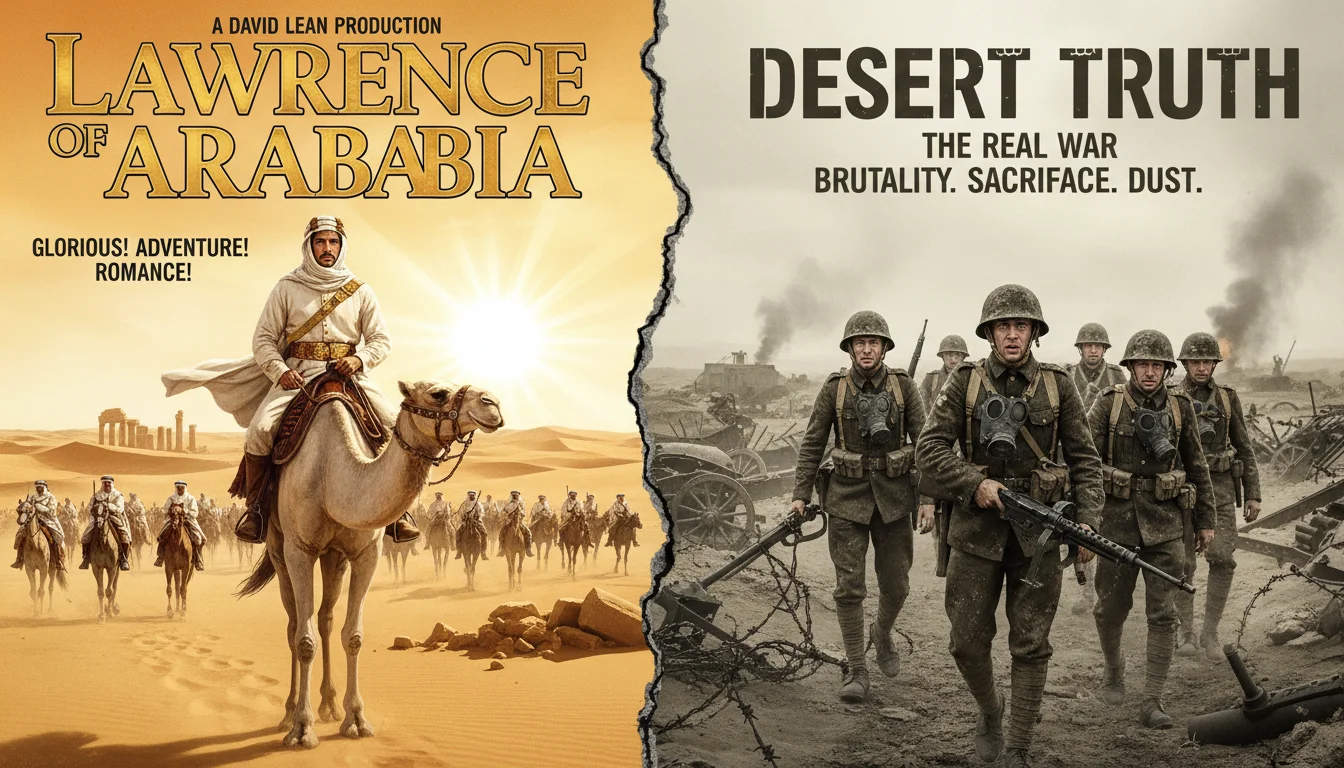
When David Lean's "Lawrence of Arabia" premiered in 1962, it instantly became one of the most acclaimed films ever made. Peter O'Toole's mesmerizing portrayal of T.E. Lawrence earned the film seven Academy Awards and permanently shaped how the world imagines the Arab Revolt. But the real story of Thomas Edward Lawrence - archaeologist turned guerrilla warfare mastermind - is even stranger than the legend Hollywood created.
What Hollywood Got Right
Lawrence Was a Genuine Misfit Genius
The film's portrayal of Lawrence as an eccentric outsider who didn't fit conventional military mold is spot-on. The real Lawrence was a short, bookish archaeologist (5'5") who spoke Arabic fluently and had spent years before the war excavating ancient sites in Syria. His commanding officers genuinely didn't know what to make of him, and he did have a habit of insubordination that would have ended most military careers.
His fellow officers at the Arab Bureau in Cairo considered him arrogant and difficult. But his intimate knowledge of Arab culture, tribal politics, and the desert terrain made him invaluable to British military intelligence.
The Arab Leaders Were Real
Prince Faisal (played brilliantly by Alec Guinness) was absolutely real, and he did become a crucial ally to Lawrence. Faisal eventually became King of Iraq after the war. The film captures the complicated dynamic between Lawrence and Faisal - mutual respect mixed with the uncomfortable reality that their long-term interests didn't align.
Auda Abu Tayi, the fierce Howeitat tribal leader played by Anthony Quinn, was also historical. The real Auda was a legendary warrior who had reportedly killed 75 men in hand-to-hand combat before siding with the revolt. His dramatic switch from Ottoman employment to the Arab cause, motivated partly by promises of gold and glory, happened much as the film depicts.
The Guerrilla Campaign Strategy
Lawrence's approach to the revolt - hitting Turkish supply lines, blowing up railways, and avoiding conventional pitched battles - accurately reflects his actual tactics. He understood that the Arab irregular forces couldn't match Ottoman firepower in direct confrontation. Instead, he pioneered a form of desert guerrilla warfare that kept the Turks off-balance while extending their supply lines to the breaking point.
His memoir "Seven Pillars of Wisdom" reveals a sophisticated understanding of insurgent warfare that military strategists still study today.
The Betrayal at Damascus
The film's depiction of British and French colonial powers carving up the Middle East while Arabs believed they were fighting for independence is historically accurate. The Sykes-Picot Agreement, secretly negotiated in 1916, divided Ottoman territories between Britain and France with little regard for Arab aspirations.
Lawrence knew about this betrayal and it genuinely tormented him. After the war, he wrote that he felt like a "fraud" for encouraging Arabs to fight for a freedom that Britain never intended to grant them.
What Hollywood Got Wrong
The Battle of Aqaba Was Nothing Like That
The film's most spectacular sequence - a massive cavalry charge directly into Aqaba's guns - is pure Hollywood invention. The real capture of Aqaba in July 1917 was impressive, but fundamentally different.
In reality, Aqaba's heavy guns faced seaward against potential British naval assault. Lawrence's genius was recognizing that the port was essentially undefended from the landward side. The actual battle took place about 40 miles from Aqaba at Aba el Lissan, where Auda led a charge against a Turkish relief battalion. After this engagement, the remaining Turkish posts surrendered with little resistance, and the Arab forces simply walked into Aqaba.
Lawrence did nearly die during the fighting - but by accidentally shooting his own camel in the head with his pistol, not in a dramatic charge. The exhausted animal collapsed and nearly crushed him.
Lawrence Didn't Lead the Revolt
The film positions Lawrence as the mastermind and leader of the Arab Revolt, with Arab leaders following his strategic vision. This dramatically overstates his role. The real Lawrence was a liaison officer and advisor - an important one, certainly, but the revolt was led by Arabs, primarily Prince Faisal and his brothers.
Sherif Nasir, not Lawrence, actually commanded the expedition to Aqaba. Auda Abu Tayi made most of the tactical decisions during the desert crossing. Lawrence provided British military resources, expertise in demolition, and crucial communication with Cairo headquarters. But describing him as the revolt's leader reflects British imperial ego more than historical reality.
The Deraa Incident Remains Controversial
The film shows Lawrence being captured, beaten, and sexually assaulted by a Turkish Bey in Deraa before escaping. Lawrence described such an incident in "Seven Pillars of Wisdom," and it profoundly shaped his psychological trajectory in both the book and film.
But historians remain deeply divided about whether this event actually occurred. Some biographers accept Lawrence's account; others point out that contemporary evidence suggests Lawrence may not have been in Deraa at the time he claimed. Military historian Michael Asher and Lawrence James argue the incident may have been fabricated or embellished.
What's certain is that Lawrence experienced significant psychological trauma during the war. Whether Deraa was the cause or a symbolic representation of other experiences remains debated.
No Women Anywhere
The film famously contains no speaking female roles - a decision that reflected both Hollywood conventions of the era and the story's desert military setting. But this also erased women who actually played significant roles in Lawrence's life and even in the revolt itself.
Lawrence's mother Sarah was a formidable figure who shaped his character. Arab women served crucial support functions during the revolt. And Gertrude Bell, the remarkable British archaeologist and intelligence officer, was Lawrence's colleague in the Arab Bureau and later helped draw the borders of modern Iraq. None appear in the film.
Peter O'Toole Was Much Too Tall
At 6'2", Peter O'Toole was nearly nine inches taller than the real Lawrence, who stood about 5'5". The real Lawrence was notably short and slight - he once wrote that he felt like an "insect" among the tall Bedouin warriors. His small stature actually helped him travel inconspicuously through Arab lands.
O'Toole's striking good looks also prompted Noel Coward's famous quip after the premiere: "If you had been any prettier, the film would have been called Florence of Arabia."
The Timeline Is Compressed and Shuffled
The film condenses roughly two years of complex military and political maneuvering into a flowing narrative. Many events are reordered for dramatic effect. The journalist character Jackson Bentley (based on American showman Lowell Thomas) is shown witnessing battles he never actually saw. Thomas met Lawrence in Jerusalem and later filmed him at Aqaba, but he never accompanied Lawrence on raids or witnessed combat firsthand.
Lawrence of Arabia Historical Accuracy Score: 6/10
"Lawrence of Arabia" is a masterpiece of filmmaking that captures the emotional and psychological truth of its subject better than the historical facts. David Lean and screenwriters Robert Bolt and Michael Wilson deliberately chose myth over documentation, creating an epic that questions heroism even while depicting it.
The film gets the broad strokes right: Lawrence was a complex, brilliant, troubled figure who played a significant role in a revolt that was ultimately betrayed by colonial powers. It accurately portrays the brutal beauty of the desert, the complicated politics of tribal warfare, and the psychological cost of violence on a man who increasingly questioned his own actions.
But it inflates Lawrence's importance, invents spectacular battle scenes, and smooths over historical controversies that remain unresolved. The real Lawrence was shorter, less conventionally heroic, and worked alongside Arab leaders rather than leading them.
Ironically, this mythologizing is exactly what Lawrence himself both craved and despised. He cooperated with Lowell Thomas's sensationalized shows that made him famous, then spent years trying to escape the legend those shows created. The 1962 film is the ultimate expression of a myth Lawrence helped build and then regretted - a fitting tribute to a man who could never quite figure out who he wanted to be.
For a more accurate picture, read Lawrence's own "Seven Pillars of Wisdom" - though remember that Lawrence himself was an unreliable narrator, mixing precise military detail with self-serving mythology. The truth of T.E. Lawrence, like the man himself, remains elusive.
For another film about a complex figure caught between worlds, see our Bridge of Spies accuracy breakdown. The Last Emperor vs. history covers another leader whose extraordinary story Hollywood couldn't resist mythologizing.

Debate the Accuracy with the Real Figures
Ask the real people what Hollywood got wrong about their lives.
Create your free account →No card required. Some figures and features require a paid plan.
Join the HistorIQly Club
Get smarter about the past.
Weekly stories, deep dives, and exclusive content straight to your inbox.