Hidden Figures vs. History: How Accurate Is the Inspiring NASA Drama?
Hidden Figures historical accuracy: fact-checking the real Katherine Johnson, Dorothy Vaughan, and Mary Jackson against the Oscar-nominated NASA drama.
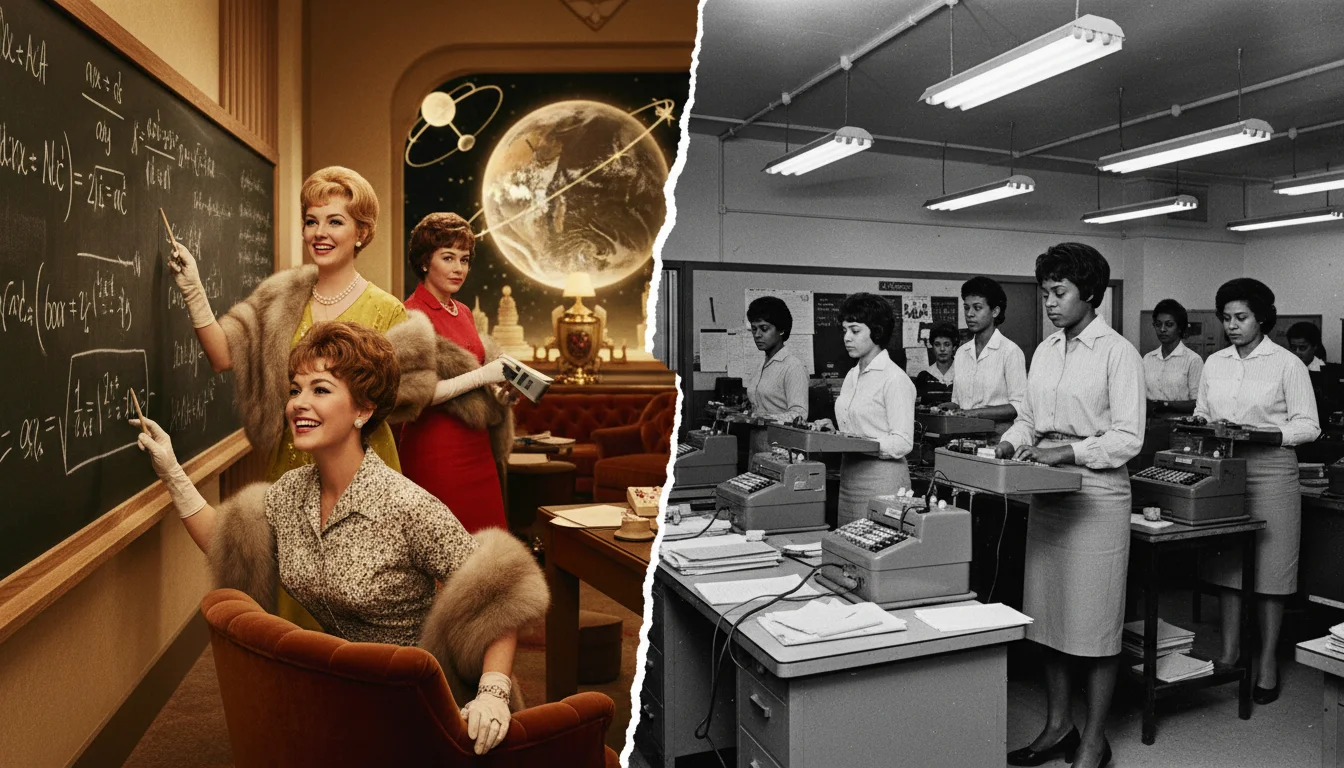
The year is 1961. America is losing the Space Race. And three Black women mathematicians are about to help change that - while fighting segregation at every turn.
Hidden Figures (2016) tells the remarkable true story of Katherine Johnson, Dorothy Vaughan, and Mary Jackson - "human computers" who calculated trajectories for NASA's earliest space missions. The film earned three Oscar nominations, grossed over $235 million worldwide, and introduced audiences to heroes who had been forgotten by history.
But how much of this inspiring story actually happened?
What Hollywood Got RIGHT
Katherine Johnson Really Did Compute John Glenn's Trajectory
The film's most dramatic moment is absolutely true. When astronaut John Glenn was preparing to become the first American to orbit Earth in 1962, the electronic IBM computers kept spitting out inconsistent numbers. Glenn, understandably nervous about trusting his life to an unreliable machine, made a specific request: "Get the girl to check the numbers."
He meant Katherine Johnson.
"If she says the numbers are good, I'm ready to go," Glenn declared. This actually happened. The legendary astronaut trusted his life to the calculations of a Black woman mathematician in the segregated South. Johnson verified the trajectory by hand, Glenn flew, and America took a giant leap in the Space Race.
Women Were Indeed Told They Couldn't Attend Briefings
In the movie, Katherine asks to attend a space program briefing and is told by engineer Paul Stafford that women don't go to meetings like that. This reflects reality. The real Katherine Johnson recalled: "I asked permission to go, and they said, 'Well, the girls don't usually go,' and I said, 'Well, is there a law?' They said, 'No.' Then my boss said, 'Let her go.'"
She asked if there was a law against it. There wasn't. She went anyway. Classic Katherine.
Segregation Laws Were Very Real at Langley
When Black women began working as "computers" at Virginia's Langley campus in 1943, segregation wasn't just a social norm - it was state law. Separate workspaces. Separate cafeterias. Separate bathrooms. A cardboard sign on one cafeteria table read "COLORED COMPUTERS" - referring not to machines, but to the Black women doing mathematical work.
Author Margot Lee Shetterly, whose book the film is based on, confirmed: "Even though they were just starting these brand new, very interesting jobs as professional mathematicians, they nonetheless had to abide by the state law."
Mary Jackson Became NASA's First Black Female Engineer
Janelle Monáe's portrayal of Mary Jackson captures a real pioneer. Jackson was hired at Langley in 1951 and, with encouragement from her mentor Kazimierz Czarnecki (renamed Karl Zielinski in the film), pursued an engineering degree. She petitioned the city of Hampton to attend graduate classes alongside white students, won her case, earned her degree, and was promoted to engineer in 1958 - becoming NASA's first Black female engineer.
What Hollywood Got WRONG
Kevin Costner's Character Didn't Exist (And Neither Did That Bathroom Scene)
That powerful moment when Kevin Costner's Al Harrison dramatically smashes the "COLORED LADIES ROOM" sign with a crowbar? Never happened.
First, Harrison isn't real. The director couldn't secure rights to portray the actual NASA director, so he created a composite of three different people. Second, and more importantly, segregation at NASA Langley ended in 1958 when NACA became NASA - three years before the movie's main timeline begins.
Critics accused the film of creating an unnecessary "white savior" moment. Director Theodore Melfi defended it: "There needs to be white people who do the right thing, there needs to be black people who do the right thing, and someone does the right thing." But the fundamental problem remains: the dramatic bathroom confrontation is fiction.
Katherine Johnson Didn't Run Half a Mile to Use the Bathroom
One of the film's most memorable images - Katherine running across the NASA campus in the rain to find a colored bathroom - didn't happen to her. It was actually Mary Jackson who experienced this humiliation when she was assigned to a building on the East Side and couldn't find a bathroom for Black employees.
As for Katherine? She didn't even realize the bathrooms at Langley were segregated. She used the unmarked "white" bathrooms for years. When someone finally complained, she simply ignored them and kept using whichever bathroom was closest. No consequences followed.
Katherine Said She Didn't Feel Segregation at NASA
Here's where the film diverges most dramatically from the real Katherine Johnson's experience. In the movie, she faces constant microaggressions, exclusion, and racism. In real life, she told WHRO-TV: "I didn't feel the segregation at NASA, because everybody there was doing research. You had a mission and you worked on it, and it was important to you to do your job... and play bridge at lunch. I didn't feel any segregation. I knew it was there, but I didn't feel it."
This doesn't mean racism didn't exist - it clearly did. But the film heightened the workplace conflicts for dramatic effect.
The Three Women Weren't Actually Close Friends
The heartwarming friendship between Katherine, Dorothy, and Mary - carpooling together, attending family events, supporting each other through struggles - was largely invented for the film. The timeline compression forced them together in ways they never were in reality.
Dorothy Vaughan became a supervisor in 1949 - five years before Katherine even started at Langley. The women's careers overlapped, but they didn't carpool together (Katherine actually rode with her neighbor), and they certainly didn't have the tight-knit friendship depicted on screen.
The Timeline Is Compressed by Over a Decade
The film kicks off in 1961 and condenses everything into about two years. In reality:
- Dorothy Vaughan became NACA's first Black supervisor in 1949
- Mary Jackson became NASA's first Black female engineer in 1958
- The West and East Computer divisions didn't even exist by the late 1950s
- Many of Katherine's achievements spanned her entire 33-year career
The Police Encounter Never Happened
That tense scene where the three women break down on the road and are questioned by a police officer? Complete fiction - created to illustrate the dangers Black people faced in the Jim Crow South. It's effective storytelling, but it's not their story.
Hidden Figures Historical Accuracy Score: 6/10
Hidden Figures gets the big picture right: Katherine Johnson, Dorothy Vaughan, and Mary Jackson were genuine pioneers who made crucial contributions to America's space program while navigating the indignities of segregation. Their accomplishments were real, their brilliance was real, and their stories deserved to be told.
But the film significantly dramatizes their workplace experiences, invents characters and confrontations, compresses a decade of history into two years, and creates a "white savior" moment that never occurred. Most notably, it portrays Katherine Johnson as facing far more overt racism than she herself described experiencing.
The real Katherine Johnson - who passed away in 2020 at age 101, having received the Presidential Medal of Freedom from Barack Obama - might have appreciated the attention her story finally received. But she might also have raised an eyebrow at seeing herself run through the rain to find a bathroom she never actually had to find.
Sometimes the truth is more nuanced than Hollywood can handle. These women didn't need fabricated obstacles to be heroes. Their actual accomplishments - calculated by hand, verified against early computers, trusted by astronauts - were extraordinary enough.
The numbers don't lie. They never did.
For another NASA story tested against the record, see our First Man vs. history breakdown of Neil Armstrong's biopic. The Apollo 13 accuracy review examines how Ron Howard's thriller handled the real crisis.

Debate the Accuracy with the Real Figures
Ask the real people what Hollywood got wrong about their lives.
Chat with HistoryJoin the HistorIQly Club
Get smarter about the past.
Weekly stories, deep dives, and exclusive content straight to your inbox.