If Cesare Borgia Lived Today: Machiavelli's Prince, Updated
If Cesare Borgia lived today, he'd be the private equity operator that everyone fears and nobody can outmaneuver - Machiavelli's prince in a three-piece suit.
Read Wikipedia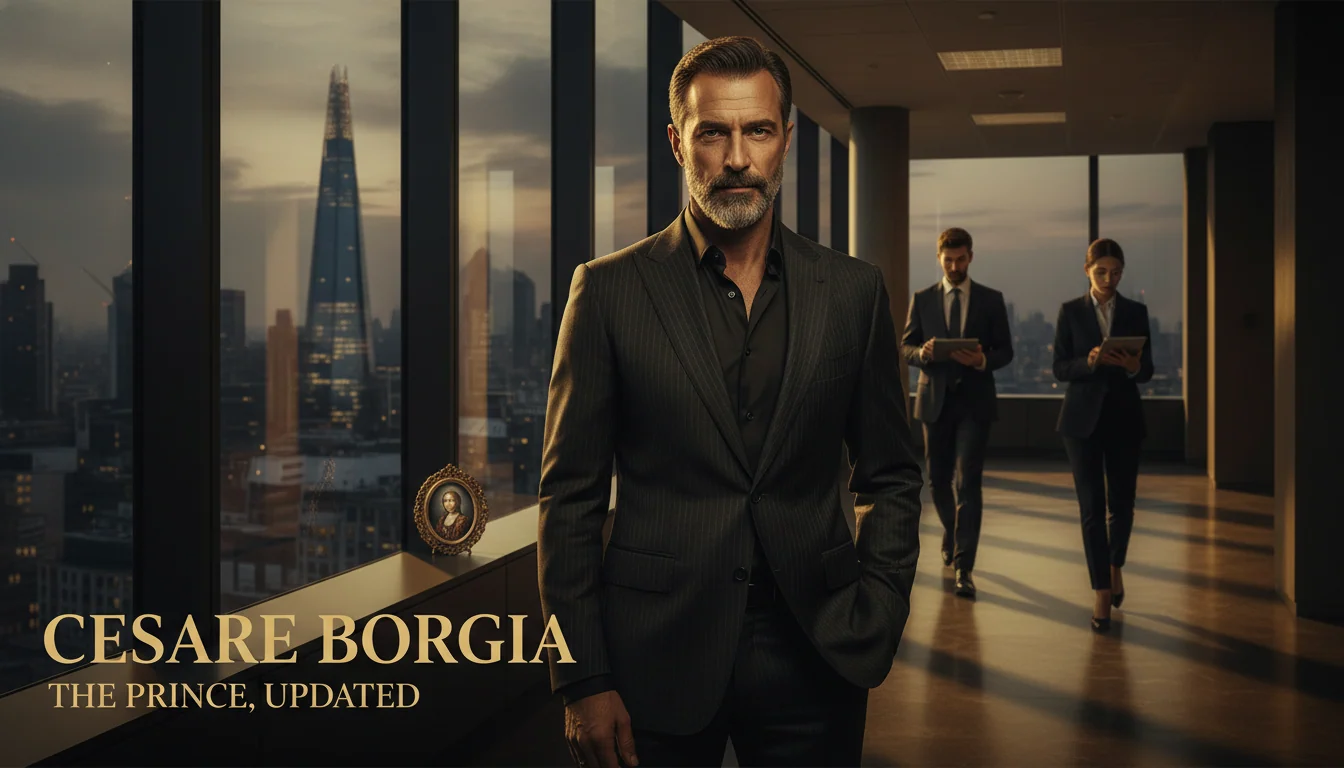
In 1498, Cesare Borgia did something that no cardinal in the history of the Catholic Church had ever voluntarily done: he resigned. He handed back the red hat, the benefices, the political protection of the church hierarchy, and the path to influence that his father the Pope had spent years constructing for him - and walked out of it to build something of his own. Within five years he had conquered a string of city-states in central Italy, terrified Florence, impressed Niccolo Machiavelli into writing a book about him, and become the most talked-about political operator in Europe.
Then his father died, his health failed at the worst moment, and by 1507 he was dead in a ditch in Navarre at thirty-one. The arc from brilliant to ruined happened faster than almost any other career in the Renaissance.
In 2026, Cesare Borgia would complete the same arc. The question is in which industry, and over how many fiscal quarters.
The historical figure
He was born around 1475 or 1476, the illegitimate son of Cardinal Rodrigo Borgia and a Roman noblewoman named Vannozza dei Cattanei. Rodrigo had arranged for several of his children - Cesare, Juan, Lucrezia, and others - to be established within the church and the nobility before he became Pope Alexander VI in 1492. Cesare was made a bishop at seventeen and a cardinal at eighteen, an appointment his father orchestrated with the kind of casual corruption the Renaissance papacy had raised to an art form.
Cesare was, by multiple contemporary accounts, physically imposing, exceptionally charming, and deeply unhappy in clerical robes. His brother Juan was given military command, which Cesare wanted. He endured this arrangement for several years before Juan was murdered in Rome in 1497 - Cesare was widely suspected and never definitively cleared - and the following year Cesare took his opportunity, resigned his cardinalate, and never looked back.
What he built over the next five years was, by Renaissance Italian standards, remarkable. He formed an alliance with King Louis XII of France, who gave him the Duchy of Valentinois and a French princess as a wife, and in return supported French military campaigns in Italy. With French backing and his own organizational talent, Cesare systematically conquered the city-states of the Romagna. He dealt with opposition by the method Machiavelli later praised without irony: lure your enemies to a negotiation when they think they have leverage, and kill them there. The trap at Senigallia in December 1502, where he invited four conspiring condottieri captains to meet with him, had them arrested, and had two strangled that same night, was the operation Machiavelli cited as a masterclass in practical statecraft.
He was thirty-one when a fever killed his father and destroyed the power base that everything depended on.
The modern role
In 2026, Cesare Borgia is the founder and CEO of a private technology holding company with a Mayfair address and seven portfolio companies, four of which are in sectors he entered by acquiring struggling competitors at distressed valuations. He is forty-nine years old and has been the youngest partner at a major investment bank, the chief digital officer of a government ministry that he left after eighteen months with strategic information that has never been publicly explained, and the founder of two companies of which one failed spectacularly and one was sold to a consortium for a price that made him independently wealthy.
The current operation does not have a marketing deck. It does not need one. The people Cesare calls know who he is, and the people he wants to call him generally find a way to do so within the week.
He is known in three distinct worlds: the private equity world, where he is respected and slightly feared; the policy world, where he is known as the former official who knows where the levers are; and the technology world, where he is known as the buyer who appears when a company is at its most vulnerable and offers terms that seem generous until the founder reads the governance clause.
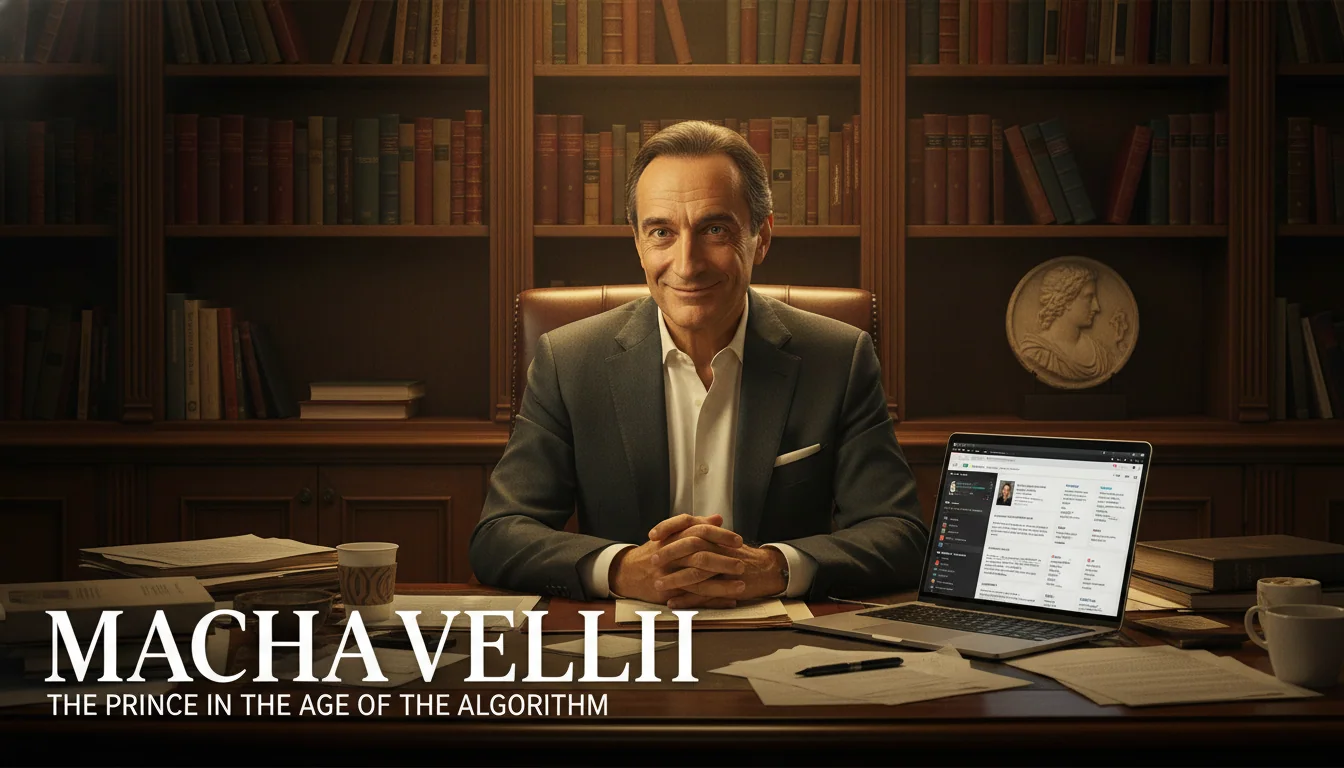
Machiavelli - call him a senior fellow at a geopolitical think tank in Florence, Italy, someone who has watched this man operate across three continents over a decade - has been working on a memo about him since 2021. It keeps getting longer.
The skills that translate
Three things from 1502 arrive intact in 2026.
The strategic patience that breaks suddenly. Cesare could wait. He spent years in clerical robes he despised, building relationships and watching for the moment to act. When the moment came, he moved with a speed and completeness that left contemporaries describing it as if it had happened overnight. The 2026 version of this is recognizable to anyone who has watched him in a board meeting: he says little for two hours, asks three questions that seem mild, and then proposes something that restructures the entire situation in his favor before the room has processed what happened. The people he does this to tend to describe it, later, as having been very reasonable at the time.
The talent for loyalty engineering. Cesare's campaigns worked partly because he understood that violence without construction leaves nothing. His father provided the institutional cover; he provided the administrative framework in the territories he conquered, replacing corrupt local officials, reducing certain taxes, and establishing the kind of basic order that made him more popular in conquered towns than his predecessors had been. In 2026, this translates to a well-known practice of being exceptionally good to the people he needs to keep. His senior staff are paid above market, given equity structures competitors will not match, and treated with a personal warmth that is genuine while it lasts. When it stops being strategic to treat someone well, it stops, and it stops completely.
The willingness to be the person everyone else is reluctant to be. The Senigallia trap worked because Cesare was willing to do what his enemies assumed no one would actually do at a diplomatic meeting. In 2026, this manifests as a willingness to make the offer no one else is willing to put on the table, use the regulatory lever no one else is willing to pull, or make the personal phone call that every other operator would consider beneath them. He does not have a reputation for squeamishness. This is known and it does work.
The scandals
The historical Cesare wore a mask in public during his final years, which some contemporaries attributed to syphilitic lesions on his face. The 2026 version is obsessively private about his personal life, maintains no active social media presence under his real name, and employs a small and effective team whose job it is to keep his name out of stories he hasn't chosen to be in.
He has been connected, at various times, to two major corporate investigations in different jurisdictions, neither of which resulted in charges. He settled one civil case. He co-founded a lobbying organization that achieved its regulatory objective and was dissolved the following year. He had a relationship with a politician in a country he was simultaneously doing business in, which ended before anyone published anything about it.
His sister - in this version a tech lawyer who runs her own firm and has been his quietly essential back-channel for fifteen years - occasionally gives short interviews about her own work and declines to discuss her brother. She is genuinely fond of him and genuinely exhausted by him. This is the most humanizing thing about him, and it is not available to the public.
The fall and the difference
The historical Cesare collapsed because his entire structure rested on his father's pontificate and he was too ill to act when it ended. The 2026 version has had decades to think about this failure mode and has diversified accordingly: multiple jurisdictions, multiple revenue streams, multiple protectors. He is not dependent on any single relationship for survival.
This makes him more durable than the original. It does not make him any easier to deal with. A similar structural problem runs through the Julius Caesar in 2026 comparison and, at larger scale, through Napoleon translated to the modern era.
The contemporary peer he most resembles is not a tech founder and not a politician. It is the type of figure who appears in multiple industries across a twenty-year period, always at moments of maximum leverage, and who never quite becomes famous in any single domain. You have heard of the companies but not always the name behind them. When the name comes up in a private meeting, the conversation pauses for a moment before continuing.
Machiavelli finished The Prince in 1513, six years after Cesare died. He dedicated it to a Medici, which was practical. He wrote it about Cesare, which was honest.
Quick Answers
Common questions about this topic
Who was Cesare Borgia?
Cesare Borgia (1475-1507) was the son of Pope Alexander VI and one of the most ruthless and effective political operators of the Italian Renaissance. He resigned the cardinalate in 1498 - reportedly the first cardinal to do so voluntarily - to pursue military ambitions. Over the following five years he conquered much of the Romagna region of central Italy through a combination of military force, strategic deception, and the calculated elimination of rivals. Niccolo Machiavelli met him in 1502 and used him as the central model for The Prince.
Why did Machiavelli admire Cesare Borgia?
Machiavelli served as a Florentine envoy to Cesare's court in 1502 and was struck by his decisiveness, his ability to create loyalty through a mix of fear and reward, and his willingness to use violence precisely and without hesitation when it served his purposes. Machiavelli wrote that Cesare was the best example of a new prince - someone who acquired power entirely through ability rather than inheritance - and he held up the Senigallia trap of 1502, in which Cesare lured treacherous captains to a meeting and had them killed, as a model of effective statecraft.
How did Cesare Borgia lose his power?
His power rested almost entirely on his father, Pope Alexander VI, who died in August 1503. Cesare was seriously ill at the time, probably with the same fever that killed his father, and could not move fast enough to secure his position. The new pope, Julius II, was hostile to the Borgias and moved to strip Cesare of his territories. He was arrested, imprisoned in Spain, escaped in 1506, and died in a skirmish at Viana in Navarre in March 1507. He was thirty-one.
What is Cesare Borgia's reputation today?
He is one of the most contested figures in Renaissance history. The Black Legend of the Borgias, amplified by hostile contemporaries and later writers, attributed to him murders and cruelties that may be exaggerated. What is documented is a deliberate, intelligent operator who used violence as a tool of statecraft with unusual precision. He inspired one of the most influential political books ever written. His reputation oscillates between monster and misunderstood modernizer depending on who is writing.

Meet Them in Person
Chat with the historical figures behind these modern reimaginings.
Create your free account →No card required. Talk to anyone in history with 8 free credits a day. Some features require a paid plan.
Join the HistorIQly Club
Get smarter about the past.
Weekly stories, deep dives, and exclusive content straight to your inbox.