If Toussaint Louverture Lived Today: The Liberator Who Would Navigate Every Great Power
If Toussaint Louverture lived today, he would be the Global South's most formidable statesman: brilliant, self-taught, ruthless, and ultimately betrayed by trust.
Read Wikipedia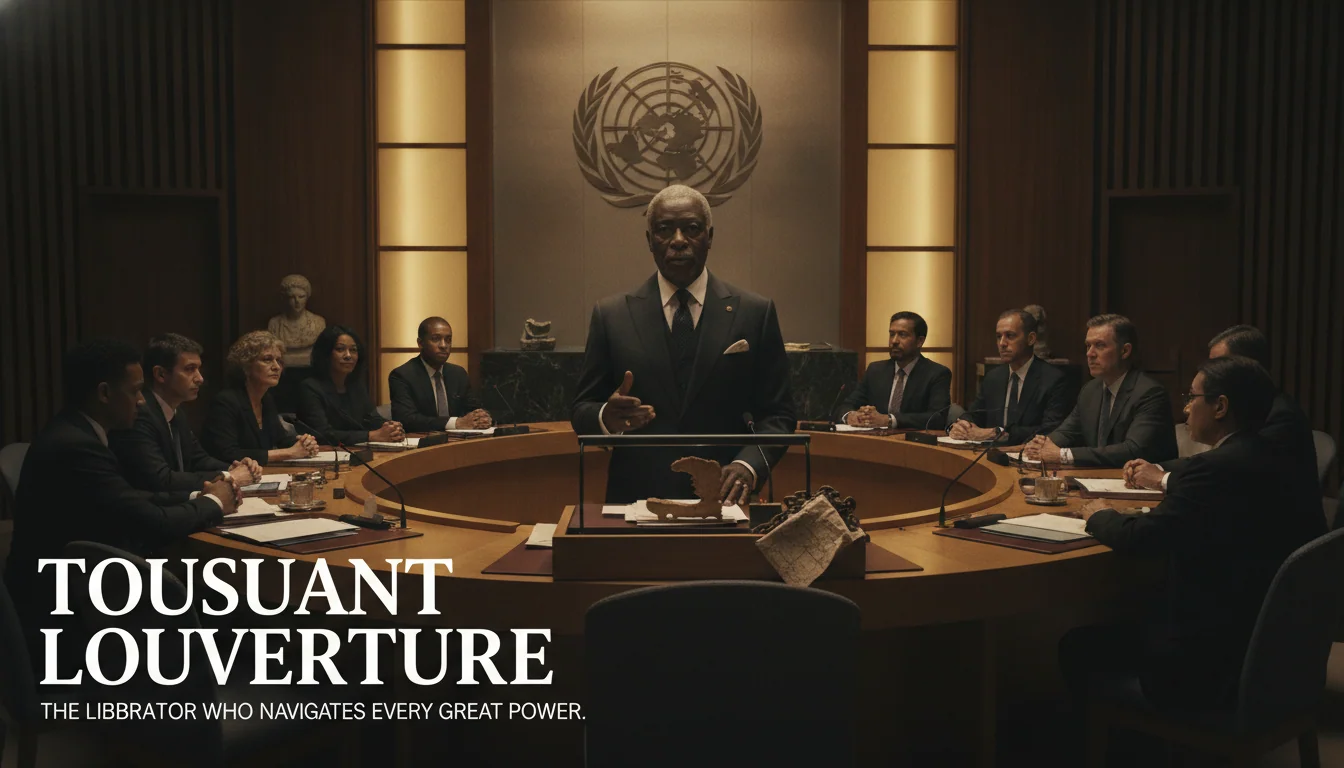
Born enslaved. Taught himself to read from a Latin grammar and the military writings of Julius Caesar. Led an uprising of half a million enslaved people. Built a disciplined army from nothing. Drove out one of the world's great colonial empires through battlefield skill and strategic patience. Governed a prosperous territory for years. Was arrested under a flag of truce by the man he had trusted, shipped across the Atlantic to a cold mountain prison, and left there until he died.
Toussaint Louverture is the most consequential revolutionary leader of the 18th century, and the most incompletely remembered. In 2026, the skills that made him extraordinary - literacy acquired against all prohibition, military genius that emerged from nothing, the ability to negotiate with great powers from a position of formal weakness while never losing sight of the actual objective - are not merely admirable. They are a template.
The historical figure
Toussaint was born around 1743 on the Breda plantation in Saint-Domingue, the French colony that occupied the western third of Hispaniola and produced roughly forty percent of Europe's sugar. The details of his early life are partly reconstructed and partly self-narrated, and both versions deserve some skepticism. What is established is that he was not treated as a typical field slave. He was assigned duties as an overseer and livestock manager, and at some point was given access to books. He read Caesar. He read the Stoics. He read manuals on horse care that also contained information about mathematics and logistics.
When the slave uprising began in August 1791, Toussaint was in his late forties, which made him old for a revolutionary general. He joined the rebel forces only after the first wave of violence had already begun, and he spent some time in the service of Spain, which was fighting France on the island. When the French National Convention abolished slavery in February 1794, he switched sides. His reasoning was explicit in his own letters: he served the power that would keep Black people free, and France had just become that power.
Between 1794 and 1798, his army drove out the British expedition that had moved into Saint-Domingue hoping to claim the colony. The British lost somewhere between 45,000 and 60,000 men in the campaign, the majority to yellow fever but a significant number to Toussaint's forces. By 1801 he governed the entire island under a constitution he had drafted, which declared him Governor-General for Life. He remained nominally French but was in practice independent.
Napoleon sent his brother-in-law Charles Leclerc with 20,000 soldiers in January 1802. Toussaint fought, then negotiated, then accepted terms that allowed him to retire to his plantation. In June 1802, French officers invited him to a conference under a guarantee of safe conduct and arrested him the moment he arrived. He was put on a ship to France and confined at Fort de Joux in the mountains of the Jura, where the cold and the deliberate curtailment of food and fire killed him by April 1803. For more on the man who gave that order, see If Napoleon Lived Today.
The modern role
In 2026, Toussaint is the head of state of a mid-sized African nation with a colonial inheritance, a strategic commodity that the great powers want, and a political class that has spent two generations oscillating between dependence and defiance. His country has a functioning military, a parliament that respects his authority without loving it, and a foreign debt load that functions as quiet coercion.
His office is bare by the standards of the presidential palaces he visits in Paris and Washington. The shelves have books in French, English, and Yoruba. A satellite phone sits beside a classified military briefing. The calendar shows meetings with the Chinese infrastructure minister this week, the World Bank the week after, and a call with the African Union scheduled between them because Toussaint does not ignore his regional flank while managing his great-power relationships.
He has been described in the Western press as autocratic, in the Chinese press as a valued partner, and in the African press as the most strategically independent leader on the continent. All three descriptions are simultaneously accurate, which is precisely the position he has been working toward.
The skills that translate
The strategic switching that defined his historical career was not inconsistency. It was clarity about objectives combined with flexibility about means. He wanted the freedom of his people. He would work with Spain or France or Britain or anyone else who served that objective. The moment any ally moved against it, he moved against the ally.
In 2026, that clarity expresses itself in a consistent pattern: he signs infrastructure agreements with whichever power offers the best terms without the political conditions, then renegotiates the terms before the first payment falls due. He does not announce that he is playing China and the IMF against each other. He simply does it, and both parties suspect what is happening and find it less costly to continue than to stop.
His military background shows in how he runs his government. Cabinet meetings start on time. Decisions are made in the meeting and executed afterward, not debated in the corridor for weeks. He promotes people who do the thing they were asked to do and moves aside people who manage upward instead of working outward. This has made him effective and has made him enemies within his own administration, which he considers a reasonable trade.
He reads voraciously. He still reads Caesar. He has read every peace agreement signed by a smaller nation with a larger one in the past century and can tell you, from memory, which clauses were honored and which were not.
The family
He has been married once, for thirty years. His wife is a physician who runs the national health authority and who considers most political conversation a waste of time she could be spending on the malaria prevention program. They have three children, two of whom are in government in junior roles they were not given by their father. The third is a historian at a university in France studying the Haitian Revolution, which Toussaint finds either poetic or unbearable depending on the week.
He does not do social media himself. His communications office runs accounts in his name that are careful, professional, and almost completely without personality. Anyone who has met him in person is struck by the gap between the accounts and the man.
What goes wrong
The historical Toussaint was betrayed at the moment he chose to trust. He had won on the battlefield. He negotiated a settlement from a position of some strength. He then attended a meeting on the assumption that his interlocutors would honor a commitment they had made in writing, and they did not.
The modern Toussaint knows this story. He has read it many times. He lectures his ministers about it. He has constructed a government and a foreign policy specifically designed to avoid replicating it: the diversification of great-power relationships so that no single partner can close all the doors at once, the insistence on never disarming before the other side has delivered, the careful maintenance of domestic political support so that no external power can remove him by simply bribing the people around him.
What he has not solved is the problem his historical predecessor also could not solve: great powers do not negotiate permanently. They wait. They look for the moment when the internal stresses of a country produce a faction that can be supported against the leadership. They calculate the cost of patience versus the cost of confrontation. And the moment a leader's position weakens enough, they move.
His version of Fort de Joux is less picturesque. It might be an orchestrated financial crisis. It might be a coup backed by an intelligence service that has spent five years cultivating a general. It might be something as mundane as the commodity price dropping at the wrong moment.
He lies awake thinking about which one it will be. He has no answer. He continues the work anyway.
Why it matters
Toussaint Louverture is remembered, when he is remembered at all in the English-speaking world, as the precursor to Haitian independence - the man whose revolution produced the state that Dessalines declared on January 1, 1804. This is not wrong but it is incomplete.
What Toussaint demonstrated was that a person with no formal education in a closed system can build an extraordinary capability, that the strategic instinct to switch sides at the right moment is not disloyalty but intelligence, and that the most dangerous moment in any confrontation with a stronger power is the moment after you have reached an agreement and before you have verified that the agreement will be honored.
The lesson he never stopped teaching, and that the 21st century keeps relearning: formal freedom is not the same as actual sovereignty. Declaring independence is the easy part. Maintaining the capacity to make genuinely independent decisions - about debt, about trade, about who your army trains with - is the work that never ends. It is the same lesson Simon Bolivar spent his own revolution relearning a generation later, on the other side of the same ocean.
If Toussaint Louverture lived today, he would understand that perfectly. He would be doing the work. He would also be watching the door.
Quick Answers
Common questions about this topic
Who was Toussaint Louverture?
Toussaint Louverture (c. 1743-1803) was the leader of the Haitian Revolution, the only successful large-scale slave revolt in history. Born enslaved in Saint-Domingue (present-day Haiti), he rose to command a disciplined military force, drove out British invaders, and governed the colony as Governor-General for Life before being captured by Napoleon and imprisoned in France, where he died in 1803.
Why was Toussaint Louverture captured?
Napoleon sent a 20,000-strong expedition to Saint-Domingue in 1802 with instructions to restore French authority and, eventually, slavery. When direct military defeat seemed possible, French officers invited Toussaint to a meeting under a flag of truce, arrested him, and shipped him to France. He was imprisoned at Fort de Joux in the Jura mountains and died there on April 7, 1803, of cold, neglect, and what a French physician described as pulmonary illness.
What made Toussaint Louverture different from other revolutionary leaders?
Three things: his ability to maintain military discipline in a force that began as an improvised slave uprising, his strategic willingness to change alliances based on which great power offered the best terms for abolition, and his capacity for governance. He organized Saint-Domingue's agriculture, maintained trade, wrote a constitution, and managed relationships with the United States and Britain while formally remaining under French sovereignty. He was not just a military leader but an administrator.
What would Toussaint Louverture's cause be today?
In 2026, he would be navigating the structural inequalities that the Haitian Revolution exposed but could not resolve: debt, financial dependence, and the tendency of great powers to support formal independence while enforcing economic subordination. His cause would be genuine sovereignty - not just the flag but the capacity to make independent economic decisions - which is as contested today as it was in 1803.

Meet Them in Person
Chat with the historical figures behind these modern reimaginings.
Create your free account →No card required. Some figures and features require a paid plan.
Join the HistorIQly Club
Get smarter about the past.
Weekly stories, deep dives, and exclusive content straight to your inbox.