If Galileo Galilei Lived Today
If Galileo lived today, the astronomer who saw what institutions didn't want seen would still be fighting the same battles - with a podcast and a Substack instead of a printing press.
Read Wikipedia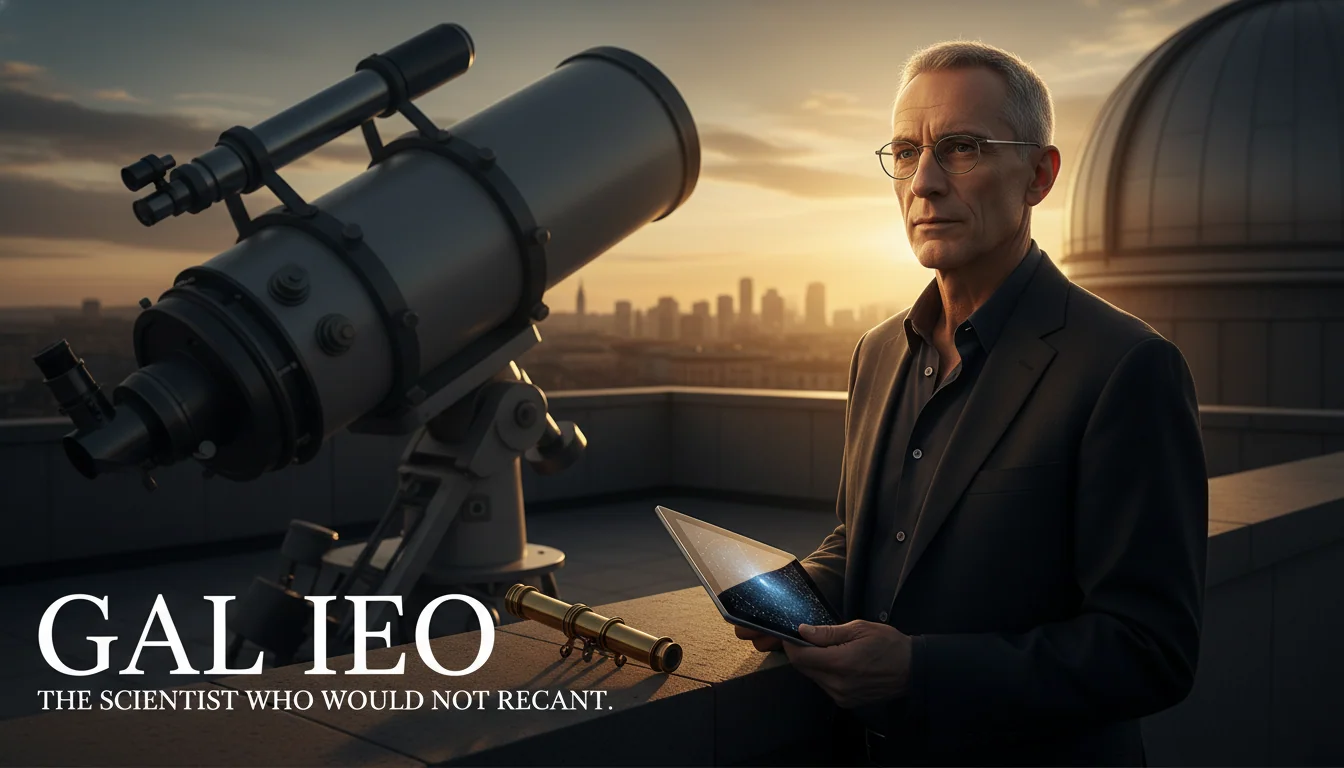
The Dutch spectacle-makers who first combined lenses into a tube that made distant objects appear closer had a perfectly serviceable product. Galileo Galilei, a mathematics professor in Padua, heard about it in 1609, built a better one in days, achieved twenty times magnification against the original three times, and then - this is the important part - pointed it at the sky.
Nobody had done that with sufficient precision or persistence before. What the sky contained turned out to be embarrassing for several influential institutions. Jupiter had four moons that no one had seen, circling it on schedules that could be predicted and verified. Venus showed phases exactly like the Moon, which was only possible if it orbited the Sun. The Moon itself was not the perfect smooth sphere Aristotle had described and the Church taught; it was covered in mountains and craters. The Milky Way was not a smear of celestial fire but a vast accumulation of individual stars too numerous to count.
Galileo published all of this in a short book in 1610, named the moons after his patron the Medici Grand Duke, and became the most famous scientist in Europe within months.
By 1633 he was kneeling before the Roman Inquisition, formally recanting.
If Galileo lived today, the trajectory would be immediately recognizable.
The historical figure
Galileo was born in Pisa in 1564, the son of a musician and music theorist named Vincenzo Galilei. He studied medicine at the University of Pisa before switching to mathematics, which he found more congenial and considerably more useful for the questions that interested him.
He spent eighteen years at the University of Padua, which was then the best scientific institution in Europe and, being under Venetian rather than Papal jurisdiction, somewhat more liberal about what a professor could investigate. He was productive, combative, and relentlessly attentive to physical evidence. He dropped balls off inclined planes. He timed pendulums. He made careful, quantified observations of things people had previously only described qualitatively. He was not interested in received authority as a substitute for looking at the object.
He was also an excellent writer in Italian, by preference, rather than the Latin of academic discourse. His books were designed to be read by educated nonspecialists. He enjoyed making the Aristotelian establishment look foolish, and he had a talent for it. These were not unrelated facts.
After the publication of his "Dialogue Concerning the Two Chief World Systems" in 1632, in which the traditional geocentric view was systematically demolished by the sharper of the book's two discussants while the view was supposedly defended by a character named Simplicio, the Inquisition's patience ran out. He was tried, forced to recant the heliocentric view, and sentenced to house arrest at his villa in Arcetri near Florence. He continued working. He went blind around 1638. He died in 1642, still under the sentence, still producing science dictated to students who came to see him.
The modern role
In 2026, Galileo is a fifty-eight-year-old professor of astrophysics at a research university in northern Italy, split his time between Padua and a US institution with funding he attracted by being unexpectedly good at certain kinds of instrumentation that other people underestimated.
He built something. Not a telescope, exactly, but analogously: he took a new class of sensor or detector technology - originally developed for a different field entirely - and applied it to a problem in observational astronomy that the established observational programs had not gotten around to addressing systematically. The results were, to put it gently, inconsistent with several things people had been confidently asserting for fifteen years.
He published them. The papers were not warmly received by the people whose work they undermined.
He then wrote a book about the findings for a general audience, in accessible Italian and English, that sold very well and was reviewed in the publications that matter to the informed public. The reviews from scientists in the affected specialty were rather less enthusiastic. One eminent colleague wrote a widely circulated response that characterized Galileo's methodology as "promising but not yet rigorous." The academic translation was obvious to everyone who read it.
He has a podcast with three million subscribers and a Substack with another half million. He responds to critics publicly, at length, with evidence, and he is not particularly careful about what the response implies about the quality of the critic's thinking.
The skills that translate
Three things about Galileo's career survive the five-century translation almost without modification.
He is a tool-builder first. The telescope was not Galileo's invention. Lipperhey and other Dutch craftsmen had it first. What Galileo contributed was a much better version very quickly, and then the decision to use it for something nobody had thought sufficiently important. The modern version of this move - taking an existing platform and applying it to a problem the original designers were not thinking about - is something he does repeatedly. The sensor was built for one purpose; he found a different question it could answer.
He communicates downward, not just across. Galileo's deliberate choice to write in Italian rather than Latin was a statement about who he thought his audience should be. He wanted to reach the educated non-specialist, the literate merchant or nobleman who could read but was not part of the university apparatus. In 2026 this is the podcast, the well-edited popular book, the newsletter that actually explains what the work means. His colleagues find it undignified. He finds their opinion of dignity unpersuasive.
He is tactically poor with institutions and tactically excellent with patrons. Naming Jupiter's moons after the Medici was pure marketing genius, and it worked: it secured him a better position, more freedom, and the institutional protection of Florence. He did not play nearly as well with the Inquisition, which is a different kind of institution with different leverage. In 2026 he is excellent at finding the tech philanthropist or foundation that believes in his work and is willing to fund it outside the standard grant apparatus. He is not good at academic politics. He tends to win arguments and lose rooms.
The institutions he fights
The modern Inquisition is distributed and has no central authority, which in some ways makes it more manageable and in some ways makes it worse.
The first instrument is the peer review system. When results are inconsistent with the established consensus in a productive research field, the papers land at the journals where the relevant reviewers are the established figures whose work is being challenged. This is not a conspiracy; it is a structural feature of how expertise is organized. The papers take longer. They come back with more revisions requested. Some do not appear in the journals at first intended.
The second instrument is grant review. His applications to the major national and European science funding bodies are evaluated by committees that include people whose work he has, publicly and politely but unmistakably, called into question. The success rate drops.
The third is the conference circuit. He is not uninvited, because the talks are too interesting and too many people want to see him. But the question periods are combative and the dinner conversations less welcoming than they used to be. A colleague of thirty years introduces him at a colloquium with an introduction that spends as much time on caveats as on achievements.
The house arrest in 2026 is a funding drought and a decade of journal friction. He works through it. He finds the patronage. He keeps publishing.
Where he lives
An apartment in Padua, a visiting appointment in the US that keeps him connected to the instrument he built. He rents rather than buys because he has always been somewhat chaotic about money, which was true of the historical Galileo as well - he spent most of his career with significant debt and relied heavily on outside patronage. His adult daughter manages the things he forgets to manage.
He has a workshop. There is always something being built.
What goes wrong
The historical Galileo's failure was a version of the same mistake Alcibiades made and Machiavelli made: he overestimated the tolerance of the institution for being made to look foolish. He was right about the science. He was wrong about how much being right protected him.
The 2026 version makes a version of the same error. He writes something - not about planetary motion, but about something with equivalent institutional sensitivity - that does not just make the establishment wrong but makes them publicly, specifically, demonstrably wrong, in a forum that non-scientists can follow. The response is not an argument. It is a process: a formal inquiry at the institution, a review of his grant management, a request from the department chair for a conversation. Nothing is ever quite stated directly. But he understands what is happening.
He recants, in a limited sense, meaning he softens some of the sharper language in the book's second edition. He does not recant the finding. The finding holds.
The end of the story is the same as the original: he keeps working. The work is eventually vindicated by the people who were too young to have institutional interests in the earlier outcome. The old objectors die or retire. The instruments multiply.
Whether he mutters "and yet it moves" on the way out of the departmental inquiry is between him and the recording app on his phone. For scientists who navigated similar institutional friction in their own eras, see if Tesla lived today and if Archimedes lived today - both cases where the tools changed but the collision between individual discovery and institutional authority stayed the same.
Quick Answers
Common questions about this topic
Who was Galileo Galilei?
Galileo Galilei (1564-1642) was an Italian physicist, astronomer, and mathematician who improved the telescope and used it to make observations that supported the Copernican model of a Sun-centered solar system. He discovered Jupiter's four largest moons, observed the phases of Venus, studied sunspots, and laid important groundwork for physics with his work on motion and falling bodies. He was tried by the Roman Inquisition in 1633 and spent his final years under house arrest.
Why did Galileo get in trouble with the Church?
Galileo's 1632 book Dialogue Concerning the Two Chief World Systems clearly argued for the Copernican view that Earth orbits the Sun, contradicting official Church teaching. He had been warned in 1616 not to hold or defend this position. The book's satirical framing, placing the Church's arguments in the mouth of a character named Simplicio, did not help. He was found vehemently suspect of heresy and sentenced to house arrest.
What did Galileo discover with his telescope?
In 1609-1610 Galileo built an improved telescope and made several discoveries: Jupiter's four largest moons (now called the Galilean moons), mountains and craters on the Moon, the phases of Venus, and the resolution of the Milky Way into individual stars. The phases of Venus were particularly important as direct evidence that Venus orbits the Sun rather than Earth.
What was Galileo's modern legacy?
Galileo is considered one of the founders of modern observational science. His willingness to let physical evidence override received authority, his use of mathematical description for natural phenomena, and his insistence on communicating science to educated non-specialists all shaped the Scientific Revolution. Albert Einstein called him 'the father of modern science.'

Meet Them in Person
Chat with the historical figures behind these modern reimaginings.
Create your free account →No card required. Talk to anyone in history with 8 free credits a day. Some features require a paid plan.
Join the HistorIQly Club
Get smarter about the past.
Weekly stories, deep dives, and exclusive content straight to your inbox.