If Metternich Lived Today: The Diplomat Who'd Run the Room Nobody Sees
If Metternich lived today, he would run a fragile alliance from the back channel, not the podium, undone by the same force that ended his career: an unmanageable crowd.
Read Wikipedia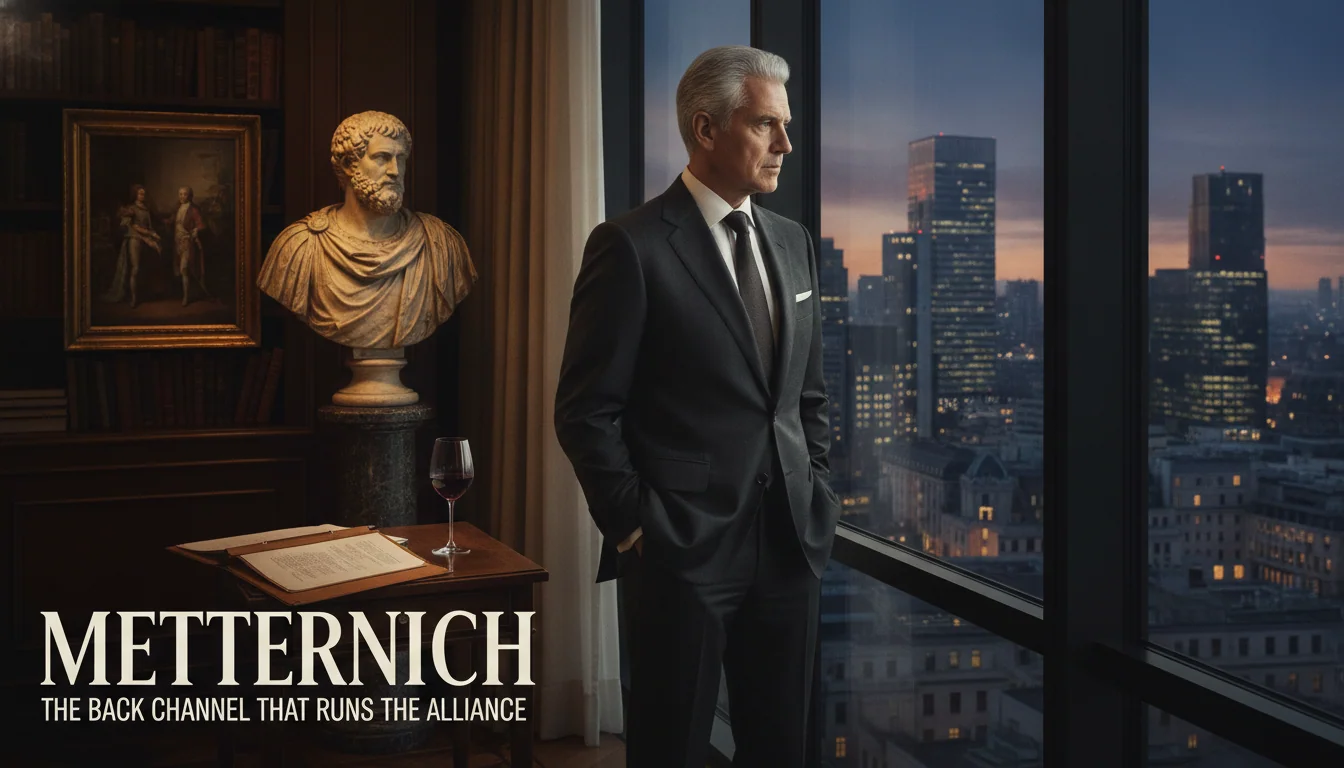
Every era has a figure whose whole career is a demonstration that the person managing the meeting matters more than anyone actually sitting at the table. In early nineteenth century Europe that figure was Klemens von Metternich, the Austrian foreign minister who spent the better part of four decades keeping a continent's rival monarchies from tearing each other apart, largely by making sure he was the only man in the room who fully understood what everyone else wanted. If Metternich lived today, he would not disappear into a museum exhibit, dropped into 2026 as a curiosity. He would become the unelected diplomat everyone in Brussels or Washington quietly admits actually runs the alliance.
Who he actually was
Metternich rose to prominence as the Austrian Empire's foreign minister starting in 1809, at a moment when Napoleon's armies had already humiliated Austria on the battlefield more than once, and he built his early career on the pragmatic, sometimes uncomfortable work of keeping a weakened Austria relevant among stronger powers through marriage diplomacy and careful timing rather than force. By 1814 he was the central organizer of the Congress of Vienna, the sprawling set of negotiations that redrew Europe's map after Napoleon's defeat. What made the Congress remarkable was less its final territorial settlement than the sheer diplomatic craft Metternich brought to managing it: months of overlapping balls, private dinners, and one-on-one conversations conducted alongside the formal sessions, all designed to let rival powers, Russia, Prussia, Britain, and a defeated but still dangerous France, walk away feeling they had each gotten enough to accept a settlement none of them fully wanted. Contemporaries joked that the Congress danced rather than worked, a jibe that undersold how much of Metternich's actual diplomacy happened precisely in those social settings rather than around a formal negotiating table.
The resulting system, often called the Concert of Europe, kept the continent's major powers from a general war for roughly four decades, an extraordinary run of stability that Metternich treated as his life's central achievement and his personal responsibility to defend. He maintained it not through any single treaty but through a continuous, exhausting process of managing crises as they arose, intervening diplomatically wherever a revolution or a border dispute threatened to drag the major powers into open conflict, always arguing for negotiated equilibrium over decisive victory for any one side.
That defense came at a real cost, and it is worth stating plainly rather than glossing over in admiration of his diplomatic skill. Metternich built an extensive surveillance and censorship apparatus to suppress the liberal and nationalist movements he saw, correctly from his own point of view, as the greatest threats to the conservative order he had constructed. He was brilliant, vain, and genuinely charming in the salons of Vienna, a man whose personal relationships with foreign ministers and monarchs across Europe were themselves instruments of policy. It ended for him the way these things often do: in March 1848, when revolutionary crowds rose up across European capitals demanding the liberal and national reforms Metternich had spent his career blocking, Vienna's mob turned on him personally as the era's defining symbol of repression. He resigned and fled the city in disguise, reportedly leaving so quickly that he abandoned much of his personal correspondence behind, eventually settling in London before an aging, diminished return to Austria years later, by which point the political order he had built no longer existed in anything like its original form.
The 1848 uprisings that toppled him were not confined to Vienna. Similar revolutionary waves broke out that same year in Paris, across the German and Italian states, and in Hungary, a continent-wide upheaval that historians sometimes call the Springtime of Nations. Metternich had spent decades treating the suppression of exactly this kind of popular nationalist and liberal sentiment as the core function of his diplomacy, and the fact that it broke out almost simultaneously across so many capitals, despite his surveillance networks and censorship regime, is itself a measure of how much frustration had been building underneath the stable surface he had spent so long maintaining.
The modern reimagining
Metternich in 2026 does not run for office, because visible power was never really his instrument. He is the veteran foreign policy hand who has outlasted six administrations and three changes of government coalition, the one senior diplomat every incoming foreign minister is quietly told to keep on retainer because he is the only person who actually remembers how the last four crises were defused and who owes whom a favor. He would be equally at home chairing a closed-door session at a security conference in Munich or running back-channel talks nobody officially confirms are happening, always positioned just outside the frame of the official photograph while being the reason the photograph gets taken at all.
His household staff would be small and fanatically loyal, his social calendar a genuine instrument of statecraft rather than leisure, a rotating cast of ambassadors, defense ministers, and the occasional tech executive with geopolitical interests, all entertained at a residence he treats the way a Congress-era prince treated a ballroom: as neutral, elegant ground where difficult conversations become easier after the second course. He would have a discreet but extensive private intelligence network built from decades of favors rather than any official position, and a reputation, deserved, for knowing what every major government in a given negotiation actually wants before their own delegations have finished saying it out loud.
His closest contemporary peer is probably a Henry Kissinger type: the aging realist statesman whose actual government title matters less than his rolodex, invited everywhere, formally accountable to almost no one, treated with a mixture of genuine respect and real unease by younger officials who need his access but resent how much of the system's actual functioning depends on a man nobody elected. Unlike Kissinger, though, Metternich's real gift was never grand strategic theory. It was room management: the specific skill of making four mutually suspicious parties feel they had each won something, deployed over champagne rather than in a memo. He would also recognize a kindred, sharper-edged spirit in if Bismarck lived today, another nineteenth-century statesman built for a world of blocs and alliances, though one who reached for coercion far more readily than Metternich ever allowed himself to.
He would also, almost certainly, run a quiet and effective information operation, less a government surveillance apparatus in the nineteenth-century sense than a private network of aides, former officials, and journalists who owe him access and favors, feeding him early warning of which government is about to shift position before that shift becomes public. It is easy to imagine him treating an early leak of a sensitive negotiating document the way he once treated a hostile pamphlet: not with panic, but with a calm, practiced effort to control how the story is framed before anyone else gets to it.
Where the story ends the same way
The counterfactual gets darkest where the history already did. Metternich's downfall in 1848 came not from a rival diplomat outmaneuvering him but from a crowd in the street, the one variable his entire style of statecraft was never built to manage, because it operated on consent from ordinary people rather than agreement among elites. A modern Metternich, brilliant at managing presidents, chancellors, and central bankers, would likely find himself equally exposed to the one force his skill set cannot touch: a viral moment, a leaked memo, a populist wave that does not care who used to run the back channel. History suggests he would see it coming later than anyone expected, and that when it arrived, he would flee the same way he did in 1848, quietly, in disguise, one step ahead of the very public he had spent a career managing from just out of sight. It is much the same vulnerability that would confront if Churchill lived today, another figure whose command of elites counted for far less once the public mood turned against him.
Quick Answers
Common questions about this topic
Who was Klemens von Metternich?
Metternich (1773-1859) was the Austrian Empire's foreign minister and later state chancellor, best known for engineering the Congress of Vienna in 1814-1815, which redrew Europe's borders after Napoleon's defeat and established a conservative balance-of-power system known as the Concert of Europe that he then worked for decades to preserve.
What did Metternich actually do at the Congress of Vienna?
Metternich hosted and largely orchestrated the negotiations among the victorious powers, using a mix of genuine diplomatic skill, lavish social entertaining, and a network of informants to manage rival monarchs and ministers toward a settlement that restored conservative monarchies and contained French power without crushing France so completely that it destabilized the wider balance.
Why was Metternich forced to flee Austria?
In March 1848, revolutionary uprisings swept across European capitals, including Vienna, where crowds demanding liberal and nationalist reforms turned specifically against Metternich as the symbol of the repressive conservative order he had spent decades building. He resigned and fled the city in disguise, eventually settling in London before later returning to Austria in his final years.
What is Metternich most remembered for today?
He is remembered chiefly as the architect of a durable, conservative balance-of-power system that kept a broad peace among Europe's major powers for roughly four decades, and as the era's defining practitioner of realist diplomacy focused on stability and equilibrium over ideology, a legacy historians and diplomats still invoke as shorthand for that style of statecraft.

Meet Them in Person
Chat with the historical figures behind these modern reimaginings.
Create your free account →No card required. Some figures and features require a paid plan.
Join the HistorIQly Club
Get smarter about the past.
Weekly stories, deep dives, and exclusive content straight to your inbox.