If Nikola Tesla Lived Today: The Visionary Who Still Can't Get Funded
If Nikola Tesla lived today, he would be Silicon Valley's most brilliant unfundable founder - the visionary who won the AC power wars but lost every commercial battle.
Read Wikipedia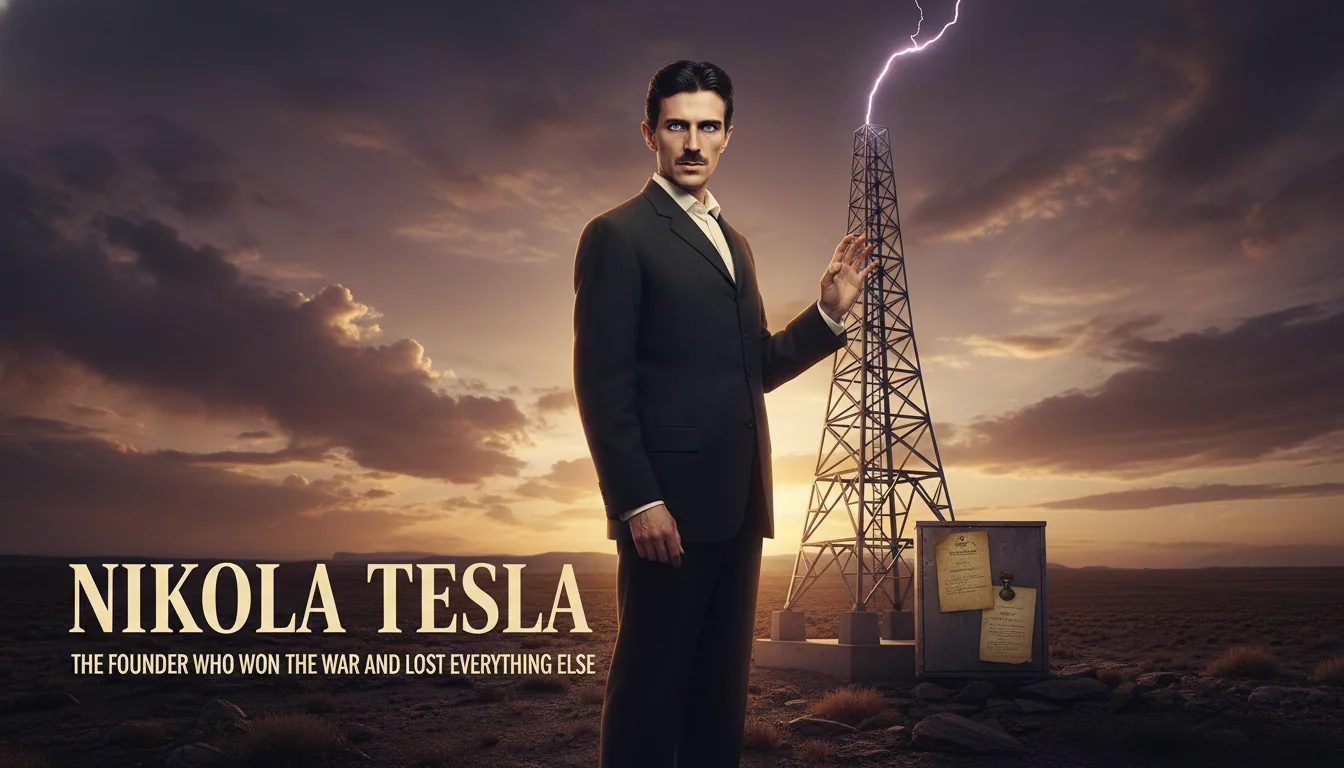
Nikola Tesla arrived in the United States in June 1884 with the equivalent of four cents in his pocket, a letter of introduction to Thomas Edison, and a complete induction motor design that existed entirely in his head. Within ten years he had won the most consequential technical argument of the 19th century. Within twenty years he was broke. He died in 1943 in a New York hotel room, alone, in debt to the management, having spent his last decade in near-isolation.
If Nikola Tesla lived today, the story would rhyme almost exactly.
The historical figure
Nikola Tesla was born on July 10, 1856, in Smiljan, in the Austro-Hungarian province of Croatia, the son of a Serbian Orthodox priest. He was educated in physics and engineering in Graz and Prague, worked briefly at telephone exchanges in Budapest and Paris, and arrived in New York with the Edison introduction in 1884.
The Edison period lasted less than a year. Tesla later claimed Edison had offered him $50,000 to redesign certain DC generator systems, then refused to pay when Tesla completed the work, calling the offer a joke. Edison's version of events differed and the truth of the specific claim is uncertain. What is documented is that Tesla left Edison's employ in 1885, spent a miserable year doing manual labor including ditch-digging while his first attempts at forming his own electrical company failed, and emerged from that period with nothing except his ideas intact.
The rescue came in 1888, when George Westinghouse licensed Tesla's AC patents for a substantial sum and a royalty arrangement. The resulting contest between Westinghouse's AC system and Edison's DC - the War of Currents - is one of the more dramatic commercial and technical disputes in industrial history. Edison's direct current required a generating station roughly every mile for urban distribution. Tesla's alternating current could be stepped up to high voltage for long-distance transmission and stepped back down for use, meaning a single large station could serve an entire city. The Niagara Falls hydroelectric project, which came online between 1895 and 1896 using Tesla's polyphase AC system, made the argument academic.
Tesla then spent the next decades generating ideas that ranged from the immediately practical to the spectacularly speculative. The Tesla coil, developed around 1891, remains in use in high-voltage research and radio applications. His contributions to early radio transmission are real and have been legally acknowledged - a 1943 US Supreme Court ruling recognized his priority over Guglielmo Marconi in certain radio patents. He demonstrated radio-controlled boats in 1898, which should have launched an industry but attracted mostly curiosity.
The Wardenclyffe Tower on Long Island, begun in 1901 with partial backing from financier J.P. Morgan, was intended to be a global wireless power and communications system. Morgan withdrew support around 1904 after the commercial model failed to materialize and after it became clear that Marconi's radio operation was succeeding with simpler means. Tesla never completed it, never found replacement funding, and financially never recovered. He surrendered the Wardenclyffe property to pay hotel debts in 1917. The tower was demolished the same year.
In 1897, when Westinghouse told Tesla the company was struggling and could not afford the royalty payments their contract required, Tesla tore up the royalty agreement on the spot. He explained afterward that he could not allow his friend Westinghouse to fail because of him. This act of loyalty and commercial self-destruction may have cost Tesla the fortune that his inventions should have generated.
The modern role
In 2026, Nikola Tesla is the founder and CEO of Tesladyne LLC, operating out of a converted warehouse in Denver, Colorado, which he chose partly for altitude and partly because it is not San Francisco, where he finds the culture insufferable.
The company has raised two rounds of funding. He has spent both on things his investors did not fund. His primary pitch is a global wireless energy transmission system built around a network of high-altitude tower stations and resonant ionospheric coupling. He has constructed three prototypes. Each one performs impressively in demonstration. Each one requires a complete redesign before any kind of commercial scaling. His investors receive the redesign news with decreasing patience.
His second most recent pivot was to inductive power beaming for electric vehicles. His most recent pivot involves atmospheric plasma channels and a theoretical framework that none of his board members claim to understand, which is not entirely different from how the Wardenclyffe situation developed in 1903.
The company has twelve employees: eight engineers who joined because they genuinely believe in the core technology and four recent graduates who are there because a university supervisor told them to get startup experience. The engineers stay because the work is genuinely interesting. The four recent graduates will leave for Google or a battery startup within eighteen months. Tesla will not notice immediately because he works at 3 AM and the graduates do not.
What translates directly
Tesla's productive pattern in the historical record was consistent: receive funding, disappear into experimental work for months, produce a result that impressed specialists and baffled investors, fail to produce a commercializable product on any agreed timeline, lose the funding, repeat. In 2026 this pattern is extremely familiar to any venture capitalist who has reviewed more than one hundred pitches from deep-physics founders. It is also common enough that Tesla would be competing with many other brilliant non-commercializable people for the same limited pool of patient capital.
His most transferable gifts are spatial visualization and experimental intuition. He claimed he could design and test machines entirely in mental simulation before touching a physical component, running virtual prototypes through full operational cycles and identifying failure modes without building anything. Whether the claim was entirely accurate is uncertain - his historical output does show an unusual freedom from design-phase errors, though plenty of commercial-phase ones. The problems were never technical in the narrow sense. They were always commercial.
His liability in the current environment is his relationship with equity and money. He gave away royalties that would have made him permanently wealthy because a partner said the company needed them. He walked away from potentially profitable demonstrations because he thought the application was beneath the technology's actual potential. He spent money on what interested him rather than what the investors had paid for. These are not 2026 behaviors that produce good Series B outcomes.
The Edison dynamic
The figure Tesla most uncomfortably resembles in 2026, and would most bitterly oppose, is Elon Musk. The surface parallels are not accidental. A company using Tesla's name was founded after his death, when nobody owned the intellectual legacy, and now it is the most valuable automotive company in the world. Tesla's AC electrical architecture underlies the charging infrastructure that makes that company's products function. The radio frequencies used by Musk's satellite internet constellation trace back to patent disputes in which Tesla was eventually vindicated by the Supreme Court, posthumously.
The actual Nikola Tesla, alive in 2026, would have opinions about this. A lawsuit would be filed within weeks of his becoming aware of the naming situation. The settlement, knowing Tesla's historical business acumen, would be poorly negotiated. He would emerge from it with a press statement and insufficient money.
He would also recognize something he might not admit aloud: that Musk is, in certain respects, the commercial executor that Tesla himself could never be. Musk builds on foundational electrical physics that Tesla's generation established, operates with the kind of aggressive promotional instinct that Tesla completely lacked, and has the investor relationships and public presence to absorb failures that would have permanently ended a lesser operator. Tesla would understand this, hate it, and be right about most of his specific technical objections anyway.
Where he lives and how he operates
Denver, as noted. Altitude. He would maintain a hotel address rather than a permanent home - the pattern of hotel living, which showed up in his historical life as it deteriorated financially, appears earlier in the modern version because hotels are logistically frictionless. He sleeps poorly, keeps unusual hours, eats the same meals at the same restaurants at the same times, and prefers an environment he does not have to maintain himself.
His social media presence is active, technically rigorous, and completely counterproductive from a fundraising standpoint. Posts alternating between dense physics and scathing assessments of competing wireless energy startups have attracted 2.1 million followers, the large majority of whom have never funded anything. His four angel investors follow the account nervously.
He is currently in a dispute with a neighboring research institution over patent priority on a resonant coupling design. He is correct about the priority. He will not win the dispute.
The contemporary peer
The closest comparison is not Musk despite the surface overlap. It is Geoffrey Hinton: a foundational contributor whose core work underlies most of the commercial landscape, who is not personally capturing the commercial value of that contribution, and who has reached a point of public concern about where the technology is going. Tesla would be doing exactly this. He would be specific, on record, and extremely precise about which applications of his wireless power work he considers unsafe or misused. The people with money to act on his concerns would not be listening. The people with no money would be sharing his posts enthusiastically.
He would consider this situation deeply familiar and say so publicly. He would be right. For the other side of the Tesla-Edison rivalry reimagined in the present, see If Thomas Edison Lived Today. For another brilliant historical mind navigating modern power structures, see If Machiavelli Lived Today.
Quick Answers
Common questions about this topic
Who was Nikola Tesla?
Nikola Tesla (1856-1943) was a Serbian-American inventor and electrical engineer who developed alternating current electrical systems, the polyphase induction motor, the Tesla coil, and contributions to early radio transmission. He partnered with George Westinghouse to win the War of Currents against Thomas Edison, establishing AC as the global standard for electrical power distribution. Despite this, he died broke and largely forgotten in a New York hotel room in 1943.
Why did Tesla die poor despite his inventions?
Tesla's financial ruin stemmed from his lack of commercial instinct and his fixation on speculative long-range projects over profitable short-term ones. His most ambitious project, the Wardenclyffe Tower intended to transmit wireless electricity globally, lost J.P. Morgan's backing around 1904 when no commercial model materialized. He also gave away his AC royalties to Westinghouse in 1897 when Westinghouse said the company could not afford the payments. Tesla agreed immediately. This is not how successful inventors negotiate.
What was the War of Currents?
The War of Currents was a commercial and technical dispute in the late 1880s between Thomas Edison, who backed direct current (DC) for power distribution, and George Westinghouse and Nikola Tesla, who backed alternating current (AC). AC could be stepped up to high voltage for long-distance transmission and stepped back down for household use, while DC required generating stations roughly every mile. The Niagara Falls hydroelectric project, which came online in 1895-1896 using Tesla's polyphase AC system, effectively settled the argument.
What modern technology traces back to Tesla?
The AC power grid that supplies virtually every building in the world is built on Tesla's polyphase system. His induction motor principle underlies most electric motors in industrial and consumer use. His work on radio transmission is acknowledged in a 1943 US Supreme Court ruling that recognized his priority over Marconi in certain radio patents. The rotating magnetic field he described in the 1880s remains foundational to electrical engineering.

Meet Them in Person
Chat with the historical figures behind these modern reimaginings.
Create your free account →No card required. Talk to anyone in history with 8 free credits a day. Some features require a paid plan.
Join the HistorIQly Club
Get smarter about the past.
Weekly stories, deep dives, and exclusive content straight to your inbox.