If Robespierre Lived Today
The modern Robespierre: incorruptible, principled, and deadly certain. He sent thousands to the guillotine for virtue. Reimagined in 2026, he looks familiar.
Read Wikipedia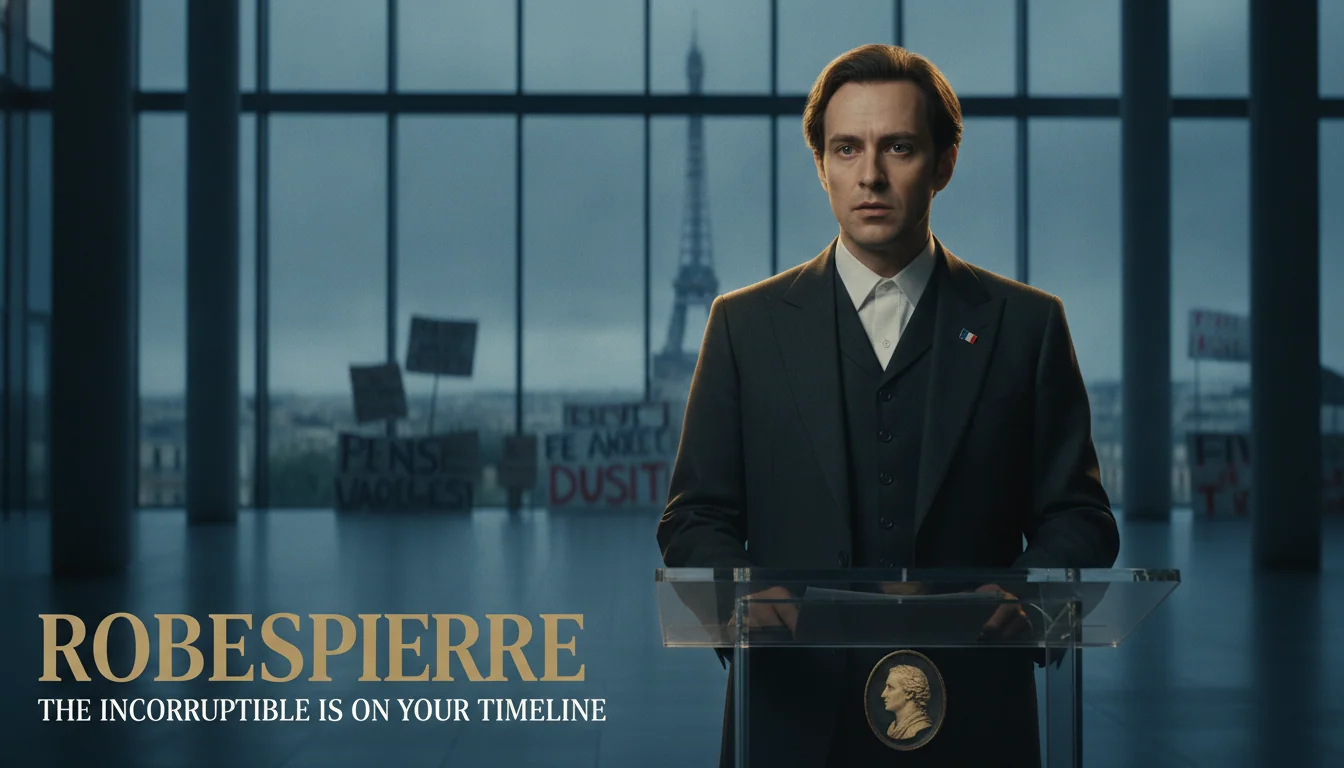
Maximilien Robespierre was born in Arras in 1758, trained as a lawyer, and won a scholarship to study at the College Louis-le-Grand in Paris on the basis of his academic record. He was small, precise, dressed carefully in powdered wig and knee breeches in an era when other revolutionaries were ostentatiously shabby. He refused bribes. He took positions that cost him politically. He sent approximately 17,000 people to the guillotine in the name of the Republic and the Revolution, and he genuinely believed it was necessary.
He was 36 when they arrested him and 36 when they killed him, in July 1794, which means his active political career ran for about five years and his period of maximum power for roughly eighteen months. In that time he helped design the revolutionary government's structure, chaired the Committee of Public Safety, which functioned as the executive council of France during the most violent phase of the Revolution, and came closer than perhaps any individual of his era to making virtue - as he defined it - into state policy.
The question of what he would be doing in 2026 is partly a thought experiment and partly a warning.
The background
Robespierre's career before the Revolution was not glamorous. He practiced law in Arras, took cases for poor clients, and built a reputation for painstaking work and unusual ethical consistency. He was elected to the Estates-General in 1789 as a Third Estate deputy, meaning he represented the commoners rather than the clergy or the nobility.
In the early years of the Revolution he was notable but not dominant. He gave many speeches. He opposed the death penalty, in the abstract, before the Revolution made the issue concrete. He was seen as principled but not charismatic in the theatrical sense - a careful arguer rather than a natural orator, though his prepared speeches were extremely effective with audiences who had come to distrust eloquence for its own sake.
His rise through the Jacobin Club and then through the Revolutionary government followed the pattern of a man who had always been right in his own assessment of things and who found, unexpectedly, that history had finally provided an arena commensurate with his certainty.
What he would be doing today
In 2026, Robespierre would be a political figure whose career began in law and whose reputation was built on the consistency between what he said and what he did. He would have had a clean record through the early stages of his career - no corruption cases, no financial scandals, no documented personal inconsistencies. This would be noted, approvingly, by his supporters, and analyzed with increasing unease by the people who worked with him.
He would not be a conventional politician. He would probably be someone who had become prominent through a specific public position that seemed, at the time, relatively uncontroversial - advocating for legal reform, for prosecutorial accountability, for institutional transparency. The legal background would have given him a skill set that combined rhetorical precision with procedural knowledge, meaning he would be very good at using institutions to accomplish things that, described nakedly, would sound alarming.
His social media presence would be distinguished by the absence of personal warmth. Other politicians post photographs of their families or their dogs. Robespierre would post dense, principled arguments written in careful prose. His accounts would have no photographs of him relaxing. He would not be seen to relax. His followers would find this admirable. His colleagues would find it exhausting and faintly frightening.
He would live modestly. His apartment would be small, his clothes expensive but not ostentatious, his personal life either genuinely spare or simply invisible to outside observation. There would be no private jets, no undisclosed consulting arrangements, no personal financial gain traceable to his public positions. This would be one of the most politically powerful things about him.
The ideology
Robespierre's political theology was built on a distinction between the people and their enemies. The people were virtuous by definition. Their enemies - royalists, Girondins, foreign agents, speculators, anyone whose loyalty to the Republic was insufficiently absolute - were not simply wrong but corrupt, and corruption in the Robespierrian sense was not merely ethical but almost ontological. You could not be argued back into virtue. You had to be removed.
The Committee of Public Safety, during the period when Robespierre's influence was at its peak, oversaw the Revolutionary Tribunal, which operated with procedural innovations including the removal of defense counsel in cases of conspiracy against the state, the presumption of guilt for certain categories of accused, and the use of revolutionary communes to identify suspects.
In 2026, the equivalent of this architecture would not look the same institutionally but the logic would be recognizable. A public figure who had built a reputation for incorruptibility, who framed every political disagreement as a distinction between the virtuous and the corrupt rather than between competing policy positions, and who had access to institutional mechanisms for removing opponents from public life, would be doing something that Robespierre would immediately recognize.
The specific charge that sent people to the guillotine in 1793 and 1794 was often not a specific act but a general category: being insufficiently republican, being suspected of moderation, being associated with someone already condemned. The category was infinitely extensible. Once the definition of treason included ideological wavering, anyone could be treasonous.
The Thermidor problem
Robespierre's fall, on 9 Thermidor Year II - July 27, 1794 - was not a popular uprising. It was a parliamentary coup carried out by men who had themselves voted for the Terror and who had now calculated that they were likely to be next on its lists. They outmaneuvered him procedurally, which is the most Robespierrian way to lose.
In 2026, this problem would present itself early. A political figure who had driven multiple opponents out of the system - through procedural mechanisms, through reputational campaigns, through defining the ideological boundaries of the movement in ways that excluded rivals - would at some point face a coalition of people who had concluded that they were next. The coalition would include people who had supported him until very recently.
His response would be consistent with his record: he would treat it as further evidence of corruption. The people opposing him would be doing so because they were guilty of something. He would say this publicly, carefully, in writing. It would be exactly right in tone and exactly wrong in strategic judgment.
The contemporary peer
The specific figure he most resembles in 2026 is difficult to name without producing a lawsuit, but the type is recognizable. A moralist in a position of institutional power who has built a reputation for personal integrity, who frames every political question in terms of virtue and betrayal rather than policy and tradeoff, and who has found that the system can be operated most effectively from a position that is never fully visible but always present.
The difference from Robespierre is the guillotine. Modern democracies have mostly replaced execution with cancellation, prosecution, procedural exclusion, and the kind of institutional exile that allows someone to be removed from public life without dying. This is an improvement. It is also, from the perspective of the people it happens to, not entirely dissimilar in its structure of accusation, judgment, and removal.
Robespierre in 2026 would be deeply engaged with whatever mechanisms were available. He would be patient, principled, consistent, and completely sincere. He would not profit. He would not be hypocritical in his personal conduct. He would be more certain than anyone else in the room that he knew what virtue required.
That is the part that should concern you.
The apartment
He would still be living in a small apartment, above a carpenter's shop or the modern equivalent. The rent would be low relative to his income. There would be a great deal of paperwork. He would answer his correspondence carefully and completely, including correspondence from people who opposed him.
The correspondence files, if they were ever made public, would be illuminating. Not because they contained anything incriminating, but because they demonstrated, across hundreds of exchanges over years, a mind that had never genuinely considered the possibility that it might be wrong.
The Revolution needed exactly that, at the exact moment it needed it. The problem was what it needed next.
For other historical figures whose virtues and pathologies were inseparable, see If Oliver Cromwell Lived Today and If Talleyrand Lived Today.
Quick Answers
Common questions about this topic
What made Robespierre so dangerous?
Robespierre was dangerous because he combined genuine incorruptibility with the absolute certainty that he alone understood what the Revolution required. He did not profit personally from the Terror. He genuinely believed it was necessary. That combination - sincere virtue and sincere willingness to kill in its name - made him far more threatening than a cynical opportunist would have been.
Was Robespierre actually incorruptible?
By the evidence available, yes. He lived modestly in the home of a carpenter named Duplay, dressed carefully but without extravagance, refused substantial bribes, and was documented taking unpopular positions that cost him politically. The title 'the Incorruptible' was not self-applied; it came from admirers and then stuck as irony after the Terror. He appears to have genuinely believed what he said.
Who was Robespierre most similar to in modern politics?
The comparison is uncomfortable because it cuts across conventional political categories. Robespierre was a left-wing figure who used institutional power, ideological purity, and the language of popular virtue to eliminate not only enemies but anyone who seemed insufficiently committed to the correct definition of the Revolution. Equivalents can be found on multiple sides of modern politics.
How did Robespierre die?
Robespierre was arrested by the Convention on 9 Thermidor Year II (July 27, 1794), having been outmaneuvered by a coalition of men who feared they were next on his lists. He was guillotined the following day, July 28, 1794, without trial. He was 36 years old.

Meet Them in Person
Chat with the historical figures behind these modern reimaginings.
Create your free account →No card required. Some figures and features require a paid plan.
Join the HistorIQly Club
Get smarter about the past.
Weekly stories, deep dives, and exclusive content straight to your inbox.