If Talleyrand Lived Today: The Diplomat Who Outlasted Every Regime
If Talleyrand lived today, he'd run a Washington advisory firm with clients on every side - the survivor of six French regimes who would thrive in 2026 just as well.
Read Wikipedia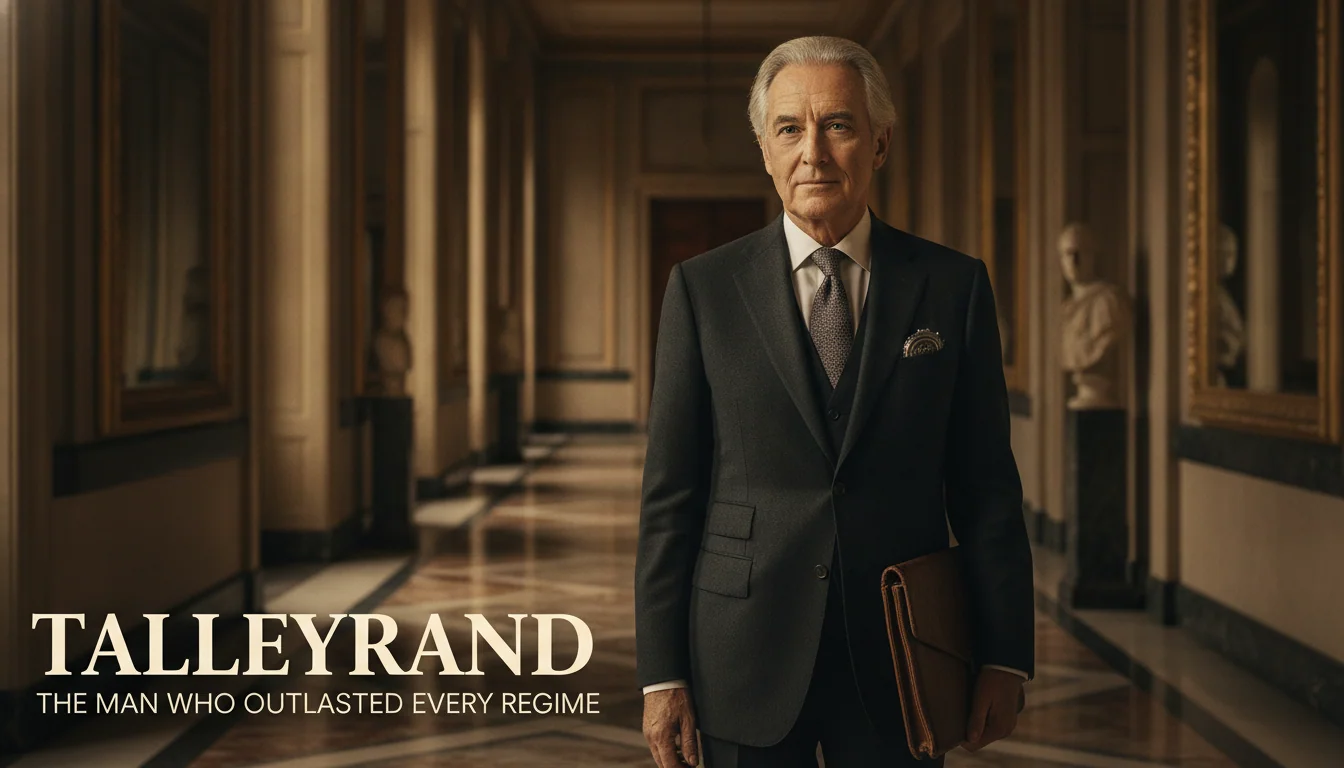
In February 1754, Charles-Maurice de Talleyrand-Perigord was born into one of France's oldest noble families and immediately dealt a hand that would have finished a lesser man. He was club-footed, a condition that in the aristocratic world of the ancien regime disqualified him from the military career that was the family's default path for younger sons. The Church would have him instead. His parents sent him off to the seminary at Saint-Sulpice and more or less forgot about him.
He became the most consequential diplomat in European history.
He also served under six different French governments, was excommunicated by the Pope, accepted bribes from at least two sovereign nations, betrayed Napoleon before Waterloo, and died at eighty-three having successfully reconciled with the Catholic Church after a sixty-year estrangement. The French state gave him a magnificent funeral.
If Talleyrand lived today - drop him into 2026 - the question is not whether he survives. He survives anything. The question is what his business card says and how long before you regret calling the number on it.
The historical figure
The church disqualified Talleyrand almost immediately. He was ordained, rose quickly through the episcopal ranks, became Bishop of Autun in 1789, and promptly used his position in the Estates-General to propose the nationalization of Church property as a solution to France's fiscal crisis. This was the revolutionary government's financial salvation. It was also technically apostasy. He did not appear to lose sleep over it.
By 1797 he was Foreign Minister under the Directory, accepting payments from American diplomatic envoys who had come to renegotiate a treaty. When the Americans reported the demand back to President John Adams - referring to Talleyrand's agents only as X, Y, and Z - the resulting scandal, the XYZ Affair, nearly brought the two countries to war. Talleyrand kept his position.
He served Napoleon from 1799 as Foreign Minister and helped legitimate the Consulate and then the Empire with brilliant diplomatic cover. He grew rich. He also grew skeptical. By 1807, having watched Napoleon extend his reach into Spain in a campaign Talleyrand privately considered suicidal, he quietly began communicating with foreign courts. The Emperor knew roughly what was happening. He called Talleyrand, famously and publicly, "dung in silk stockings." He did not fire him, because Talleyrand was still useful.
When Napoleon's empire finally collapsed after 1812, Talleyrand was positioned on every side. He had maintained contact with the royalist emigres. He had maintained the confidence of the Tsar. He represented France at the Congress of Vienna in 1814 with a brief that should have produced humiliation - France had been the aggressor for twenty years, had put its emperor's brothers on the thrones of half of Europe, and had just lost catastrophically - and instead produced a peace that left France's 1792 borders essentially intact and restored the country to full participation in European affairs.
He did this by deploying a single concept: legitimacy. The principle that stable Europe required respecting established monarchies suited France perfectly, because France's legitimate monarchy was the Bourbons, who were not Napoleon. By insisting on legitimacy as the organizing principle of the peace, Talleyrand simultaneously restored France's credentials and divided the great powers against each other on every question where their interests conflicted. It was the most elegant diplomatic performance of the 19th century.
He outlived Louis XVIII, survived Charles X, and served Louis-Philippe as Ambassador to London from 1830 to 1834, helping negotiate Belgian independence in his final act of statecraft. He died in 1838 having outlasted every regime he had served and having made himself richer and more powerful at each transition than he had been at the last. What Napoleon in a modern context looks like - the opposite pattern, the man who burned brilliant and catastrophic rather than adapting - is a sharply different portrait.
The modern role
In 2026, the title on his office door reads: Senior Partner, Meridian Advisory Group - a Washington, Brussels, and Dubai practice with no public client list, a registered lobbying disclosure that covers perhaps a third of what he actually does, and a reputation precise enough that foreign ministers call without being referred.
The business is not complicated to describe, even if it is complicated to run. He advises governments that are in transition and companies that need access to them. He knows which minister in a given capital is genuinely deciding policy and which is performing it. He knows which multilateral process is the real forum and which is the publicized one. He has lunched with the relevant people for four decades. He charges accordingly.
The official framing is "strategic advisory and public affairs." The unofficial framing, used by his competitors with a respect that costs them something to admit, is that he is the only person in a given situation who has relationships on all sides and cannot be permanently aligned with any of them.
He does not formally represent any government. He has never held elected office and is mildly contemptuous of it - the phrase "not too much zeal," which Talleyrand gave as his core advice to young diplomats, applies with particular force to electoral ambition, which he regards as a form of public self-exposure that serves the politician more than the statesman. He has the statesman's patience, which means he can wait years for the moment when what he knows becomes the most valuable thing in the room.
The skills that translate
Three of Talleyrand's historical gifts move into 2026 with minimal modification.
Institutional memory as leverage. Talleyrand survived because he was the man who remembered. He remembered which treaty had which secret clause. He remembered which minister had told which lie in which room. In 2026, he keeps his own records - not on systems anyone else can access - and the detail in those records is the quiet foundation of his indispensability. He does not threaten. He simply ensures that the people he has worked with understand that his silence is a choice and his memory is long.
The principle deployed as a weapon. At Vienna, "legitimacy" was not a moral conviction. It was a tool that happened to align with French interests. In 2026, the equivalent might be "rule of law," "democratic governance," or "multilateral process" - whichever principle, sincerely invoked, happens to disadvantage the party he is working against and advantage the one he is working for. His brilliance is that the principle he reaches for is always defensible on its own merits. He is not cynical in a way you can easily accuse. Where Machiavelli's modern counterpart writes the manual on political survival, Talleyrand reads it and improvises.
Surviving the transition. Every few years a government falls, a company changes leadership, or a political landscape reorganizes itself. Talleyrand's career involved doing this six times. The modern version has done it at least three times already - a change of American administration, a European coalition collapse, a client company acquisition - and each time he has emerged with more access than he entered with. The technique is to be slightly unhappy with the regime that is ending before anyone else admits it is ending, and to be quietly helpful to the one that is forming before it has fully formed.
The family
He married brilliantly in 1788 - a widow from one of the great banking families - and the marriage was a financial and social triumph that lasted as a formal arrangement considerably longer than the affection did. The modern version follows the same pattern: a marriage contracted in his late thirties to someone with the right connections and enough independence to manage her own life while he manages his.
There are children - two, at boarding school, then university, then their own careers in fields adjacent but not identical to his. They have his intelligence and his reserve and a slightly weary relationship with his reputation, which precedes him into every room they enter. The elder one works in international finance and has inherited his father's ability to be in three places simultaneously. They have dinner together perhaps six times a year, which is more than historical Talleyrand managed.
He does not, by the standards of his immediate world, spend an unusual amount of time at home.
Where he lives
A house in the 7th arrondissement in Paris - not ostentatious, but the address says everything. A permanent suite at a hotel in Washington that he prefers not to name publicly. Use of a house in the Perigord, his ancestral region, for August, which is the one month of the year when the correct move is to be visibly not working.
He eats well, drinks moderately, and has cultivated the habit of appearing bored at exactly the moments when lesser operators are most excited - a transition of power, a crisis announcement, a leaked document. The boredom is not genuine. It is the performance of a man who has been in the room before and knows that excitement signals inexperience.
What goes wrong
The historical Talleyrand's near-miss came in 1807-08, when Napoleon discovered the extent of his back-channel communications with foreign courts and considered having him arrested. The Emperor's decision not to - partly from political calculation, partly perhaps from something like respect for an adversary he could not quite replace - was the closest Talleyrand came to the ending that his less fortunate contemporaries met.
The 2026 version knows the precedent. He has read everything about Vienna, about the XYZ Affair, about the conversation in which Napoleon called him dung in silk stockings to his face and he stood there, composure intact, waiting for the Emperor to finish. He does not make the mistake of underestimating the people he is working around. He does sometimes make the mistake of overestimating his own ability to manage them once they have decided he has become a liability rather than an asset.
The ending, when it comes, will not be violent. It will be a portfolio of clients that quietly shrinks. A return call that does not arrive. An invitation to a certain annual conference that fails to appear in January. He will notice this happening and he will adjust and the adjustment will work for a while. Then it will work less well. Then it will stop.
He will have seen it coming and he will have had the good taste not to be surprised.
Quick Answers
Common questions about this topic
Who was Talleyrand?
Charles-Maurice de Talleyrand-Perigord (1754-1838) was a French statesman who served under more regimes than anyone in European history: the ancien regime monarchy, the Revolutionary Constituent Assembly, the Directory, Napoleon's Empire, the Bourbon Restoration under Louis XVIII and Charles X, and the July Monarchy of Louis-Philippe. He was Foreign Minister for most of Napoleon's reign, negotiated France's remarkably favorable terms at the Congress of Vienna in 1814-15, and ended his career as Ambassador to London from 1830 to 1834.
How did Talleyrand survive so many regime changes?
By making himself indispensable rather than loyal. He served each regime until it was clearly finished, then positioned himself as the bridge to whatever came next. He was excommunicated by the Pope, publicly broke with Napoleon years before Waterloo, helped restore the Bourbons, and outlived them too. His formula was to offer each new power structure something they needed - access, diplomatic skill, institutional memory - in exchange for survival and influence.
What was Talleyrand's greatest diplomatic achievement?
The Congress of Vienna, 1814-15. France arrived as the defeated aggressor who had spent twenty years destabilizing Europe. Talleyrand represented it and left with France's borders essentially intact, the great powers divided against each other, and France restored to full participation in European affairs. He did this by deploying the principle of 'legitimacy' - arguing that stable European order required respecting established states - in a way that served French interests perfectly.
Was Talleyrand actually corrupt?
Comprehensively, by modern standards. He accepted enormous bribes throughout his career, most famously in the XYZ Affair when he demanded payments from American diplomatic envoys in 1797. He became fabulously wealthy through a combination of inheritance, strategic marriages, and fees for diplomatic services that would today be called influence peddling. He appears to have regarded this as a normal feature of the profession, which in 18th-century European diplomacy it largely was.

Meet Them in Person
Chat with the historical figures behind these modern reimaginings.
Create your free account →No card required. Some figures and features require a paid plan.
Join the HistorIQly Club
Get smarter about the past.
Weekly stories, deep dives, and exclusive content straight to your inbox.