If Shaka Zulu Lived Today: The Founder Who Rebuilt the Org Chart in Blood
If Shaka Zulu lived today, the Zulu king who replaced clan loyalty with iron discipline would be the founder everyone studies and no one wants to work for.
Read Wikipedia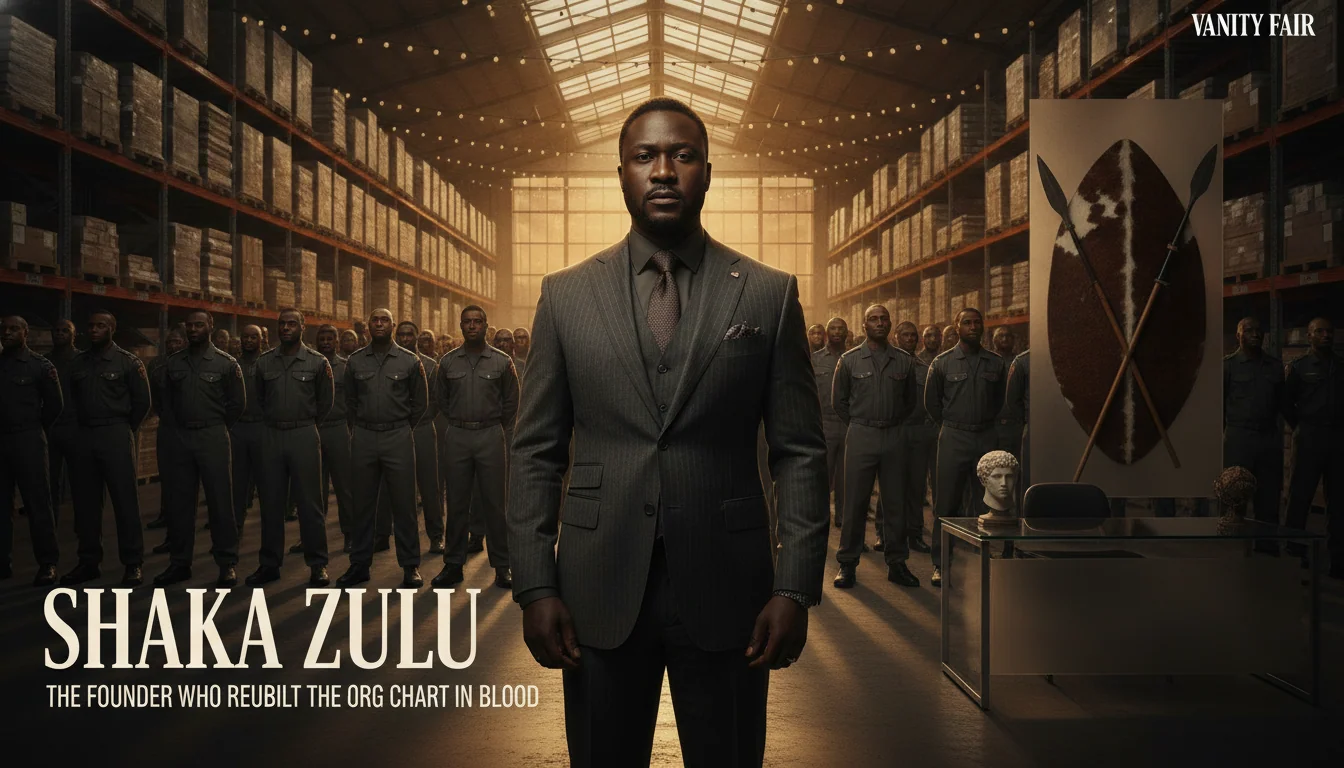
He was illegitimate, exiled from his father's household as a child, and mocked for it well into adulthood. He built his reputation somewhere else entirely, inside another organization's ranks, rising through discipline and results until the old regime back home collapsed and the top job became his almost by default. Then he took a loose, sprawling, clan-based operation with centuries of inherited habits and rebuilt it from the studs, discarding everything that did not serve total performance.
If Shaka Zulu lived today, in 2026, he would not run a kingdom. He would run the most feared and most studied company in his sector, and half the business press would still be arguing about whether he was a genius or a monster.
The historical figure
Shaka kaSenzangakhona was born around 1787, the product of a relationship his father's court considered improper, and his childhood was defined by exile and humiliation rather than privilege. He grew up largely among the Mthethwa, a more powerful neighboring chiefdom under Dingiswayo, and it was in Dingiswayo's military that Shaka built his real career, rising to command through proven battlefield skill rather than birthright. When his father Senzangakhona died around 1816, Shaka returned to claim the small Zulu chiefdom, and within roughly a decade transformed it into the dominant military power of the region.
What he built was not simply a bigger army. It was a different kind of organization. Shaka is credited with retiring the old practice of throwing spears from a distance in favor of the iklwa, a short stabbing weapon that forced combat to close, decisive range, and with reorganizing warriors into age-based regiments, the amabutho, that answered to the king directly rather than to individual clan chiefs. The buffalo-horns formation, a three-pronged encirclement with a "chest" to pin the enemy and two "horns" to envelop the flanks, became the doctrine that let disciplined, drilled units consistently beat larger but looser opposing forces. None of this was recorded by Shaka himself. He left no writing. Everything historians know comes from oral tradition passed down through generations and from the accounts of European traders who arrived at his court and had their own reasons to sensationalize what they saw.
The scale of what he assembled in roughly a decade is still striking by any measure. A minor chiefdom that could field a few hundred warriors under his father became, under his direct command, a kingdom capable of mobilizing tens of thousands of drilled soldiers, absorbing or displacing neighboring peoples across a wide swath of what is now KwaZulu-Natal. Rivals who resisted incorporation were defeated outright; those who submitted were folded into the amabutho system rather than left as tributary vassals, which is itself the more radical move. He was not building an empire of subjects. He was building one organization with a single chain of command, and that structural choice is what later historians point to when they call him a state-builder rather than merely a conqueror.
The modern role
In 2026, Shaka's title is founder and chief executive of a logistics and manufacturing group that started as a modest family supplier and, within about a decade of his taking over, became the dominant vertically integrated operator in its regional market. He did not inherit the position cleanly. He spent his early career at a larger competitor, learning the industry from inside a better-run machine, and returned to the family business only once its previous leadership had collapsed into irrelevance.
The rebuild was total. He discarded the loose network of semi-autonomous regional managers, each running their patch by old habit and personal loyalty, and replaced it with a single centralized command structure organized by performance cohort rather than tenure or family connection. Long-serving employees who could not keep pace were pushed out regardless of history with the company. New hires were drilled relentlessly on a standardized method, cutting equipment changeover time and turnaround speed to a fraction of what competitors could manage. Analysts who cover the sector describe the resulting operation, admiringly and warily in the same paragraph, as the most efficient and most ruthless supply chain in the industry.
The skills that translate
What made Shaka effective was total intolerance for anything that diluted performance: sentiment, seniority, inherited privilege, comfort. He measured people by results under pressure and moved instantly to remove anyone, however senior, who did not meet the standard. In 2026 that same instinct reads as an obsessive, founder-led operating culture, the kind that produces extraordinary growth curves and extraordinary attrition rates in the same set of quarterly numbers.
He is genuinely brilliant at reorganizing broken systems. Give him a division that has calcified around outdated habits and he will restructure it into something faster and harder within eighteen months. What he struggles with is anything that requires him to leave a functioning structure alone. Rivals who built empires through consolidation rather than constant upheaval, a management style closer to Cyrus the Great, tend to keep what they conquer longer than founders who run every division as a permanent state of restructuring.
The family
Shaka's mother, Nandi, was the one relationship that survived his rise intact, and by every account the bond was genuine rather than merely political. In 2026, she is the company's founding co-signer and Shaka's closest advisor, the person who backed him with capital and credibility when the rest of the family's old guard wanted nothing to do with him.
When she dies in 2026, in this version from a sudden illness rather than the pressures of court, Shaka's grief becomes company-wide policy. He suspends normal operations across every regional facility, mandates a company-wide period of extreme, visible mourning, and, according to former employees who later spoke to trade journalists, forces out senior staff who he judges did not display sufficient grief on camera during an internal memorial livestream. Board members privately call it the moment public sentiment about the company started to sour, even as revenue kept climbing.
What goes wrong
Shaka's actual downfall came from the people closest to him rather than any external rival. His half-brothers, sidelined and resentful for years, assassinated him in 1828 with the help of a trusted aide, and the kingdom passed to one of them almost immediately.
In 2026, the equivalent is a boardroom coup rather than a knife. Two co-founders, brothers by a different marriage of the family patriarch, who had spent years watching Shaka's methods erode morale and expose the company to regulatory scrutiny, quietly assemble a majority of shareholder support with the backing of a trusted chief operating officer Shaka had trusted completely. The vote is fast, procedurally clean, and total. Shaka is escorted out of the headquarters he built by security he personally hired. The company he built does not slow down. It simply changes hands.
The modern comparison
Shaka Zulu resembles the founder-CEO archetype the business press profiles every few years: the outsider who returns from exile inside a rival organization, tears down an inherited system that could not compete, and builds something faster and far more centralized in its place, at a human cost that gets litigated for decades afterward. Like Genghis Khan, he is remembered simultaneously as a nation-builder and as a source of enormous regional upheaval, and modern historians still argue about how much of that upheaval was truly his doing versus forces already in motion before he ever took command.
What makes him distinct from most founders is how little of his own account survives. Everything we know about Shaka comes from other people's records, some hostile, some awestruck, none entirely reliable. A modern Shaka would have a livestream, a personal brand team, and a documentary crew following his every move. The 19th-century Shaka had none of that, and the gap between the man and the myth has never fully closed.
Quick Answers
Common questions about this topic
Who was Shaka Zulu?
Shaka kaSenzangakhona, born around 1787, was the king who transformed a minor Zulu chiefdom into the dominant power in southern Africa. Raised in exile among the Mthethwa after his illegitimate birth made him an outcast at his father's court, he rose through Mthethwa's military ranks before taking control of the Zulu chiefdom around 1816, following his father's death. He ruled until his assassination in 1828, roughly twelve years in which he built the Zulu kingdom into a centralized military state.
What military reforms is Shaka credited with?
Shaka is credited with popularizing the iklwa, a short stabbing spear meant for close combat rather than throwing, and with organizing warriors into age-based regiments, called amabutho, that cut across old clan loyalties and answered directly to the king. He is also associated with the buffalo-horns formation, a three-part encirclement tactic, and with drilling warriors to a standard of discipline that older, looser clan levies could not match.
Did Shaka Zulu really cause the Mfecane?
Shaka's military expansion contributed to a period of widespread upheaval and displacement in southern Africa known as the Mfecane or Difaqane, but historians increasingly view this as only one factor among several, including drought, competition over trade routes to the Portuguese post at Delagoa Bay, and later pressure from Voortrekker migration. Attributing the entire upheaval to one king's ambition is now considered an oversimplification rooted partly in colonial-era sources with their own agendas.
How did Shaka Zulu die?
Shaka was assassinated in September 1828 by his half-brothers Dingane and Mhlangana, with the collaboration of an induna named Mbopa. Dingane succeeded him as king. Much of what is known about Shaka's reign, including its most extreme episodes, comes from oral tradition recorded later and from the writings of European traders like Henry Francis Fynn and Nathaniel Isaacs, whose reliability historians continue to debate.

Meet Them in Person
Chat with the historical figures behind these modern reimaginings.
Create your free account →No card required. Some figures and features require a paid plan.
Join the HistorIQly Club
Get smarter about the past.
Weekly stories, deep dives, and exclusive content straight to your inbox.