If Vlad the Impaler Lived Today: The Strongman Who Writes the Rules in Blood
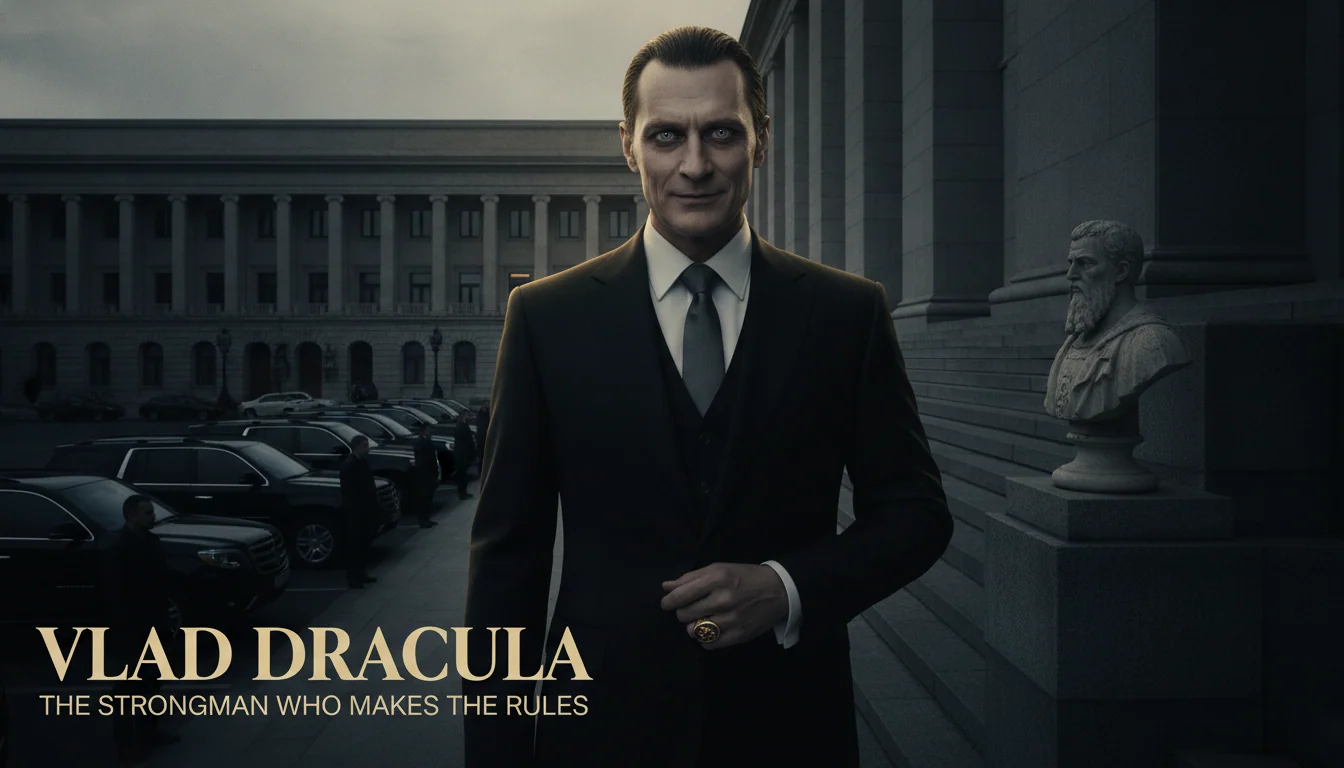
If Vlad the Impaler lived today, he would be a nationalist strongman ruling a small country between two great powers, governing by spectacle and fear.
He spent years as the political prisoner of a country that feared him, which is how he learned everything he needed to know about that country's weaknesses. When he came home, he was patient for exactly long enough to consolidate power. Then he was not patient at all.
Vlad III of Wallachia - called Dracula after his father's membership in the Order of the Dragon, called "the Impaler" by the German pamphlets that circulated horror stories about him across central Europe after his death - is one of the more misread figures in the history of European statecraft. He is remembered as a sadist. He was a sadist. He was also, within the context of a small principality crushed between the Ottoman Empire and the Kingdom of Hungary, one of the most effective practitioners of deterrence as explicit government policy that the 15th century produced. These two things are not in tension. They are the same thing.
The historical figure
Vlad III was born around 1428 or 1431 in Sighisoara, in Transylvania, the second son of Vlad II Dracul - a knight of the Order of the Dragon and Prince of Wallachia. Wallachia occupied the position between powerful neighbors that has defined Romanian history for centuries: too strategically important to ignore, too small to fight its way to safety. Vlad's father navigated this position by playing Hungary and the Ottoman Empire against each other, a strategy that required constant recalibration and produced, eventually, his assassination by Wallachian boyars who preferred a different political alignment.
Around 1442, Vlad and his younger brother Radu were sent to the Ottoman court as hostages, guarantors of their father's loyalty. They remained in Ottoman custody for several years. Radu became a favorite of the court, eventually converted to Islam, fought for the Ottomans, and was later installed as Prince of Wallachia as an Ottoman client. Vlad did not convert. He learned. He acquired fluency in Turkish, absorbed the internal dynamics of the Ottoman court, identified who held real power and who held ceremonial power, and mapped the empire's logistical constraints in distant operations. He also encountered impalement as an Ottoman form of punishment during this period and filed it carefully away.
His main reign as Prince of Wallachia lasted from 1456 to 1462. In six years he consolidated power by executing the boyar families responsible for his father's and brother's deaths, established internal loyalty through systematic terror, raided into Transylvania against Saxon merchants he accused of illegal trade, and launched military operations against Ottoman forces along the Danube.
In the winter of 1461 to 1462, when Sultan Mehmed II assembled a force to remove him, Vlad responded with a campaign of scorched-earth devastation and then, as the Ottoman army approached Targoviste, with what became the most-described single act of his career. He arranged thousands of impaled bodies - Ottoman prisoners and those he considered insufficiently loyal - in a display outside the capital. Mehmed II's court historian recorded that the sultan, surveying the scene, withdrew without engaging. Even Mehmed, the man who had taken Constantinople at age twenty-one, found the psychological statement sufficient.
Vlad's own army then unraveled through plague, desertion, and the defection of boyars who preferred the Ottoman-backed alternative: his brother Radu. Vlad fled to Transylvania. Matthias Corvinus of Hungary imprisoned him, for reasons that remain historically disputed, until the mid-1470s. He was released, converted nominally to Catholicism, married into a Hungarian noble family, and was briefly reinstated as Prince of Wallachia in late 1476. He died the same year, killed in battle or by assassination near Bucharest. His head was reportedly sent to Constantinople.
The modern role
Drop him into 2026 and the title on the office door reads: President of the Republic. Not prime minister - that is a position for people willing to negotiate with parliaments. President of a small Eastern European country with a NATO border to the west and a hostile great power to the east: a position that requires someone willing to make threats nobody else believes they would carry out, and then carry them out.
He came from a family with a history in politics - a father who tried to balance between blocs and was destroyed by his own side for it. He himself spent years in a neighboring country's detention system, jailed on corruption charges that everyone in the region understands were fabricated by a government that considered him a destabilizing threat. He speaks the language of the neighboring great power fluently, having learned it during those years. He uses this to read their diplomatic communications and internal factions with an intuition that professional intelligence analysts find unsettling.
His method of consolidating power after returning from imprisonment follows the original closely. He identifies the oligarchs and political families who collaborated with his detention, documents their corruption - which is genuine and not difficult to find, because corruption is universal in his country - and removes them from public life in a sequence that is legally defensible in the sense that the charges are real, but is also, unmistakably, a purge. Several of those removed subsequently have accidents. Nobody investigates very thoroughly.
The skills that translate
Psychological deterrence through visible demonstration. The forest of the impaled is the defining image of Vlad's career because it worked. Arranging thousands of impaled bodies outside the capital was not punishment - the men were already dying - it was a calculated message directed at Mehmed II: the cost of taking this country exceeds its value. The modern Vlad runs the same calculation. His border enforcement operations are documented and released in footage that circulates without official announcement. The footage is not an accident. It is the message.
Exploitation of insider knowledge. Years in the Ottoman court gave Vlad a fluency in his enemy's decision-making that no intelligence report could match. The modern version's years in a neighboring country's prison system produced the same education. He knows how the great power's internal politics work, which faction is ascendant, and which moves will create enough internal disagreement to slow their response time. He exploits this with precision that feels personal because it is personal.
Absolute distrust of loyalty based on interest. The boyars who murdered his father did so because a different patron served their interests better. Vlad spent his reign making that calculation too expensive to repeat. The modern version does not build coalition governments. He builds dependency structures - personal loyalties enforced by the knowledge that defection carries consequences that the justice system, in his country, will not moderate.
The family
He has two children, and he controls their public exposure with the attention of a man who grew up understanding that children can be used as hostages. They are not available for media profiles. His wife, from a family respectable enough to satisfy domestic audiences but never prominent enough to have independent leverage over him, does not give interviews. The marriage is functional. He has not allowed the alternative.
The contemporary peer
The closest single comparison in recent political history is Rodrigo Duterte of the Philippines for the use of extrajudicial deterrence as explicit, openly stated government policy. The geopolitical small-country-between-great-powers posture is closer to Viktor Orban or to other Eastern European leaders who have chosen assertive nationalism over accommodation. But neither comparison captures the specific quality that distinguishes the modern Vlad from any recent politician: the man who was physically held by the great power he resists, who learned its internal weaknesses from inside, and who came back with that knowledge as his primary weapon.
What goes wrong
The same thing that went wrong in 1462. The great power he is resisting backs a more pliable alternative - someone within his own country who has calculated that accommodation is more rational than resistance and who promises neighboring powers what they actually want: a cooperative and predictable buffer state rather than a porcupine with a long memory.
The modern Vlad is outmaneuvered not militarily but diplomatically and financially. His coalition, held together by fear and necessity rather than shared interest, begins to recalculate when the external pressure becomes sustained enough. His former allies discover that he is expensive to support. The international community, which had been perpetually appalled by his methods but perpetually in need of his cooperation, discovers that it can live without him.
He does not go quietly. But he goes. The mistake is the same one he made in 1462: he overestimates the permanence of the loyalty his methods have purchased, and underestimates the patience of the adversary he has spent years humiliating.
Why it matters
Vlad the Impaler is remembered as a monster, and the German pamphlets that documented his methods through the 1460s and 1470s were not wrong about the facts, only about the frame. The frame they chose was horror. The frame he was operating in was the survival of a principality with no natural allies, sitting on the invasion route between two empires, whose previous rulers had all been killed or co-opted by one side or the other.
A small country between great powers does not typically get the luxury of proportionate responses. The leaders who survive in that position tend to be, by the standards of more comfortable places, excessive. The ones who are not excessive tend to end up like Vlad's brother Radu: converted, installed by a foreign power, and then quietly forgotten.
If Vlad the Impaler lived today, the question he would pose to the world is the same one he posed in 1462: how much is autonomy worth, and who exactly is paying for it? In Wallachia the answer was measurable in impaled bodies and a legacy that outlasted the country that produced it. In the modern version, the answer is still being negotiated, by people in offices with no windows who are trying very hard not to end up on the wrong side of someone who spent years in a cell learning their weaknesses. For comparable historical strongmen reimagined in the present day, read our portraits of If Attila the Hun Lived Today and If Genghis Khan Lived Today.
Quick Answers
Common questions about this topic
Who was Vlad the Impaler historically?
Vlad III (c. 1428-1476), Prince of Wallachia, was the ruler of a small principality between the Ottoman Empire and the Kingdom of Hungary. He is remembered for using impalement as a systematic tool of deterrence against enemies, Ottoman forces, disloyal boyars, and Saxon merchants. He ruled three separate times, the longest reign lasting from 1456 to 1462, and died in battle or by assassination in late 1476.
Why is Vlad called Dracula?
The name Dracula comes from his father, Vlad II Dracul, who was a member of the Order of the Dragon. 'Dracul' means dragon in Romanian, and 'Dracula' means 'son of the Dragon.' Bram Stoker borrowed the name for his 1897 novel but invented his Count Dracula character independently of the historical Vlad. The two share a name and a Transylvanian setting and little else.
Was Vlad the Impaler considered a hero in Romania?
Yes. In Romanian historical tradition, Vlad III is primarily remembered as a defender of Wallachia against Ottoman domination and as a ruler who imposed order on a fractured principality through extreme but, by the standards of his supporters, necessary measures. The 'monster' image comes mainly from German pamphlets and Ottoman chronicles, both of which were produced by his enemies.
What modern leader is most similar to Vlad the Impaler?
No single modern leader fully maps onto Vlad, but the combination of elements most recognizable in recent political history is the explicit use of deterrence through visible and extreme punishment (closest to Rodrigo Duterte of the Philippines) combined with the small-country-between-great-powers geopolitical position (comparable to Viktor Orban's Hungary or similar Eastern European contexts). Vlad's specific quality - the man who was a captive of a great power and came back with its playbook - has no precise modern equivalent.

Meet Them in Person
Chat with the historical figures behind these modern reimaginings.
Start the ConversationJoin the HistorIQly Club
Get smarter about the past.
Weekly stories, deep dives, and exclusive content straight to your inbox.