1917 vs. History: How Accurate Is Sam Mendes's WWI Masterpiece?
Examining 1917 historical accuracy: the real German retreat, message runners, and the personal story behind Sam Mendes's acclaimed WWI epic.
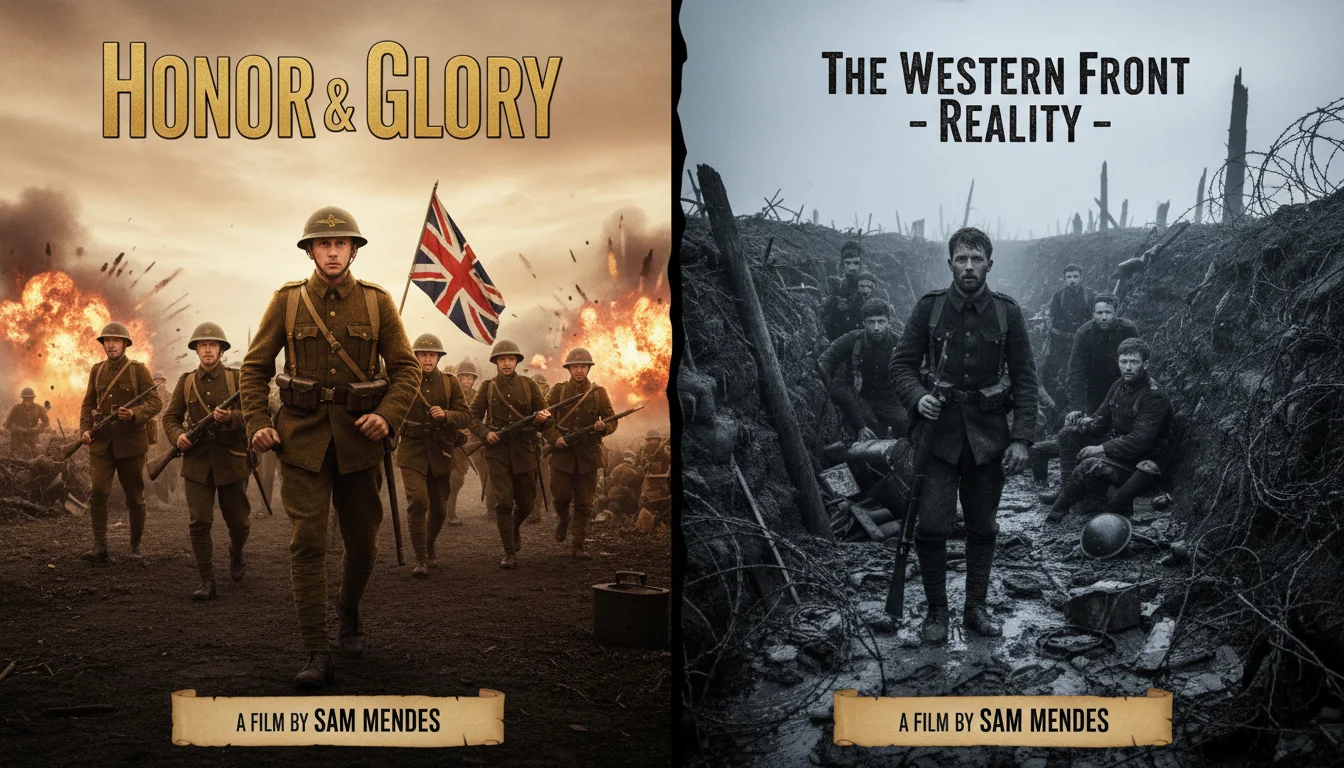
Sam Mendes's 1917 arrived in theaters with a gimmick that could have felt like a gimmick - the entire film appears to unfold in one continuous shot. But within minutes, that technique stops feeling like a trick and starts feeling like a trap. You are stuck in those trenches. You are crossing that hellscape. You cannot look away or cut to safety.
The film follows Lance Corporals Blake and Schofield as they race against time to deliver a message that could save 1,600 soldiers from walking into a German ambush. It won Golden Globes, earned ten Oscar nominations, and made audiences feel, perhaps for the first time, the claustrophobic terror of trench warfare. But how much of this harrowing journey actually happened?
What Hollywood Got RIGHT
The German Strategic Withdrawal Was Real
In early 1917, the Germans really did execute a massive retreat that baffled Allied commanders. Operation Alberich saw them pull back to the Hindenburg Line - a heavily fortified defensive position - essentially moving 42 miles of their Western Front overnight. As portrayed in the film, this created genuine confusion. British generals could not agree whether the Germans had fled in defeat or were setting a trap. "Everyone was disagreeing," Mendes noted in interviews. That uncertainty - the feeling that you might find empty trenches or thousands of pointed rifles - captures reality perfectly.
The Scorched Earth Tactics
Those devastated landscapes in the film - the charred trees, poisoned wells, demolished bridges - were not artistic license. The Germans systematically destroyed anything useful as they retreated. They burned towns, felled trees across roads, removed civilians, and left behind booby traps and snipers. The trip-wire explosion that nearly kills Schofield in the abandoned German bunker reflects documented German tactics designed to slow any Allied pursuit.
Messages Had to Be Hand-Delivered
With telephone lines cut and telegraph cables severed, the only reliable way to communicate across the front was to send a human being running through hell. Mendes drew directly from his grandfather Alfred Mendes's experiences. Alfred was small and fast - only five and a half feet tall - and the brass would send him carrying messages because the mist in No Man's Land hung at about six feet, keeping him invisible. That image of a teenager sprinting through fog while death whistled overhead is not Hollywood invention.
The Mud, Rats, and Horror
The physical conditions shown - soldiers picking through corpse-filled water, rats feasting on the dead, trenches collapsing into muddy graves - all draw from historical accounts. Alfred Mendes described the Ypres Salient as "a marsh of mud and a killer of men." The production team consulted extensively with historians to recreate the texture of trench warfare, and it shows in every frame.
The Emotional Truth of Exhaustion
Schofield is a Somme veteran who traded his medal for a bottle of wine. That detail captures something rarely shown: the profound weariness of soldiers who had already survived unimaginable carnage and knew they would be asked to do it again. The Battle of the Somme killed over a million men in 1916. Anyone still standing by April 1917 had earned their cynicism.
What Hollywood Got WRONG
The Timeline Gets Scrambled
Here is where it gets complicated. The film is set on April 6, 1917, during the aftermath of the German retreat. But the mission that inspired it - Alfred Mendes's famous message run - actually happened in October 1917, during the Third Battle of Ypres, in a completely different location. Alfred earned his Military Medal at Passchendaele, not near the Hindenburg Line. Mendes essentially took a story from autumn in Belgium and relocated it to spring in France.
That Particular Battle Did Not Exist
The fictional Colonel Mackenzie is about to lead his battalion into an ambush near the villages of Croisilles and Ecoust. While the broader situation - miscommunication leading to potential disaster - happened repeatedly throughout the war, this specific attack is invented. The real Battle of Poelcappelle and the First Battle of Passchendaele (both in late 1917) did involve tragic miscommunication, but they unfolded quite differently.
Two Men Would Not Have Been Sent
Military historians have noted that sending only two soldiers on such a critical mission strains credulity. In reality, multiple messengers would have been dispatched by different routes to ensure at least one got through. The two-man journey makes for better cinema but worse tactics.
The "One Day" Compression
The actual experiences that inspired the film happened over Alfred Mendes's entire service - two years with the 1st Rifle Brigade. His famous mission at Passchendaele took an entire day of "wandering around in circles in No Man's Land" under sniper and machine gun fire, but it was not a race against a dawn deadline. The ticking clock is pure Hollywood tension.
The Clean German Trenches
When Blake and Schofield enter the abandoned German positions, they find relatively organized, almost opulent bunkers compared to the British squalor. While German engineering was indeed superior (they built deeper, better-reinforced positions), the contrast in the film is somewhat exaggerated for dramatic effect.
The Verdict
Here is what makes 1917 fascinating: it is both less and more true than you might think. The specific events - two corporals racing to stop an attack on April 6, 1917 - never happened. But the emotional and physical reality of what these men endured absolutely did.
Alfred Mendes truly ran through No Man's Land carrying messages. He truly found scattered companies amid shell holes while snipers hunted him. He truly watched friends die in the mud. The Military Medal citation praised his "coolness and complete disregard for his personal safety" - words that could describe any scene George MacKay performs.
Mendes took his grandfather's fragmented stories and transformed them into something cinematically coherent. In doing so, he moved events, compressed timelines, and invented specifics. But he preserved the essential truth: that impossibly young men were asked to do impossibly brave things, and some of them somehow survived.
The film's greatest historical achievement might be making viewers feel what the Western Front Association calls "the vast sea of malignant mud" that swallowed so many. You cannot watch 1917 and emerge unchanged. That is its own kind of accuracy.
1917 Historical Accuracy Score: 7/10
The specific mission is fiction, but the world it depicts - the retreat, the traps, the mud, the messages carried by running boys - is painfully real. What Mendes sacrificed in literal accuracy, he gained in emotional truth.
For more WWI film accuracy, see our All Quiet on the Western Front (2022) breakdown. For WWII comparisons, our Saving Private Ryan vs. history examines a similar single-mission structure.
Quick Answers
Common questions about this topic
Is 1917 based on a true story?
1917 was inspired by director Sam Mendes's grandfather Alfred Mendes, who carried messages through No Man's Land during WWI. However, the specific mission depicted in the film (two corporals delivering a message on April 6, 1917) never happened. Alfred's actual famous message run occurred in October 1917 at Passchendaele in Belgium, not near the Hindenburg Line in France.
Did the Germans really retreat in 1917?
Yes. Operation Alberich was a massive German strategic withdrawal in early 1917, where they pulled back to the Hindenburg Line, giving up 42 miles of the Western Front. The retreat created genuine confusion among British generals about whether the Germans had fled in defeat or were setting a trap, exactly as the film portrays.
Were messages really hand-delivered across the Western Front?
Yes. With telephone lines cut and telegraph cables severed, soldiers were sent running through No Man's Land to deliver orders. Alfred Mendes was chosen for such missions in part because he was only five and a half feet tall, allowing him to stay hidden under the six-foot mist while sprinting through hostile territory.
What's historically inaccurate about 1917?
The specific battle near Croisilles and Ecoust is invented, and sending only two soldiers on a critical mission strains credibility - multiple messengers would have been dispatched by different routes in reality. The film also compresses experiences from Alfred's entire two-year service into a single day with a ticking clock, which is pure Hollywood tension.

Debate the Accuracy with the Real Figures
Ask the real people what Hollywood got wrong about their lives.
Chat with HistoryJoin the HistorIQly Club
Get smarter about the past.
Weekly stories, deep dives, and exclusive content straight to your inbox.