The Antikythera Mechanism: The 2,000 Year Old Computer Found in a Shipwreck
A corroded lump from a Greek shipwreck turned out to be a geared machine that predicted eclipses. Here is how the Antikythera Mechanism worked.
Read Wikipedia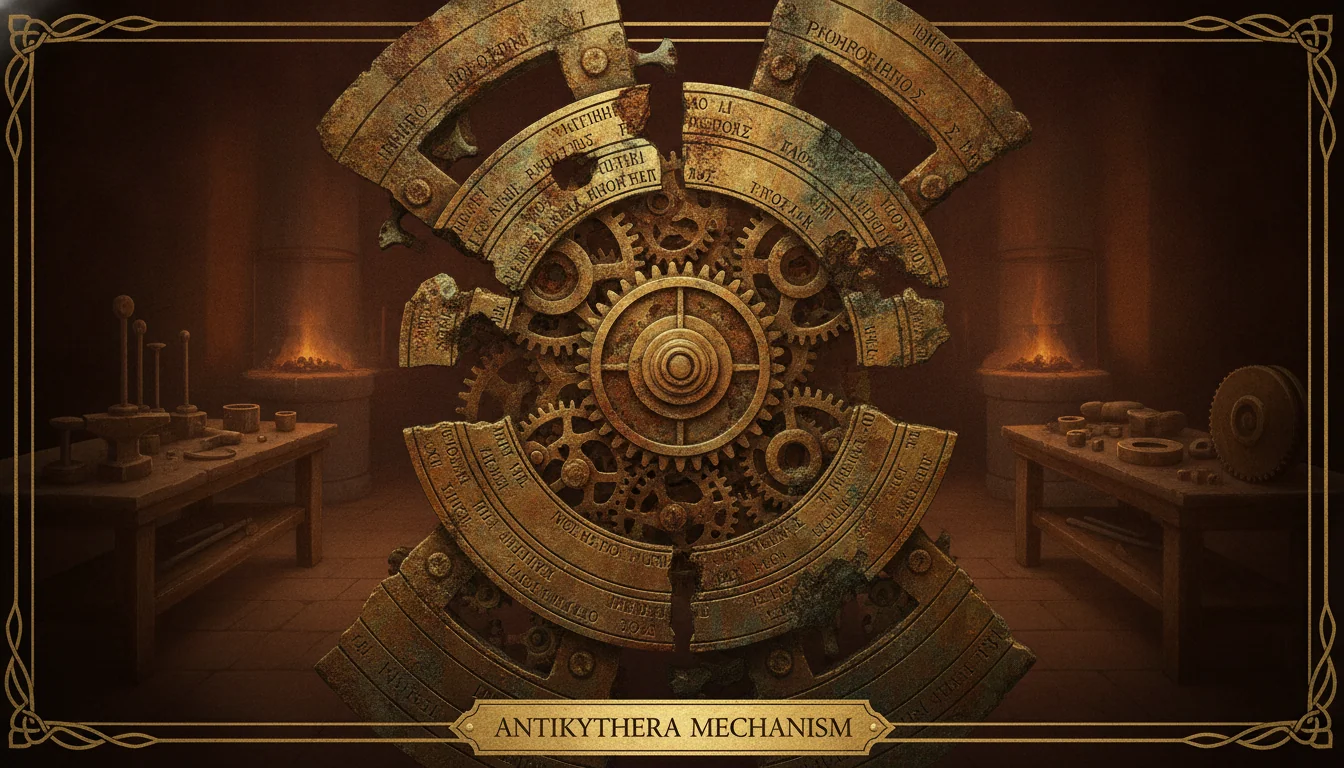
In 1900, a crew of Greek sponge divers sheltering from a storm off the tiny island of Antikythera found a Roman-era shipwreck scattered across the seabed, its cargo of bronze and marble statues still recognizable after roughly two thousand years underwater. Tangled among the more obviously valuable pieces was a corroded, unglamorous lump of bronze, about the size of a large book. It took archaeologists a couple of years to notice it was full of gear teeth, and it took most of a century after that to understand what those gears actually did. What emerged from the corrosion was a geared machine that modeled the sun, the moon, and the arithmetic the Greeks used to predict eclipses, built by people who had no business, according to the history books, having anything like it.
A lump that turned out to be a machine
The wreck itself was already a spectacular find, a cargo ship apparently carrying looted or purchased Greek luxury goods toward Rome, dated by its pottery and coins to somewhere in the first century BC. Divers and later Greek navy salvage crews brought up bronze and marble sculpture, glassware, jewelry, and furniture fittings. The bronze lump barely registered next to a shipload of statuary.
That changed when it split apart in storage, revealing a cross-section of gear wheels stacked behind a corroded front plate. An archaeologist at the National Archaeological Museum in Athens recognized the fragments as some kind of geared instrument within a couple of years of the recovery, but the case for what it actually was took decades to build. The mechanism sat mostly as a curiosity until the physicist and historian of science Derek de Solla Price began serious study in the 1950s and 1960s, eventually using early X-ray and gamma-ray imaging to peer through the corrosion without destroying the fragments. His 1974 study argued that the device was a calendar computer of a sophistication nobody expected from the ancient world, and effectively opened the field that continues today.
The heavens in a box
The mechanism arrived on that ship as a wooden case, roughly the size of a mantel clock, with bronze dial faces front and back and a hand crank on the side. Turning the crank drove an input gear connected to a train of at least 30 surviving bronze gears, cut with hand-filed triangular teeth, some of them just a few centimeters across. Researchers who have modeled the full gear train believe the complete mechanism held around 37 gears, most now lost or too fragmentary to read.
The front dial displayed a zodiac ring and an Egyptian 365-day calendar ring, with pointers tracking the position of the sun and moon against the stars, plus a small rotating ball, dark on one side, that turned to show the moon's current phase. The genuinely clever part sat in a two-gear assembly known as a pin-and-slot mechanism: one gear is mounted slightly off-center from the other, and a pin riding in a slot forces the second gear to speed up and slow down as it turns, once per revolution. That varying speed reproduces the moon's real motion, which appears to move faster and slower across the sky because its orbit is not a perfect circle. It is a mechanical encoding of a piece of Greek astronomical theory associated with the astronomer Hipparchus, translated directly into moving bronze.
The back of the case carried two large spiral dials, each wound through multiple turns to fit a long cycle onto a compact face. The upper spiral tracked the Metonic cycle, the 19-year period after which the phases of the moon repeat on the same calendar dates, with a small subsidiary dial refining it further against the 76-year Callippic cycle. The lower spiral tracked the Saros cycle, 223 lunar months, after which the sun, moon, and Earth return to a near-identical arrangement and eclipses recur in roughly the same pattern. A subsidiary dial there tracked the Exeligmos, a triple Saros correction accounting for a leftover third of a day, which let the mechanism's user push a prediction not just to the right eclipse but roughly the right time of day. A separate small dial, cross-referenced by inscriptions, tracked a four-year cycle keyed to the Panhellenic games, including the festival at Olympia, letting an owner read off which games year the calendar had reached. This was not a symbolic gesture toward astronomy. It was a functioning calculator, built to answer specific calendrical questions with a crank turn instead of a lookup table.
Who built it, and why
No signature survives on any fragment. What does survive is text: thousands of characters of tiny inscribed Greek covering the covers and internal plates, apparently functioning as a user's manual describing what each dial showed and how to read it. Analysis of the lettering style has led some researchers toward a Corinthian-derived dialect, which has in turn fed speculation, never proven, about a connection to Syracuse, the Sicilian city that was home to Archimedes, or to the island of Rhodes, a genuine center of Hellenistic astronomy where the astronomer Hipparchus is thought to have worked.
That guesswork exists because the ancient world's writers tell us devices like this existed even when no others survive. The Roman writer Cicero, writing in the century or so after devices of this kind are thought to have been built, described bronze instruments attributed to Archimedes that modeled the movements of the sun, moon, and planets, and were said to have been carried off from Syracuse as war trophies. The Antikythera Mechanism is almost certainly not one of those specific objects, but it is very likely a product of the same broad tradition: a fusion of precision Hellenistic bronze-working with the mathematical astronomy that Greek scholars had spent generations refining. Someone commissioned it, whether an astronomer, a wealthy patron, or a temple, to turn abstract calendar mathematics into something you could hold, crank, and read at a glance.
The technology that vanished
Here is the genuinely strange part. Nothing else like it has ever been found. Not a fragment, not a sketch, not a workshop, in over a century of Mediterranean archaeology. That absence is itself evidence. It suggests these were not mass-produced instruments moving through ordinary trade networks but rare, expensive, custom commissions, each one dependent on a narrow circle of makers who understood both fine metalwork and advanced astronomy at once. Other singular ancient objects share that same isolated status in the record, like the color-shifting glass of the Lycurgus Cup, a technique that appears once and is never seen again.
Knowledge concentrated that narrowly is fragile. As the independent Hellenistic Greek kingdoms were absorbed one by one into the Roman world through conquest, workshops closed, patrons died, and the specific combination of skills behind a machine like this had no obvious path to the next generation. Roman civilization borrowed enormously from Greek science and philosophy, but the tradition of engineering complex astronomical gear trains for their own sake does not resurface in the archaeological or textual record for well over a thousand years, not until geared astronomical instruments and mechanical clocks began appearing in the medieval Islamic world and then in Europe. The gap is not because nobody in between was clever. It is because a specific, hard-won body of applied craft knowledge simply broke off and was not passed down.
Reading the fragments
Modern understanding of the mechanism owes almost everything to imaging technology the ship's builders could never have imagined. Price's early X-ray work in the 1970s established that gears existed inside the corrosion. Decades later, a research collaboration built a custom industrial CT scanner, reportedly weighing several tons, specifically to capture three-dimensional X-ray data of the fragments without touching them, alongside surface-imaging techniques that could pick out faint inscribed letters invisible to the naked eye. That imaging campaign in the 2000s, published starting in 2006, sharply increased the amount of readable inscription and confirmed the gear counts and dial functions in far more detail than Price had been able to establish.
Since then, several teams have built full physical or digital reconstructions that turn and track the Metonic, Callippic, Saros, and Exeligmos cycles as the inscriptions describe, proving the underlying design actually works as a calendar and eclipse predictor rather than merely looking plausible. What remains genuinely unresolved is the front of the case, where evidence for planetary displays, dials for the visible planets known to Greek astronomy, survives only as scattered gear fragments and a few tantalizing inscriptions. Researchers have proposed competing gear trains that would fit the surviving evidence, and some are ingenious, but none can be confirmed against fragments that no longer exist. On that question, honestly, we are still guessing, just with better tools than the sponge divers had.
Echoes
The Antikythera Mechanism did not stay lost through some grand conspiracy or forgotten secret. It got unlucky, in the way that most ancient technology gets unlucky: a workshop tradition too narrow to survive its makers, a shipwreck that buried the one surviving example deep in the cold water off Antikythera, and a century of scholars needing to invent new imaging tools before the bronze would give up what it recorded. What it left behind is a plain reminder that Hellenistic engineers were doing real, working mechanical computation with real ratios and real gears, centuries before anyone assumed the idea was possible. People built this. Understanding exactly how remains one of the more satisfying detective stories in archaeology, precisely because most of the case has already been solved.
Quick Answers
Common questions about this topic
How did the Antikythera Mechanism actually work?
A hand-cranked input gear turned a train of at least 30 bronze gears that modeled the motion of the sun and moon against the zodiac. A pin-and-slot gear pair reproduced the moon's uneven speed across the sky, while spiral dials on the back tracked the 19-year Metonic calendar cycle and the 223-month Saros cycle used to predict eclipses.
Who built the Antikythera Mechanism?
No maker's name survives. The Greek inscriptions covering the mechanism use lettering that some researchers connect to a Corinthian-derived dialect, which has fed speculation about a link to Syracuse, Archimedes' home city, or the astronomical school on Rhodes. The device was almost certainly the product of a Hellenistic workshop skilled in both fine bronze work and advanced mathematical astronomy.
Why was this technology lost?
No second example has ever been found, suggesting these machines were rare, expensive, one-off commissions rather than mass-produced instruments. As the Hellenistic Greek world was absorbed into Rome, the specific workshop tradition behind the mechanism appears to have died with its makers rather than spreading, and nothing of comparable gearing complexity appears again for over a thousand years.
Can we build a working replica of the Antikythera Mechanism today?
Yes, several full physical reconstructions have been built since the 2000s, based on X-ray CT scans of the fragments, and they successfully turn and track the cycles described in the inscriptions. What remains uncertain is the exact gear train for the mechanism's lost planetary displays, since too little of the front dial survives to confirm any single reconstruction.

Meet the Ancient Engineers
Chat with the inventors who built the impossible centuries early.
Create your free account →No card required. Some figures and features require a paid plan.
Join the HistorIQly Club
Get smarter about the past.
Weekly stories, deep dives, and exclusive content straight to your inbox.