The Lycurgus Cup: How Rome Accidentally Invented Nanotechnology
The Lycurgus Cup is a 1,600-year-old Roman glass that changes color with the light. Scientists only worked out why in 1990: metal particles smaller than a virus.
Read Wikipedia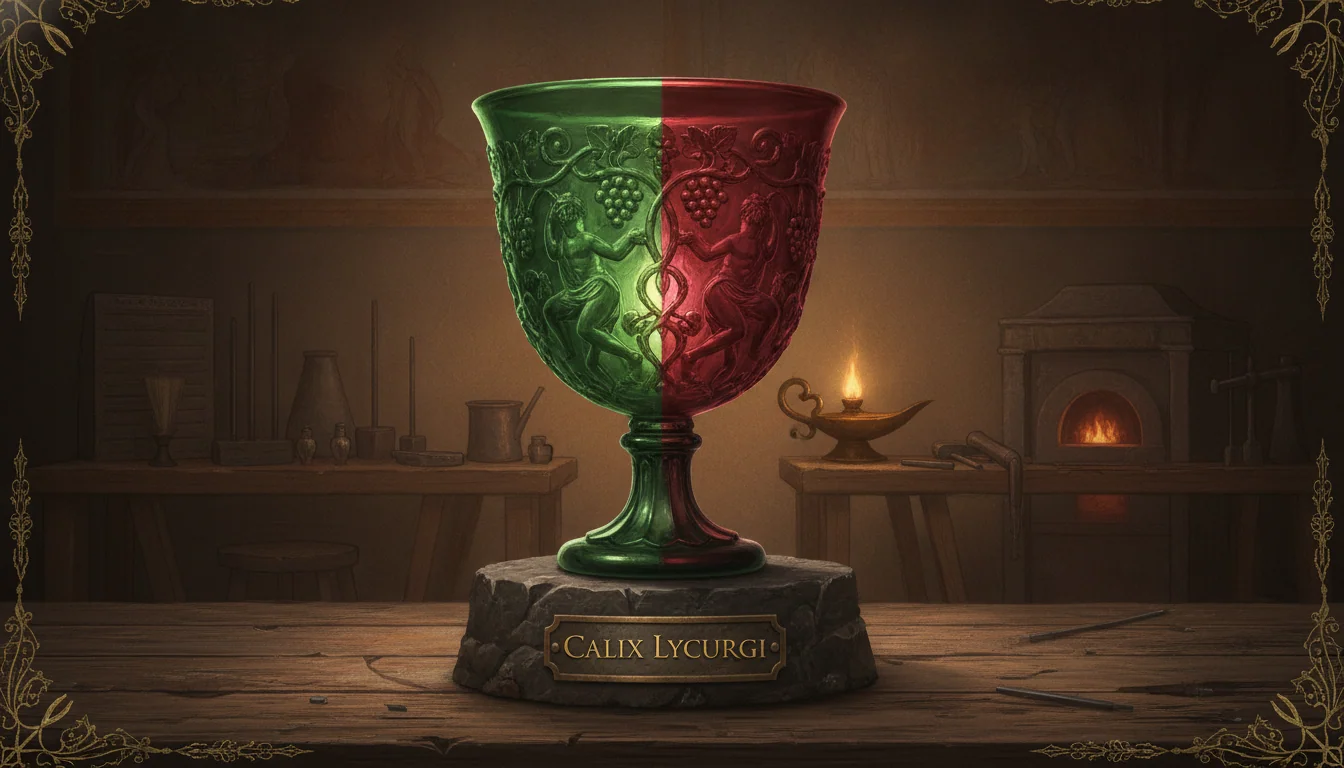
Look at the Lycurgus Cup in ordinary daylight and it is a handsome, slightly eerie shade of jade green, an elaborately carved Roman glass vessel depicting the mythical King Lycurgus being strangled by vines. Shine a light through it from behind, and the same cup turns a deep, glowing ruby red, as if it has switched materials entirely. Roman craftsmen achieved this effect in the 4th century AD with no instruments finer than a furnace and a steady hand. Scientists did not fully explain how until 1990, and the answer, when it came, was that the cup is laced with metal particles so small that measuring them requires an electron microscope.
The impossible object
The Lycurgus Cup, held today by the British Museum, is the only complete surviving example of a Roman "cage cup," a type of luxury glass vessel cut so that an outer decorative lattice, in this case a scene of Lycurgus entangled and killed by grapevines sent by the god Dionysus, stands almost free of the inner cup, connected by narrow glass bridges, an extraordinarily difficult and failure-prone carving technique in its own right. Fragments of other dichroic Roman glass, meaning glass that shows two different colors depending on the lighting, have turned up at sites across the former empire, but none survive intact and elaborately worked the way the Lycurgus Cup does.
What stunned the researchers who eventually studied it closely was not just the color-change effect itself, which had been noted for a long time, but the mechanism behind it. Dichroic effects in glass were known to result from trace metal content, but the Lycurgus Cup's transformation, from an opaque jade green in reflected light to a glowing, almost translucent ruby red in transmitted light, was more dramatic than anything ordinary metal-oxide coloring could explain. For decades, the cup was treated as a beautiful curiosity rather than a puzzle with a precise chemical answer.
How it worked
The answer came from a research team, led by scientists including Ian Freestone at the British Museum, who in 1990 examined broken fragments of the glass under an electron microscope, since analyzing intact cups nondestructively at that resolution was not yet possible and no one was going to cut into the only surviving complete example. What they found was that the glass contains tiny particles of a gold-silver alloy, roughly 50 to 100 nanometers in diameter, a scale so small that a single human hair is roughly a thousand times wider, dispersed throughout the glass matrix in concentrations of only a few parts per million.
At that particle size, gold and silver do not behave the way they do in bulk metal. Free electrons on the surface of nanoparticles that small oscillate collectively when struck by light, a phenomenon known as surface plasmon resonance, and the specific wavelengths of light absorbed or scattered by that oscillation depend sensitively on the particle's size, shape, and the metal alloy's exact composition. In the Lycurgus Cup, that resonance causes the glass to scatter green wavelengths of light back toward a viewer when the light source is in front of the cup, which is why it looks jade green in ordinary room lighting. But when light shines through the glass from behind, the same nanoparticles instead let red wavelengths pass through while absorbing much of the green, producing the glowing ruby transmission color. It is the same physical principle, at a much larger and less precisely tuned scale, that today lets researchers design nanoparticle-based sensors that change color in response to their environment, including some experimental tests for detecting substances like the presence of certain fluids in packaging.
Who built it, and why
There is no surviving signature or historical record naming the maker of the Lycurgus Cup, but the leading scholarly interpretation, based on stylistic comparison with other dated Roman luxury glass, places its manufacture in the 4th century AD, with Alexandria in Roman Egypt considered the most likely production center given the city's reputation as the empire's preeminent glassworking hub. Alexandria had inherited and built on a long Hellenistic tradition of glass artistry, and Roman-era Alexandrian workshops were already known for elaborate cut and colored glass exported across the Mediterranean to wealthy buyers.
The problem this technique solved was not functional but purely a display of extraordinary craftsmanship and wealth. Cage cups of any kind were luxury commissions, requiring a glassworker to blow or cast a thick-walled vessel and then painstakingly grind and cut away the outer layer, leaving a decorative lattice connected to the inner cup by only a few slender glass struts, a process with an extremely high failure rate even without the added complication of color-changing metal doping. A cup capable of appearing to change its fundamental color depending on how it was lit would have been, to a wealthy 4th-century Roman buyer, close to magical, evidence of both technical mastery and access to the rare and costly gold and silver needed to dope the glass in the first place, since even trace quantities of precious metal added real cost to an already expensive commission. Some scholars have suggested the cup may have functioned as a wine vessel used in the cult of Dionysus, whose mythology it depicts, with the color shift serving a ritual or symbolic purpose tied to wine's own transformation, though this remains an interpretation rather than a documented fact.
How it was lost
The dichroic glass technique was never formally banned or suppressed; it simply seems to have been an extraordinarily rare and difficult specialty even at its height, likely known to only a small number of master glassworkers who guarded the specifics of their metal-doping recipes as trade secrets, in an era with no chemical notation or standardized measurement to write such a recipe down precisely even if a workshop had wanted to share it. As the western Roman Empire fragmented in the 5th century and its long-distance trade networks and luxury economy contracted sharply, the market for extraordinarily expensive, failure-prone luxury commissions like cage cups collapsed along with it, and whatever oral or workshop-based knowledge of the precise gold-silver doping ratio existed appears to have died with the glassworkers who held it. No later medieval or Byzantine glass tradition reproduced the effect at anything like the same sophistication, suggesting the technique was never widely transmitted even within the late Roman world, let alone passed down afterward.
Rediscovery and the honest state of replication
The Lycurgus Cup itself survived by accident of preservation rather than continuous appreciation, passing through various European collections with its color-changing properties noted but not scientifically explained, until the British Museum acquired it in 1958. The 1990 electron microscope analysis of broken fragments finally supplied the mechanism, connecting a centuries-old decorative object to modern plasmonic nanoparticle science, a field that did not otherwise exist until the late 20th century.
Today, materials scientists can deliberately manufacture gold and silver nanoparticles of a controlled size and shape, applying the same surface plasmon resonance principle the Roman glassworkers stumbled into empirically, in applications ranging from experimental diagnostic sensors to specialized optical coatings. What no modern workshop has fully reproduced is the original object itself: a single cast glass vessel doped with the precise nanoparticle recipe and then cut into an elaborate free-standing cage design, a combination of chemistry and glasswork craftsmanship that took Roman artisans generations of accumulated trial and error to achieve and that no surviving text explains step by step. The wonder of the Lycurgus Cup is not that ancient people stumbled onto something beyond human capability. It is that a workshop of skilled Roman glassworkers, without any concept of atoms, wavelengths, or nanometers, refined a process precise enough to manipulate matter at a scale modern science would not have the tools to even measure for another sixteen centuries.
The Lycurgus Cup is not the only Roman material that has embarrassed modern science: see also Roman concrete's self-healing seawater formula and Damascus steel, another legendary metal nobody has fully reproduced.
Quick Answers
Common questions about this topic
How does the Lycurgus Cup actually change color?
The glass contains gold and silver nanoparticles, roughly 50 to 100 nanometers across, scattered through the glass itself. When light passes through the cup, those particles absorb and scatter different wavelengths depending on the light's direction, turning the cup jade green when lit from the front and glowing ruby red when lit from behind.
Who made the Lycurgus Cup?
The maker is unknown. The cup was produced by Roman glassworkers, likely in Alexandria in Egypt, sometime in the 4th century AD, and it is the only complete surviving example of a Roman dichroic glass cage cup, though fragments of similar dichroic glass have been found elsewhere in the empire.
Did the Romans understand they were using nanotechnology?
No. Roman glassmakers almost certainly arrived at the technique through empirical trial and error over generations, adding trace metal to glass melts and observing the color effects, without any concept of atomic structure or particle size. The scientific explanation for why the technique worked was not established until analysis in 1990.
Can modern glassmakers replicate the Lycurgus Cup today?
Yes, in the sense that modern nanotechnology can deliberately produce gold and silver nanoparticles of a controlled size in glass or other materials, and researchers have used the same principle to develop new sensor technologies. But no modern workshop has reproduced the specific glass-cutting and metal-doping craftsmanship of the original cage cup itself, and the exact Roman recipe and process remain unrecorded.

Meet the Ancient Engineers
Chat with the inventors who built the impossible centuries early.
Create your free account →No card required. Some figures and features require a paid plan.
Join the HistorIQly Club
Get smarter about the past.
Weekly stories, deep dives, and exclusive content straight to your inbox.