Zhang Heng's Seismoscope: The 2nd Century Machine That Detected Earthquakes
Zhang Heng's bronze dragon seismoscope detected a 138 CE earthquake 400 miles away in Han Dynasty China, centuries before Europe built anything comparable.
Read Wikipedia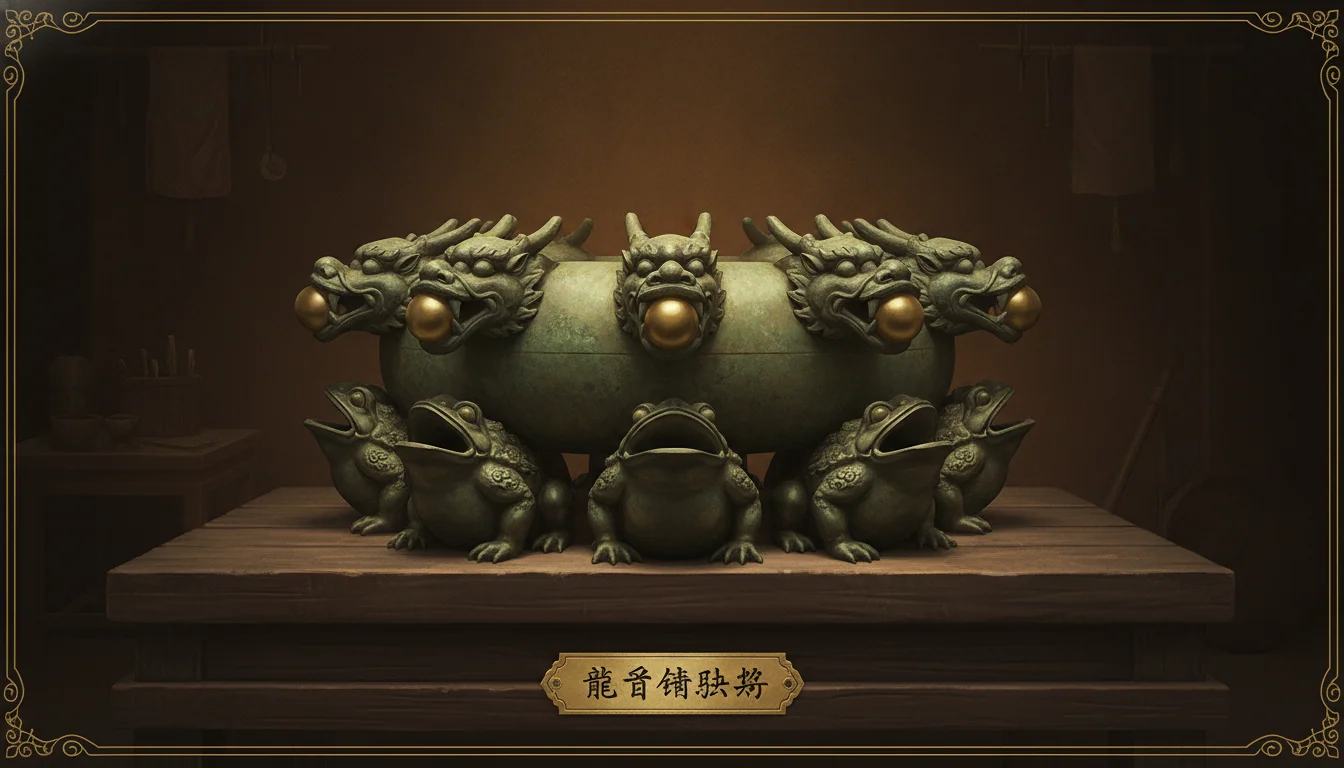
In 132 CE, a Han Dynasty court astronomer named Zhang Heng presented the imperial court with an enormous bronze vessel, roughly six feet in diameter, ringed by eight dragon heads facing the eight compass directions, each dragon holding a small bronze ball in its jaws. Below each dragon crouched a bronze toad with its mouth open, waiting. Zhang Heng called it the Houfeng Didong Yi, roughly translated as an instrument for measuring the seasonal winds and the movements of the earth. Courtiers who saw it likely assumed it was decorative, or at best a curiosity. Six years later, it did something no instrument anywhere in the ancient world was known to do: it detected an earthquake that nobody in the capital had felt.
The impossible object
According to the Hou Han Shu, the official history of the Later Han Dynasty compiled by the historian Fan Ye in the 5th century, Zhang Heng's device sat in the capital city of Luoyang and appeared, for years, to do nothing at all. Then in 138 CE, one of the bronze balls dropped from a dragon's mouth on the western side of the vessel into the waiting toad's mouth below, with a distinct clang, even though no one in Luoyang had felt so much as a tremor. Court officials, according to the chronicle, considered the device a failure or a fraud. Days later, a messenger arrived from Gansu province, roughly 400 miles to the west, reporting that a significant earthquake had struck there at almost precisely the time the ball had dropped.
That single documented episode is the reason Zhang Heng's device is remembered today as the world's first seismoscope, an instrument that detects and indicates the direction of an earthquake, roughly 1,700 years before comparable seismic-detection technology developed in Europe. No Han Dynasty engineer anywhere else is known to have built anything like it, and the instrument stunned contemporaries enough that its description survived in the official historical record for nearly two millennia after the object itself disappeared.
How it worked
No original specimen of the Houfeng Didong Yi has survived, so everything modern researchers know about its mechanism comes from Fan Ye's written description, supplemented by centuries of scholarly interpretation and, more recently, physical reconstruction attempts. The leading interpretation, refined by 20th-century Chinese seismologists and historians of science, holds that the vessel concealed a heavy pendulum, likely suspended from the lid or mounted upright inside the central chamber, engineered to remain still under ordinary conditions but to sway when a seismic wave reached the capital, even one too faint or too distant for a person standing nearby to feel directly.
When the pendulum swung toward one of the eight compass directions, it is believed to have tripped a lever mechanism connected to that direction's dragon head, releasing the small bronze ball from the dragon's jaws so it fell into the open mouth of the crouching toad positioned below it. Because only one dragon released its ball for any single tremor, the direction of the triggered dragon head indicated, at least in principle, the rough direction from which the earthquake's waves had traveled, a genuinely clever piece of directional inference built entirely from bronze, gravity, and a carefully tuned pendulum, with no electronics, no springs in the modern sense, and no written mathematics of wave propagation to guide the design.
The precision required is easy to underestimate. The pendulum and its linked levers had to be sensitive enough to respond to a real distant earthquake's faint ground motion while remaining still under the everyday vibration of foot traffic, carts, or wind, a balance that experimental archaeologists attempting modern reconstructions have found genuinely difficult to tune correctly using period-appropriate materials and tools.
Who built it and why
Zhang Heng was one of the most versatile intellectual figures of Han Dynasty China, serving as court astronomer and chief historian while also working as a mathematician, cartographer, poet, and mechanical engineer. He is separately credited with building an early water-powered armillary sphere, a rotating model of the celestial sphere used for astronomical observation, and with producing an improved estimate of the mathematical constant pi. His interest in earthquake detection grew directly out of a practical imperial problem: Han China was, and remains, seismically active, and a central government spread across a vast territory needed a faster way to learn when and where a major earthquake had struck so that relief could be dispatched before the news arrived by slow overland courier.
That practical motivation matters, because it distinguishes Zhang Heng's device from a purely scholarly curiosity. An earthquake in a remote province could take a messenger many days to report, and by the time news reached the capital on horseback, the opportunity for a fast imperial relief response had often already been lost. A device that indicated, almost instantly, that a quake had struck somewhere to the west or south, even before any human messenger departed, offered the Han court a meaningful head start in an empire where disaster response depended heavily on how quickly the throne learned what had happened.
How it was lost
The Houfeng Didong Yi did not survive antiquity, and neither the original nor any close Han-era copy has ever been recovered archaeologically. Bronze objects of this scale in ancient China were vulnerable to a familiar set of threats: wartime destruction, deliberate melting down for reuse as coinage or weapons during later periods of instability, and simple neglect once the reign and the workshop that produced them had passed. The Han Dynasty itself collapsed within decades of Zhang Heng's death, ushering in centuries of division and civil war during which many technical and artistic achievements of the earlier imperial court were lost, destroyed, or simply forgotten by the craftsmen who might otherwise have maintained the tradition.
What survived was not the object but the description of it, preserved because Fan Ye considered the 138 CE earthquake episode remarkable enough to record in detail in his official dynastic history. That written account, rather than any physical fragment, is the entire foundation of everything modern scholars know about how the device looked and, by inference, how it likely worked.
Rediscovery and replication
Modern interest in reconstructing Zhang Heng's seismoscope began in earnest in the 20th century, as Chinese and Japanese historians of science worked from Fan Ye's text to propose physical models of the internal mechanism. Several teams have since built working reconstructions, some displayed in Chinese museums and universities, that successfully replicate the basic principle: a suspended pendulum inside a sealed bronze vessel that releases a directional indicator when the vessel is subjected to simulated ground motion.
Because the original ancient text does not specify exact internal dimensions, the precise weight of the pendulum, or the fine mechanical detail of the lever-and-release system, these reconstructions remain informed engineering interpretations rather than an exact recreation of Zhang Heng's original workshop drawings, which do not survive in any form. Some reconstructions have proven notably more sensitive and reliable than others, a reminder that even with a clear textual description of the concept, the fine engineering tolerances that made the original device work as described in 138 CE are still, in important respects, a puzzle modern builders are solving from scratch rather than simply copying.
What is not in dispute is the scale of the achievement as described. Centuries before Europe developed anything resembling a seismic detection instrument, a Han Dynasty court official built a working device, using bronze casting, a tuned pendulum, and a clever mechanical release, that appears to have genuinely detected a real earthquake hundreds of miles away and indicated its rough direction before any human messenger had even set out to report it.
Other pre-modern technologies that solved genuinely hard engineering problems with comparably ingenious methods include the Antikythera mechanism and Roman concrete, both reminders that the ancient world's engineers were regularly building devices and materials whose sophistication modern audiences still find genuinely startling.
Quick Answers
Common questions about this topic
How did Zhang Heng's seismoscope actually work?
The leading reconstruction holds that a heavy pendulum suspended inside the bronze vessel would sway when ground tremors reached the device, tripping a lever mechanism that released one of eight bronze balls held in dragon-shaped mouths around the exterior, dropping it into the mouth of a bronze toad below and indicating which direction the tremor had come from.
Did Zhang Heng's device really predict an earthquake in 138 CE?
According to the Han Dynasty court chronicle the Hou Han Shu, the device dropped a ball indicating a quake to the west when no tremor had been felt in the capital, and court skeptics dismissed it as a malfunction, until a messenger arrived days later reporting a real earthquake in Gansu province, roughly 400 miles away.
Does the original seismoscope still exist?
No original Han Dynasty specimen has survived. Everything known about the device comes from a written description in the Hou Han Shu, compiled in the 5th century, and all physical seismoscopes on display in museums today are modern reconstructions built from that textual account.
Can modern engineers replicate Zhang Heng's seismoscope?
Several 20th and 21st century teams, including Chinese researchers, have built working reconstructions based on the historical description, and some have successfully detected simulated tremors. Because no original survives and the ancient text does not specify exact internal dimensions, the precise mechanism remains a best reconstruction rather than a certainty.

Meet the Ancient Engineers
Chat with the inventors who built the impossible centuries early.
Create your free account →No card required. Talk to anyone in history with 8 free credits a day. Some features require a paid plan.
Join the HistorIQly Club
Get smarter about the past.
Weekly stories, deep dives, and exclusive content straight to your inbox.