The Inca Rope Bridges Rebuilt by Hand Every Year for 500 Years
The Q'eswachaka bridge over Peru's Apurimac Canyon is woven entirely from grass, carries no metal, and is torn down and rebuilt from scratch by hand every single year.
Read Wikipedia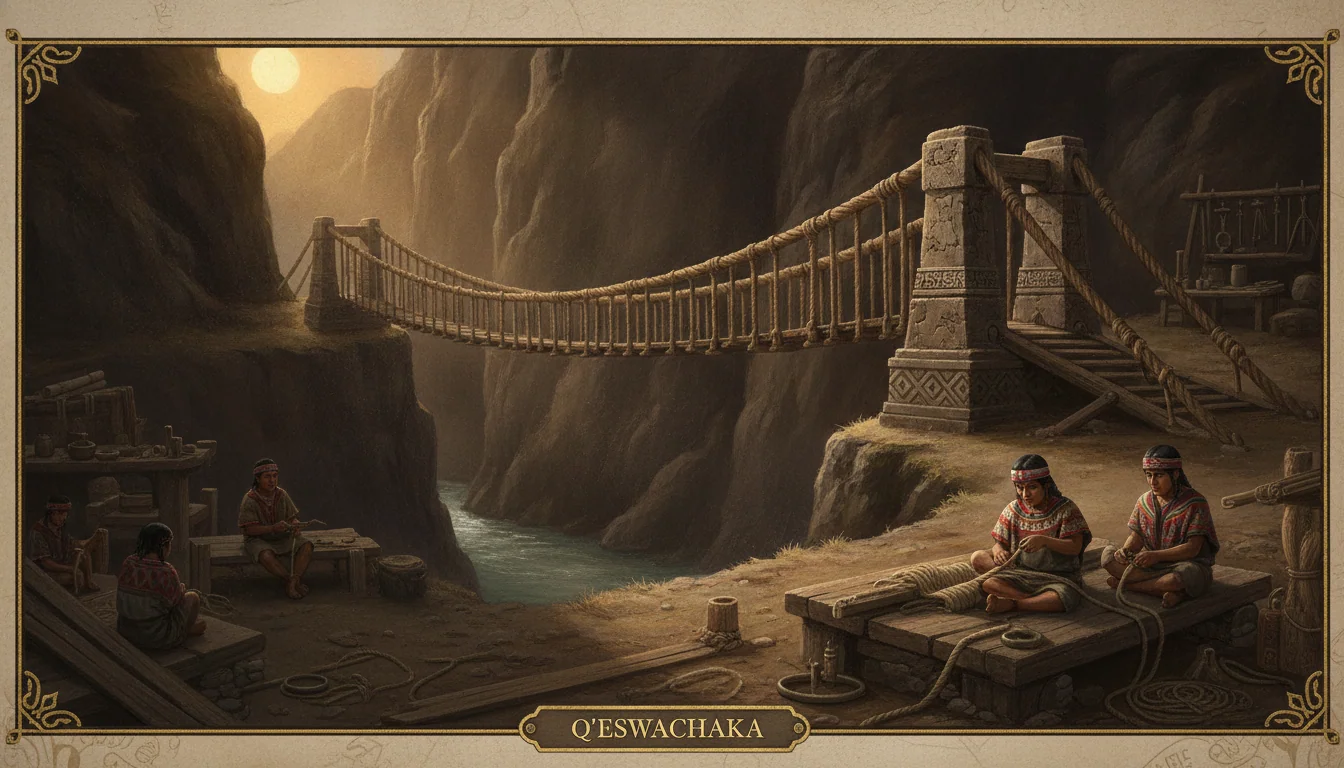
Every June, in a remote canyon of the Peruvian Andes, several hundred people gather beside a river gorge and do something that has not stopped happening, uninterrupted, for roughly 500 years. Over three days, without a single bolt, nail, or modern tool, they weave enough grass rope to rebuild an entire suspension bridge capable of holding the weight of people and pack animals crossing a chasm more than 100 feet deep. Then they cut down last year's bridge and let it rot in the canyon below. It is the last surviving example of a technology that once held the Inca Empire together.
The impossible object
The bridge is called Q'eswachaka, and it spans the Apurimac River Canyon in Peru's Canas Province, part of the vast network of roads and infrastructure known as the Qhapaq Nan, the Inca road system that once stretched roughly 25,000 miles across the Andes, connecting an empire that ran from modern Colombia to Chile. At its peak, the Inca state maintained dozens, likely hundreds, of similar rope suspension bridges across the countless rivers and ravines that cut through the mountainous terrain of Tawantinsuyu, the Inca name for their empire. Spanish chroniclers who encountered these bridges in the 16th century wrote about them with evident astonishment, describing structures that seemed to hang unsupported over terrifying drops, built from nothing but plant fiber, and strong enough to carry mounted soldiers and loaded llama trains alike.
What makes Q'eswachaka remarkable today is not just that it survived, but that it survived as a living practice rather than a museum piece. There is no steel reinforcement hidden inside it, no modern adhesive holding the fibers together, and no permanent structure that lasts more than about a year before it must be replaced entirely. The bridge you can walk across today is never more than twelve months old, even though the design and the knowledge behind it stretch back centuries.
How it actually worked
The engineering begins with a plant most visitors would walk past without a second glance: ichu, a tough, wiry bunch grass that grows abundantly across the high Andean grasslands. Community members harvest large quantities of it and, working largely by hand, twist individual blades into thin cords called q'oya. Those thin cords are then twisted together into thicker ropes, and the thicker ropes are in turn braided together into four enormous cables, each one roughly as thick as a person's torso and long enough to span the full width of the canyon.
Two of these massive cables form the walking surface of the bridge, laid parallel to each other and covered with a tightly woven mat of smaller branches and grass to create a stable deck. The other two cables run above at roughly waist height on either side, serving as handrails, connected to the deck cables below by a lattice of smaller supporting ropes that keep the whole structure rigid enough to walk across without excessive swaying. All four main cables anchor into carved stone plinths set into the rock on each side of the gorge, some of which are the same anchor points the Inca themselves originally cut into the canyon walls centuries ago. The entire structure carries no metal fastenings of any kind; every connection in the bridge is a knot or a woven joint, tensioned by hand.
Who built it and why
No single named engineer designed the Inca rope bridge system, and that absence is itself part of the story. Bridges like Q'eswachaka were built and maintained through mit'a, a system of mandatory rotational communal labor that the Inca state used to construct and sustain most of its infrastructure, from roads and terraces to storage facilities and bridges. Communities living along a given stretch of road were responsible for the bridges nearest to them, a division of labor and responsibility passed down through generations of ayllus, the kinship-based community groups that structured much of Andean rural life both before and after the Spanish conquest.
The problem these bridges solved was fundamentally about connectivity across brutally difficult terrain. The Andes are cut through with steep river gorges that would otherwise force enormous detours, and a functioning bridge network let the Inca state move soldiers, administrators, goods, and above all messengers, known as chasquis, across the empire at speeds that stunned Spanish observers used to Europe's comparatively gentler terrain. A chasqui relay system depended on bridges like this one being reliably in place; a washed-out or missing crossing could delay an urgent message by days.
How it was lost
Most of the empire's rope bridges did not survive the transition to Spanish colonial rule. Spanish administrators built their own roads and, over time, introduced different engineering approaches better suited to horse-drawn transport and to the colonial economy's shifting trade routes, which did not always follow the same paths the Inca road system had prioritized. More decisively, the communal labor obligations that had kept the annual rebuilding tradition alive were disrupted as colonial authorities reorganized indigenous labor toward mining, agriculture, and other priorities of the Spanish crown. Without a community committed to showing up every year to rebuild it, a grass rope bridge does not last. Ichu fiber weakens with exposure to weather within roughly a year, and once a bridge stopped being rebuilt on schedule, it simply weakened, sagged, and eventually collapsed into the canyon below, never to be replaced.
Q'eswachaka is generally understood to have survived where hundreds of other sites did not because of the relative remoteness of the surrounding communities and the strength of local ayllu traditions in that specific stretch of the Apurimac canyon, which kept the mit'a-style obligation to maintain the bridge alive as a community festival even after the broader Inca administrative system that had originally organized it had disappeared.
Rediscovery and the honest state of replication
Q'eswachaka never needed to be rediscovered in the way a lost artifact is, because it was never lost. The bridge has been continuously rebuilt, essentially without interruption, by the same handful of Quechua-speaking communities, principally from the village of Huinchiri, straight through the colonial period and into the present day. What has changed is outside recognition of what the tradition represents. Engineers and anthropologists who have studied the annual rebuilding in recent decades have documented the process closely, and in 2013 UNESCO inscribed the Q'eswachaka bridge and its associated knowledge system on its Representative List of the Intangible Cultural Heritage of Humanity, formally recognizing it not as an archaeological relic but as a living technology still practiced exactly as it always was.
There is no meaningful sense in which modern engineers have had to reverse-engineer this technology, since the community that built it never stopped. What modern visitors and researchers can attest to is simply that it still works: the rebuilt bridge reliably holds the weight of dozens of people and pack animals crossing at once, using a design with no metal, no modern adhesive, and no engineering credential behind it beyond several centuries of practical, hard-won knowledge passed from one generation of Andean rope-weavers to the next.
Quick Answers
Common questions about this topic
How did Inca rope bridges actually work?
Inca engineers twisted local ichu grass fibers into thin cords, then twisted those cords into thicker ropes, and finally braided the ropes into massive main cables roughly as thick as a person's torso. Four of these cables were anchored to carved stone abutments on either side of a gorge, two forming the walking deck and two serving as handrails, with a woven grass floor laid across the deck cables.
Who built the Inca rope bridges?
There was no single named engineer. The bridges were built and maintained collectively by local Quechua communities living along a given stretch of the Inca road network, the Qhapaq Nan, as a form of mandatory communal labor called mit'a, a system the Inca state used to construct and maintain most of its infrastructure.
Why did most Inca rope bridges disappear?
Spanish colonial rule shifted road-building priorities toward European engineering methods and different transportation needs, and the communal labor system that had sustained the annual rebuilding tradition broke down at most bridge sites over the following centuries. Without that yearly maintenance, unmaintained grass cables simply rotted and were never replaced.
Can we still see an Inca rope bridge today?
Yes. The Q'eswachaka bridge over the Apurimac River in Peru is the last surviving example maintained through the traditional annual rebuilding method, a living tradition recognized by UNESCO in 2013. Local communities gather each June for a multi-day festival to weave new cables and lower a fresh bridge into place, exactly as their ancestors did five centuries ago.

Meet the Ancient Engineers
Chat with the inventors who built the impossible centuries early.
Create your free account →No card required. Talk to anyone in history with 8 free credits a day. Some features require a paid plan.
Join the HistorIQly Club
Get smarter about the past.
Weekly stories, deep dives, and exclusive content straight to your inbox.