The Baalbek Trilithon: How Did Anyone Move an 800-Ton Stone?
The Baalbek Trilithon: three 800-ton blocks form a Roman temple wall in Lebanon, and a nearby quarry hides an even bigger unfinished stone. Here is how movers did it.
Read Wikipedia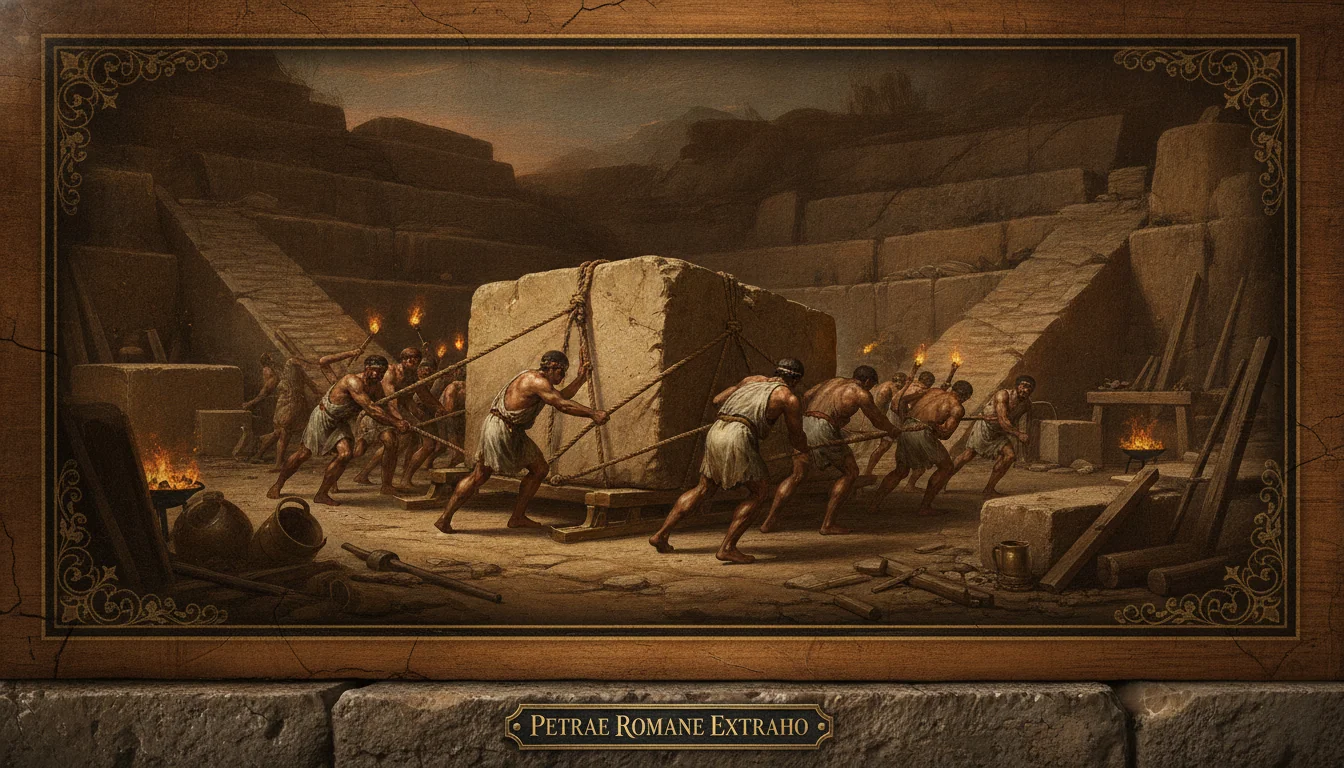
In the Bekaa Valley of Lebanon, mortared into the western wall of a Roman temple platform, sit three blocks of limestone that together weigh more than four fully loaded jumbo jets. Each stone runs about 19 meters long, roughly the length of two city buses parked nose to tail, and each is estimated at close to 800 tons. They are known as the Trilithon, and they are not even the heaviest stones at the site. A short walk up the hill, still lying in the quarry where the masons cut it and apparently walked away, rests an unfinished megalith that archaeologists have estimated at around 1,650 tons, likely the largest single block of stone ever quarried in the ancient world. Nobody left a manual explaining how any of this got done. What survives is the stone itself, and two thousand years of engineers standing in front of it asking the same question.
Three stones built to hold up a god
Baalbek sits on the site of Heliopolis, the Roman name for a sanctuary the Phoenicians had already been using to honor the storm god Baal long before Rome arrived. The Romans layered their own Temple of Jupiter Heliopolitanus onto the site, and to make the temple loom properly over the valley, its builders raised it on an artificial stone platform. The lower courses of that platform's western retaining wall are made of large but manageable blocks, several tons each, the kind Roman crews handled routinely across the empire. Then, partway up, the wall jumps to three stones so large that nothing else in the Roman architectural record compares to them. That jump, from ordinary masonry to a trio of 800-ton monsters, is the whole mystery in miniature: someone decided, partway through an already enormous project, to go bigger than had ever been attempted, and then found a way to actually do it.
The quarry that produced these blocks lies less than a kilometer from the temple, on ground slightly higher than the platform itself. That detail matters more than it sounds like it should, because it turns a seemingly impossible haul into merely an extraordinarily difficult one.
How they actually moved it
Start with what the movers did not have. Roman cranes, of the kind shown in surviving reliefs like the one from the Tomb of the Haterii, were treadwheel-powered pulley rigs capable of lifting perhaps six to ten tons in a single hoist. Even ganging several cranes together, ancient engineers had no plausible way to lift an 800-ton block clear off the ground. Whatever happened at Baalbek, it did not involve hoisting the stone into the air.
What ancient quarrying and haulage crews across the Mediterranean and Near East did have was leverage, friction control, and manpower at a scale that is hard to picture today. The likely sequence starts in the quarry itself: masons cut narrow trenches around the block's perimeter and undercut its base, using metal wedges and levers to separate it cleanly from the surrounding bedrock while leaving it resting on a thin shelf of stone until the last moment. Once free, the block was loaded onto a heavy wooden sledge, and the ground ahead of it was prepared as a trackway of timber balks, kept slick with water, animal fat, or wet clay to cut friction the same way experimental archaeologists have shown for similarly massive loads elsewhere in the ancient world.
Because the quarry sat above the temple site, the haul was mostly downhill. That flips the engineering problem: instead of needing enough pulling force to drag 800 tons uphill, which would have required an almost unimaginable number of oxen and laborers straining in unison, the crews mainly needed enough people and rope on the uphill side to brake and steer a stone that wanted to slide on its own. Estimates for how many workers this took vary widely, from several hundred to well over a thousand depending on the assumptions used, and no ancient source records an actual headcount, so any specific figure should be treated as an informed guess rather than a fact.
Getting the stone up onto the wall itself, several meters above ground level, is the part with the least direct evidence. The most commonly proposed methods are earthen construction ramps, built up in stages alongside the rising wall and removed once the block was in place, and incremental lever-and-cribbing work, in which teams pried up one edge of the stone a small amount at a time and packed timber blocking underneath before pushing more of the load's weight forward. Both techniques are documented or strongly inferred at other ancient megalithic sites, from Stonehenge's bluestones to Egypt's Great Pyramid, and both are consistent with the tools Roman-era builders are known to have had. Neither has been demonstrated at Baalbek's actual scale, so this remains the leading interpretation rather than a settled finding.
Who built it, and why
The Trilithon dates to the Roman imperial building campaign at Heliopolis, a project that unfolded over roughly two centuries starting in the decades around the reign of Augustus and continuing under later emperors who added to the sanctuary. This was not the work of some separate, vanished civilization dropped onto the site before Rome, whatever fringe theories occasionally claim. It was a Roman provincial project, funded and organized at imperial scale, using local Lebanese limestone, local labor levies, and timber likely drawn from the region's long-famous forests, already prized for construction since Phoenician times. The motive was straightforward by the standards of Roman religious architecture: a temple's prestige was measured partly by its platform, and a platform built from three stones no other city could match was a permanent, unmistakable statement about the wealth and reach of whoever commissioned it.
How the knowledge disappeared
Nothing about the Trilithon's construction was secret in the sense of a lost formula. It was lost the way large-scale infrastructure knowledge usually disappears: the institution that could afford it stopped existing. Moving 800-ton stones required the kind of centralized wealth, administrative reach, and forced or paid labor mobilization that only a functioning empire could sustain over years. As Roman authority in the eastern Mediterranean contracted through the later imperial centuries, and as the region passed through Byzantine control and then Arab conquest in the 7th century, the temple complex was repurposed, fortified, and eventually damaged by earthquakes that struck the region across the medieval period. Nobody who came after had the same combination of motive, budget, and workforce to try anything like it again, so the specific craft know-how, never written down as a technical manual in the first place, simply had no one left to practice it.
Rediscovery and the honest state of replication
European and later Lebanese and German archaeological teams documented the site in detail from the early 20th century onward, and the quarry blocks became a minor sensation of their own, particularly the Stone of the Pregnant Woman, so named after local folklore about the strength required to carry it and estimated in its own right at around 1,000 tons. In 2014, a joint archaeological team excavating nearby found an even larger stone lying partly buried beneath another unfinished block, and estimated its weight at close to 1,650 tons, edging out its neighbor as the largest known quarried stone from antiquity.
Could modern engineers move a stone that size today? In one narrow sense, yes: heavy-lift cranes exist that are rated for loads in that range, and a modern engineering firm with the right equipment could, in principle, relocate the block, at considerable expense. What has not happened is a genuine experimental-archaeology test of the ancient method itself at full scale. Smaller trials, moving stones weighing a few tons to a few dozen tons using only sledges, rollers, rope, and manpower, have supported the general plausibility of the technique. Nobody has dragged an 800-ton block down a prepared timber trackway to see exactly how many people it actually takes, how fast it moves, or how it behaves when it needs to stop.
That gap is worth sitting with, because it is the honest answer rather than a cop-out. The Trilithon is not evidence of some technology beyond human capability. It is evidence of what a well-organized, well-funded, patient human workforce can do with rope, timber, wedges, and gravity, when an empire decides the job is worth doing. The wonder here was never a mystery to be solved by aliens. It was logistics, muscle, and an audacious quarry foreman, multiplied by two centuries of imperial ambition.
Quick Answers
Common questions about this topic
How did ancient builders move stones weighing hundreds of tons?
The leading explanation is unglamorous but effective: quarry crews freed the block from bedrock, dragged it on a wooden sledge over a lubricated timber trackway using large teams of laborers and draft animals, and likely benefited from the quarry sitting on higher ground than the temple, turning much of the haul into a controlled downhill slide rather than a straight pull. Raising the stone the final few meters onto the wall probably used earthen ramps or incremental lever-and-cribbing, not cranes.
How much does the largest stone at Baalbek weigh?
The three Trilithon blocks built into the temple wall are each estimated at roughly 800 tons. A separate unfinished block still lying in the quarry, known as the Stone of the Pregnant Woman, is estimated around 1,000 tons, and an even larger block found nearby in 2014 has been estimated at close to 1,650 tons, likely the heaviest stone ever cut in the ancient world.
Who built the Baalbek Trilithon?
The wall was raised as part of the Roman temple complex at Heliopolis, dedicated chiefly to Jupiter, on a site that had older Phoenician religious associations tied to the storm god Baal. The construction was a state-scale imperial project drawing on provincial labor, timber, and financing over roughly two centuries, not the work of a single mysterious culture.
Could we move a stone that size today?
Yes, with modern heavy-lift cranes rated for loads in that range, though moving one is still a specialized, expensive operation. What has not been done is a full-scale replication using only ancient methods; smaller trials with sledges, rollers, and rope have supported the general theory, but no one has dragged an 800-ton block across a real trackway to test it at full scale.

Meet the Ancient Engineers
Chat with the inventors who built the impossible centuries early.
Create your free account →No card required. Some figures and features require a paid plan.
Join the HistorIQly Club
Get smarter about the past.
Weekly stories, deep dives, and exclusive content straight to your inbox.