Arsenal: The Flail and Its Medieval Myth
The medieval flail is one of history's most iconic weapons - and one of the least proven. The real battlefield history is far stranger than the legend on museum walls.
Read Wikipedia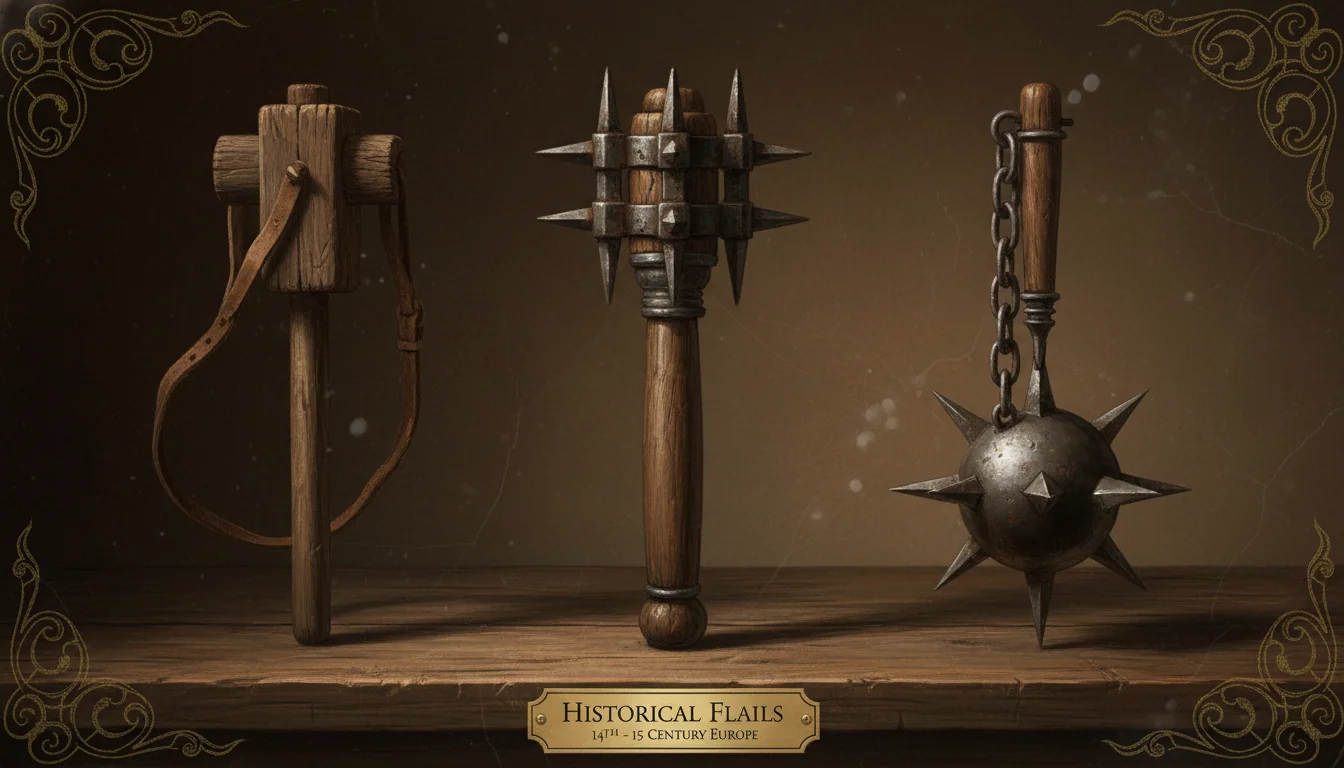
Walk through the arms and armor section of any major European museum and you will likely find, mounted on the wall or displayed in a case, the weapon that has haunted medieval imagination for two centuries: a wooden shaft, a length of chain, and a spiked iron ball at the end, designed to be swung in an arc that defeats shields, wraps around them, and crushes whatever is behind them. Knights feared it. Hollywood weaponsmiths love it. Video game designers have made it a staple from action RPGs to historical simulations.
There is one complication. The evidence that this weapon was ever a standard part of medieval warfare is surprisingly thin, and some historians argue it was more myth than weapon from the beginning.
What a flail actually was
Before arriving at the spiked ball, it helps to understand what a flail originally was, because the word covers several different objects with very different histories.
The agricultural flail is the oldest version: two wooden staves connected at one end by a short cord or leather strap, used to thresh grain by beating stalks so the kernels separate. This tool was in continuous use across Europe and Asia from antiquity into the 19th century. It is common, well-documented, and genuinely useful. Thousands of medieval people owned one, and none of them considered it a weapon - until circumstances changed.
The military flail is a different claim, and it appears in two distinct forms. The first is a shorter infantry weapon with a wooden or iron handle and a relatively short chain of perhaps 30 to 60 centimeters connecting to a weighted or spiked head. The second is the iconic long-chain variant with a spiked iron ball, sometimes called the ball-and-chain or simply "the flail" in popular sources, with a chain of 50 centimeters or more swinging freely from a grip.
The first version has some manuscript evidence behind it. The second is where things become genuinely uncertain.
What the manuscripts show
Medieval manuscript illuminations, the primary pictorial record of warfare in this period, occasionally depict weapons that could be described as flails. German manuscripts from the 13th and 14th centuries show infantry weapons with a handle and a short articulated head. French manuscripts from the Hundred Years War period include similar figures. The weapons shown are not, however, the dramatic long-chain spiked ball of popular culture. They are shorter, thicker, and more closely resemble modified agricultural tools than theatrical weapons.
What the manuscripts almost never show is cavalry use of a ball-and-chain flail. This is significant because cavalry is where such a weapon would theoretically have its greatest advantage: mounted on horseback, a long swing could reach past a footman's shield. But swinging a weighted ball on a long chain from horseback creates obvious problems of control. The arc is constrained by the horse's movement and the rider's grip. A rebound can strike the user or the horse. Medieval cavalry manuscripts, which depict combat in considerable detail, do not show a solution to these problems, because the long-chain flail does not appear in them with any frequency.
Surviving examples compound the problem. Very few unambiguous ball-and-chain military flails exist in museum collections with verified pre-17th-century provenance. Many of the most dramatic pieces were acquired in the 19th century from arms dealers whose documentation was, charitably, aspirational.
The Hussites: the one case that is real
The most credible mass military use of a flail-derived weapon occurs not in the chivalric warfare of the Hundred Years War but in the revolutionary peasant armies of Bohemia in the early 15th century.
When the Council of Constance burned the reformer Jan Hus as a heretic in 1415, the resulting uprising produced one of the most surprising military forces of the medieval period. Hussite armies of Bohemian peasants and minor nobility, under the tactical command of the brilliant one-eyed general Jan Zizka, defeated every crusading army sent against them between 1419 and the mid-1430s. One factor in their success was the deliberate use of improvised weapons that untrained fighters could actually handle, and the agricultural flail was prominent among them.
Hussite flails were not the spiked iron ball. They were wooden threshing flails, sometimes with iron fittings added to the striking end, wielded by infantry fighting from behind or between the Hussite war wagons - the Wagenburg, a mobile fort of linked agricultural carts that Zizka used as both a defensive position and an offensive platform. When crusading armies closed to close quarters around the wagon laagers, flail-armed infantry could be genuinely effective. The weapon's swing could break the footing and balance of a man in heavy plate armor, and a fallen knight in a press of men was a dead knight.
Jan Zizka's tactical innovations - the mobile wagon fort, coordinated crossbow fire, the early integration of gunpowder artillery alongside hand-to-hand infantry - are well-documented and historically significant. The flail was one component in this system, not the defining weapon of the age. But the Hussite evidence establishes something important: a modified agricultural flail, used by trained infantry in the right tactical context, was a real weapon with real battlefield results. It just looked nothing like what hangs on museum walls.
The knight's variant: the morning star
There is a better-documented cousin to the flail in the late medieval cavalry arsenal: the morning star and its variant sometimes called the horseman's flail. This is a weapon with a short rigid shaft, a joint or short chain of perhaps 20 to 30 centimeters, and a heavy spherical or cylindrical head studded with flanges or spikes. It appears in German, Flemish, and Italian manuscript illustrations from the 14th and 15th centuries with enough consistency to be taken seriously.
Its mechanics are more defensible than the long-chain ball. The short chain allows the weighted head to move just far enough to wrap around or slip past a blocked strike, while the brief length prevents the uncontrolled rebound that makes the long-chain version impractical. Contemporary fighting manuals that discuss mace and club work sometimes address weapons in this class.
The morning star is real, reasonably documented, and plausible as a cavalry weapon for specific situations - the unhorsed opponent, the press at a gate. What it is not is the iconic long-chain ball of film and games. The two have been conflated for centuries, and museum labeling has not always helped distinguish them.
Why the myth persists
The long-chain spiked flail entered popular imagination largely through the 19th century, when Neo-Gothic revivalists and Romantic painters reconstructed medieval warfare from imagination as much as from primary sources. Arms dealers supplied weapons that matched what buyers expected, and the provenance of many museum pieces acquired in the Victorian era is questionable. A spiked ball-and-chain flail is visually distinctive. It conveys a satisfying suggestion of both engineering ingenuity and brutal consequence. It photographs well, renders beautifully in illustration, and transfers perfectly to film and game design.
Physical testing has confirmed the mechanical problems: a spiked iron ball on a 60-centimeter chain is difficult to control in any combat context. It rebounds unpredictably. In the tight press of actual medieval infantry fighting, where space to swing is typically unavailable, it would be nearly as dangerous to the wielder as to the opponent. These are exactly the problems that a weapon in regular military use would have been refined away. The absence of that refinement in the historical record is itself evidence.
None of this proves the long-chain flail never existed. It means the weapon was, at best, an experimental or regional curiosity rather than the standard-issue nightmare of popular legend.
What replaced it
Nothing replaced the flail specifically, because the flail was never universal enough to require a replacement. What replaced the family of impact weapons - mace, morning star, war hammer, and flail variants - in late medieval and early modern warfare was the gradual refinement of edged weapons optimized for fighting plate armor, together with the slow spread of gunpowder weapons that eventually made all close-combat weapons supplementary.
The pike and the early firearm made the tactical conditions under which impact weapons had functioned effectively increasingly rare. The dismounted knight grinding through a press of men with a mace became less common as firearms pushed engagements to longer ranges and altered the calculus of armor entirely.
The agricultural flail, source of the whole tradition, outlasted every military derivative. It was still in use on European farms in the early 20th century, threshing grain by the same method it had used in antiquity.
The spiked iron ball on the chain, meanwhile, migrated into fantasy, film, video games, and museum gift shops, where it sells reliably and looks exactly as dangerous as everyone always imagined. Whatever its battlefield credentials, it is one of the most successful pieces of marketing in the history of medieval weaponry - a weapon that conquered popular culture without ever quite conquering a battlefield.
For other medieval and ancient weapons with better-documented battlefield records, see our profiles of the medieval mace and the war chariot.
Quick Answers
Common questions about this topic
Did medieval soldiers actually use ball-and-chain flails?
This is genuinely disputed. Very few surviving examples of long-chain spiked-ball military flails exist from the medieval period, and their appearance in manuscript illustrations is far rarer than popular culture suggests. Military historians note that the weapon's mechanics - the difficulty of controlling a spiked iron ball on a long chain in close combat - make it problematic as a standard battlefield weapon.
What was the Hussite flail?
The Hussites, followers of Jan Hus who fought a series of crusades from 1419 onward, made effective use of modified agricultural flails as infantry weapons. Under Jan Zizka's command, Hussite peasant armies equipped with these wooden-staved tools and wagon-fort tactics defeated several crusading armies. The Hussite military flail was a genuine battlefield weapon, though it looked nothing like the spiked iron ball of popular imagination.
What is a morning star?
A morning star is a mace-type weapon, a heavy shaft topped with a round or cylindrical head studded with iron spikes or flanges. Some versions connected the shaft and head with a short chain, creating a hybrid sometimes called a horseman's flail. These are better documented than the long-chain spiked-ball variety and appear more plausibly in cavalry use.
Why does the spiked flail dominate medieval weapon imagery?
The dramatic silhouette of a spiked iron ball on a long chain is visually memorable and entered European imagination through theatrical reenactments, Victorian-era history paintings, and eventually film and video games. Museum collections that display ball-and-chain flails often acquired them through 19th-century arms dealers whose provenance records were optimistic at best.

Talk to the People Who Wielded These Weapons
Chat with the soldiers, smiths, and commanders whose lives were shaped by the weapons of their age.
Create your free account →No card required. Talk to anyone in history with 8 free credits a day. Some features require a paid plan.
Join the HistorIQly Club
Get smarter about the past.
Weekly stories, deep dives, and exclusive content straight to your inbox.