Arsenal: The Mace from Bronze Age Club to Medieval Crushing Machine
Mace weapon history from Bronze Age Egypt to medieval plate armor: five thousand years of the simplest, most enduring dedicated weapon ever made.
Read Wikipedia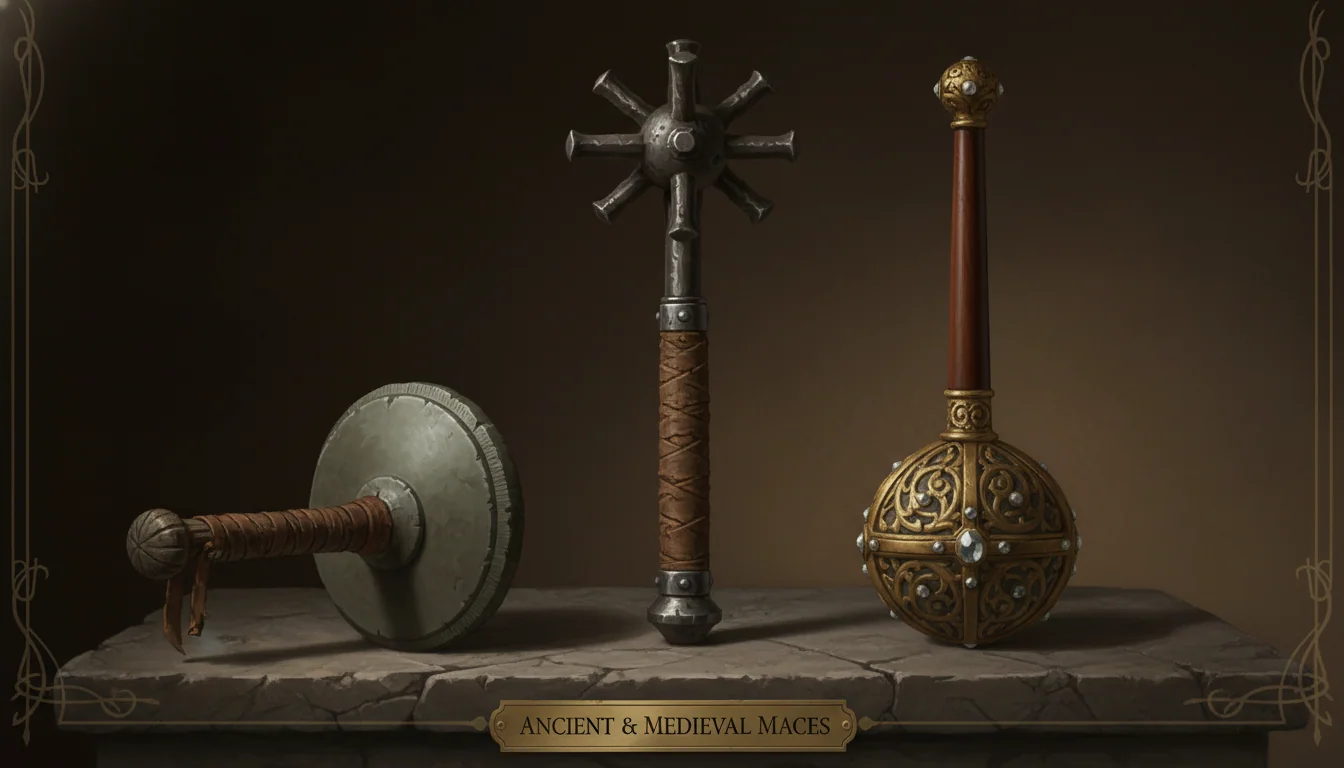
Pick up a rock. Swing it at something. You have just reinvented the oldest offensive weapon in human history. The mace is nothing more sophisticated than that first impulse given material form and five thousand years of engineering attention. What makes it remarkable is that those five thousand years of attention produced something genuinely useful at each step, from the polished stone heads of predynastic Egypt to the steel-flanged instruments that troubled the plate-armored knights of the 15th century.
Most famous weapons tell the story of increasing refinement pushing toward a moment of obsolescence. The mace tells the same story from the other direction. It kept being useful because human beings kept inventing better armor, and the mace, alone among ancient weapons, is specifically designed to defeat armor without penetrating it.
Origins: stone on a stick
The earliest confirmed maces are not improvised clubs. They are purpose-built weapons with carefully shaped stone heads, shaped to maximize the mass concentrated at the point of impact, and mounted on wooden shafts through a drilled socket hole. Examples from Predynastic Egypt, dated to roughly 3500 BCE, are already sophisticated objects. The heads are shaped by knapping and grinding into a disc or pear form that fits the socket cleanly and will not split on impact the way an improvised rock would.
The disc mace of Predynastic Egypt is the earliest type: a thin, wide stone disc on a short shaft. It is a specific design choice rather than a casual one. A disc head concentrates edge mass well away from the socket and delivers impact through a broad band. It was the dominant Egyptian mace form through the Early Dynastic period, and it was important enough to appear repeatedly in the earliest royal iconography. The Narmer Palette, carved around 3100 BCE and one of the oldest historical documents in existence, shows the pharaoh Narmer raising a disc mace above a captive he is about to execute. This is not an incidental artistic choice. The mace was, by that point, already a symbol of royal power and legitimate violence.
The disc mace gave way to the pear-shaped mace head around the early Old Kingdom. The pear shape delivers more mass to a narrower striking surface and handles the mechanical stress of impact better than the wide disc. Stone mace heads of this period have been found across the ancient Near East, Egypt, and the Levant, suggesting a parallel development or a technology that spread rapidly along trade and military contact routes.
Bronze and the armor problem
Stone maces worked well against unarmored opponents. They worked less well once Near Eastern warfare began to produce helmets, shields, and eventually early bronze body armor. Stone is brittle. A heavy bronze or hardened leather helmet absorbs or deflects the shock that kills a mace head. The response was to move to metal heads.
Bronze mace heads appear across the ancient Near East by the third millennium BCE. They are cast rather than shaped, which allows the head to be produced in specific geometries suited to defeating armor. Some early bronze mace heads have simple star-shaped flanges that anticipate by a thousand years the form that medieval armourers will rediscover. The flanges concentrate force into narrower impact lines, allowing the head to bite into bronze or hardened leather rather than glancing off.
By the time of the Egyptian New Kingdom, roughly 1550 to 1070 BCE, metal-headed maces were common weapons in the infantry. They do not replace swords and spears in this period - they supplement them. The mace fills a role that no cutting weapon handles well: the short-range, closed-in, cramped-space blow that does not require room to swing.
Maces appear consistently in the iconography of authority across the ancient Near East. Mesopotamian rulers carry them. Hittite kings are depicted with them. The Egyptian pharaoh's regalia includes a mace, and the symbol of the mace as royal power persists in ceremonial form long after the battlefield version has evolved past stone heads.
The medieval rediscovery
After the fall of Rome, maces become less prominent in Western European warfare. This is not because the weapon is forgotten but because early medieval combat is conducted by warriors in mail, which the contemporary sword handles adequately. A mace against chain mail is useful but not dramatically superior to a sword, and swords carry greater social prestige.
The calculus shifts around the 11th and 12th centuries, as improvements in metalworking begin producing better plate defenses. Early plate, initially applied to shoulders, elbows, and knees over mail foundations, changes the dynamics of combat. A sword edge that cuts through mail meets a different problem against a hardened iron or steel plate. The mace does not need to cut. It needs to transmit force.
The medieval European mace of the 12th century is typically an iron or steel head with simple raised ridges or knobs on a wooden or metal shaft. It is a more sophisticated tool than the ancient equivalents in design but the same tool in principle. Crusader-period artwork shows maces in use by both European and Near Eastern warriors, which is unsurprising - the weapon had never disappeared from warfare in the eastern Mediterranean, and the Crusades put European knights in contact with armies that had been using flanged metal maces continuously.
The flanged mace and plate armor
The 13th and 14th centuries produce the most technically sophisticated maces in history, and they produce them in direct response to the most sophisticated armor in history. As plate armor coverage expands from partial to near-total, the flanged mace emerges as the purpose-built answer.
A flanged mace head carries between four and eight steel fins arranged radially around the socket. The fins are typically angular, trapezoidal in cross-section, with a narrow leading edge. When the mace lands on plate armor, the fin concentrates the force of the blow into a line rather than a surface. The pressure delivered per unit area is dramatically higher than a smooth round head of the same mass. The result is a dent in the armor, or more precisely a series of dents, each following the contour of a flange, that transmit shock through the steel plate into the body of the wearer.
A dented armor plate does not fail structurally in the way a breached section does, but it achieves something else: it transfers energy. The physics of a heavy mace blow against a closed helmet are unforgiving. The helmet does not come off. The energy of the swing, multiplied by the mass of the head, enters the skull through the steel. Soldiers in the 14th and 15th centuries are not much better equipped than modern athletes to absorb repeated impacts to the head, regardless of the material surrounding them.
Maces in this period are also shorter and lighter than the archaeological record of stone and early bronze examples suggests. A practical fighting mace of the 14th century weighs perhaps one to two kilograms and measures around 60 centimeters. This is a one-handed weapon for mounted combat, usable in close quarters where a sword would be difficult to deploy. Some knights carried both, using the sword for initial engagement and the mace for the clinch.
The mace across cultures
The mace was not exclusively a European weapon. Ottoman and Mamluk maces of the 14th and 15th centuries are often more elaborately decorated than their Western counterparts, with gold and silver inlay work that suggests high-status objects intended for display as much as combat. The Persian shish par, a six-ribbed flanged mace, is functionally related to European examples while being entirely distinct in form. Indian maces of the Mughal period, Mongol cavalry maces, and Korean ceremonial variants all point to the same convergent engineering logic: when armor improves, the blunt weapon finds a new generation of users.
The mace was also carried across the social spectrum in Europe, from foot soldiers to kings. Richard I of England and Charles the Bold of Burgundy are documented mace users. It did not carry the aristocratic prestige of the sword, but it was not a weapon of the lower orders either.
The decline
The mace does not have a dramatic retirement story. It does not get superseded by a superior weapon in a single decisive engagement. It slowly becomes redundant as the military technology of the 15th century moves in two directions that marginalize it simultaneously.
The first is the pole weapon. Halberds, pole axes, and similar weapons deliver concussive force with longer reach and more mass than a handheld mace. Against a knight in plate armor, a halberd in the hands of a skilled infantryman is generally superior to a mace, particularly at the moment of a charge when the knight is moving and the window for a killing blow is narrow.
The second is, eventually, gunpowder. The firearms revolution of the 16th century makes the entire debate about mace versus plate armor historically academic. Plate armor capable of defeating small arms requires so much mass that it becomes impractical. As armor lightens and eventually disappears, so does the specific advantage the mace was engineered to exploit.
The mace survives into the 16th and 17th centuries as a cavalry weapon, particularly in Eastern European and Ottoman contexts where armored cavalry remains relevant longer than in Western Europe. By the early modern period it has largely retreated into ceremony, which is where it was always also at home. The ceremonial maces that still sit on tables in legislative chambers, universities, and courts throughout the English-speaking world are the last heirs of the Narmer Palette, carrying the same symbolism of legitimate authority that the disc-headed stone mace carried five thousand years ago.
The weapon's functional life ended. Its symbolic life never has.
For more on the weapons that defined medieval and ancient warfare, see our histories of the Roman gladius and the Japanese katana.
Quick Answers
Common questions about this topic
What is the history of the mace weapon?
The mace is one of the oldest dedicated weapons in human history, with examples dating to the Predynastic period of Egypt around 3500 BCE. It began as a stone head mounted on a wooden shaft and evolved over five millennia through bronze, iron, and steel, culminating in the flanged steel maces of the 14th and 15th centuries designed specifically to defeat plate armor.
Why did medieval knights use maces?
Knights used maces because bladed weapons became less effective against improving plate armor through the 14th century. A mace delivered concussive force rather than cutting force, transmitting shock through armor to injure or stun the wearer. A well-delivered mace blow could dent plate, fracture bones, and incapacitate an opponent without needing to penetrate the steel.
What is a flanged mace?
A flanged mace is a mace whose head carries several protruding flanges, fins, or raised ribs of steel arranged radially around the shaft. The flanges concentrate the force of impact into smaller surface areas, increasing the pressure delivered to armor. Flanged maces became the dominant form in the 12th through 15th centuries and are the design most associated with medieval warfare.
Is the morning star the same as a mace?
No, though the terms are often confused. A morning star (or morgenstern) typically refers to a weapon with a spiked head, either mounted on a fixed shaft or attached to a chain as a flail. A mace has a heavy solid or flanged head on a fixed shaft, without spikes. The spiked ball-on-chain that popular culture calls a flail is largely a myth - reliable medieval examples of a free-swinging spiked ball on a chain are extremely rare in the historical record.

Talk to the People Who Wielded These Weapons
Chat with the soldiers, smiths, and commanders whose lives were shaped by the weapons of their age.
Create your free account →No card required. Some figures and features require a paid plan.
Join the HistorIQly Club
Get smarter about the past.
Weekly stories, deep dives, and exclusive content straight to your inbox.