Arsenal: The Medieval War Hammer
Medieval war hammer history: purpose-built to crack plate armor with a hammer face and piercing beak. Here is how the weapon worked and who carried it from 1350 to 1520.
Read Wikipedia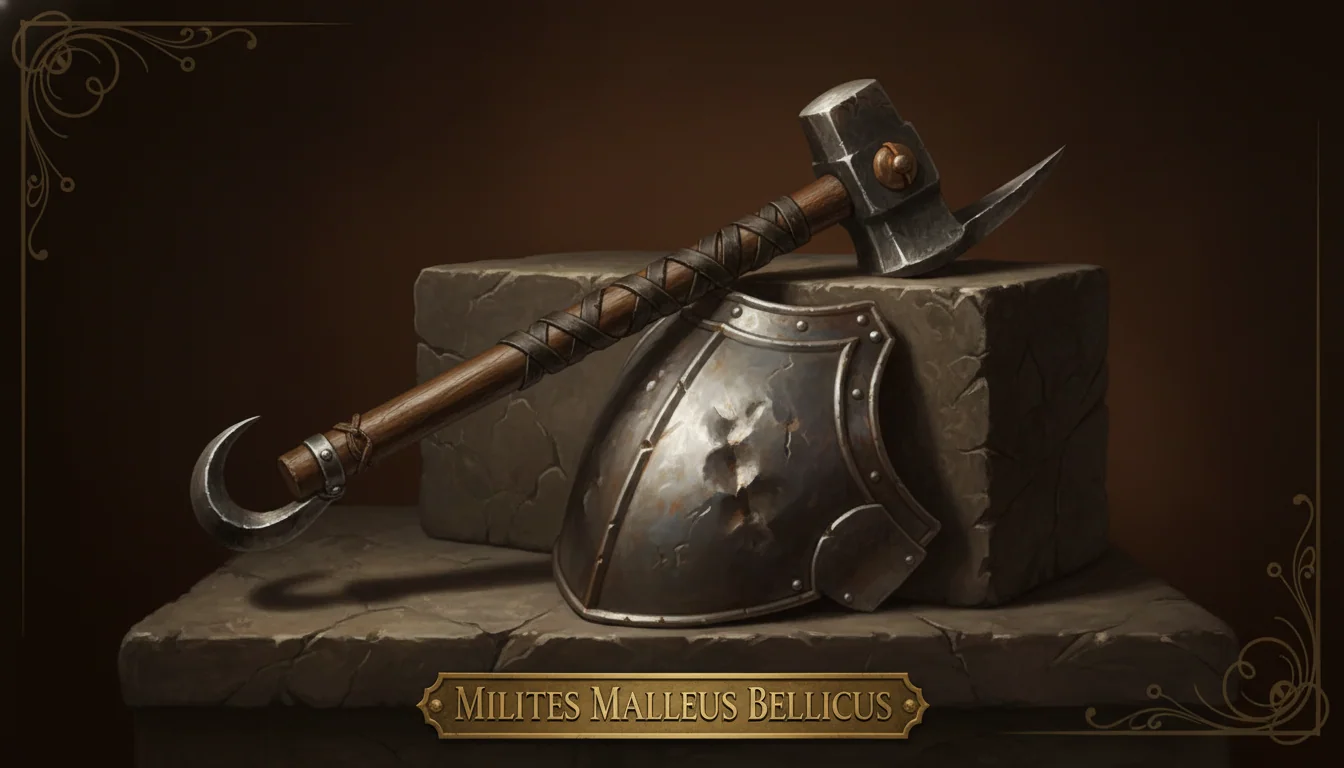
Plate armor is one of the most effective personal protection systems in the history of warfare. A well-made late medieval harness of interlocking steel plates, correctly fitted and properly articulated, covers almost every vital area of the body, allows surprisingly free movement, and defeats most cutting and thrusting weapons cleanly. A sharp sword blade skates off a polished steel pauldron. A lance breaks on a breastplate. Even an arrow shot from a warbow frequently cannot punch through the best quality plate at distance.
This presented late medieval soldiers with a genuine tactical problem. If you had a fully armored opponent in front of you and a conventional sword in your hand, your options were limited: thrust for the gaps, grapple and use a dagger, or spend a long time trying to find an opening. The war hammer was the engineered solution to all three of those limitations at once.
The armor problem
Plate armor developed gradually over the 13th and 14th centuries from earlier combinations of mail and reinforcing plates into the complete articulated harness recognizable from the late 1300s onward. The key transition point was approximately 1350-1400, when full plate coverage of the torso, limbs, and head became achievable and affordable for the wealthier categories of military personnel. Once an opponent was fully plated, a swordsman was largely trying to find the gaps between plates at the armpits, inner elbow, groin, the back of the knee, and the visor slots of the helmet.
The problem with relying on gap-finding was that a well-armored opponent knew exactly where those gaps were and covered them in movement. The alternative was not to cut at all, but to deliver blunt force in concentrated form - enough to cave the armor inward and transfer the damage directly to the body inside, or enough to apply the spike with leverage into any opening that presented itself.
The mace had done this for centuries, with flanged or knobbed heads that concentrated impact into smaller contact areas than a flat surface. The war hammer refined the concept by combining a striking face on one side with a pointed beak or spike on the other, giving the wielder a choice of attack mode against any specific defensive configuration.
Design and anatomy
The defining feature of the war hammer is its dual-purpose head: a hammer face on one side, a beak or pick on the other. The hammer face is typically slightly crowned rather than perfectly flat, which concentrates the force of impact further. The beak varies in design - some are nearly straight, some curve downward like a crow's bill, some are more spike-like - but all serve the same function: finding gaps and concentrating force to a point small enough to penetrate.
Short war hammers used as one-handed weapons had hafts of roughly 40 to 70 centimeters, similar to a mace. The head was iron or steel, sometimes with additional reinforcement at the striking areas. The design was simple enough to produce in quantity and robust enough to withstand the sustained shock loads of combat.
Long-hafted war hammers, the polearm variants, had hafts of up to 1.5 to 2 meters and were used by infantry. The extra length provided both reach and additional leverage for driving the beak through resistant material. A particularly well-documented variant is the Lucerne hammer, named for the Swiss city with which it became associated, featuring a hammer face, a curved beak, and a top spike integrated into a single complex head. The bec de corbin, or crow's beak, is a closely related design distinguished by a more pronounced downward curve on the beak. Both were Swiss and German infantry staples of the 14th and 15th centuries.
Hafts on polearm versions were often reinforced with metal bands called langets that ran down the shaft from below the head, preventing an opponent from cutting through the wood with a sword stroke.
Tactical doctrine
The war hammer required a different tactical mindset than the sword. A swordsman looks for an opening and inserts a blade. A war hammer wielder looks for a surface and delivers force.
Against the helmet, the hammer face could produce a concussive shock through the metal without necessarily penetrating it - enough to stun an opponent, disrupt their balance, or damage structures inside the skull. A strike to the visor could drive it inward into the face. The beak, aimed at the visor slots or applied to the joint between the helmet and gorget at the throat, could find the gaps that existed in every harness.
Against the body, the hammer face struck the breastplate and transferred kinetic energy through the steel into the ribs and sternum. A strong blow from a heavy hammer dented the breastplate inward, and a dent of even a centimeter or two could crack a rib or compress the chest. Against the limbs, the weapon targeted the thinner protection at joints - the pauldron-to-vambrace joint at the shoulder, the couter at the elbow - using the beak to lever or pierce.
Medieval fighting manuals, including sections of Hans Talhoffer's combat treatises from the mid-15th century, describe specific techniques for war hammer use in armored combat, showing how the beak was hooked behind the knee or driven under the armpit and how the weapon was used in close grappling once contact was established.
Who used it and when
The war hammer was primarily a weapon of the mounted knight and the professional foot soldier during the period of peak plate armor, roughly 1350 to 1520. Cavalry used the shorter one-handed version from horseback, where a mace or war hammer was practical in close quarters after the lance was spent. Infantry, particularly Swiss and German mercenaries, favored the polearm versions for their reach.
Swiss confederate armies of the 14th and 15th centuries built their reputation in part on their effectiveness against armored cavalry, using a combination of halberds and pole hammers to close with mounted knights and disable them. The battles of Morgarten in 1315, Laupen in 1339, and the later Burgundian Wars of the 1470s, culminating at Grandson and Murten in 1476, demonstrated that well-drilled infantry with the right polearms could consistently defeat armored cavalry that charged them in constricted terrain.
Italian condottieri, the professional contract soldiers who dominated Italian warfare through the 14th and 15th centuries, used war hammers extensively in the highly professionalized armored combat of the peninsula. English and French men-at-arms carried them throughout the later phases of the Hundred Years' War, when both sides put heavily armored knights into dismounted formations and fought at close range.
Henry V of England is traditionally associated with a war hammer at Agincourt in 1415, though the exact weapon is a matter of some iconographic uncertainty. What is clear from the battle's accounts is that the close-quarters fighting after the archers' initial work was done involved the kind of brutal armored brawling for which the war hammer was specifically designed.
Related weapons
The war hammer existed in a family of anti-armor weapons. The poleaxe - a polearm combining an axe blade, a hammer face, and a top spike on a long haft - was closely related and often more versatile, especially in the tournament foot combat that became an art form in its own right during the 15th century. Italian fighting masters including Fiore dei Liberi described poleaxe and war hammer techniques in similar terms, emphasizing the interchangeability of many wrestling-and-striking combinations across both weapons.
The maul - a large, heavy-headed hammer without the beak, often with a wooden or partially wooden head - was a cruder anti-armor tool used by infantry to break up pike formations or simply to bludgeon. It required less skill but less precision, and it served a different tactical role than the war hammer proper.
Decline and legacy
The war hammer's decline followed directly from the decline of its target. During the 16th century, the development of firearms capable of defeating plate armor at useful ranges made the complete harness increasingly impractical and increasingly rare on the battlefield. A weapon whose entire design rationale was defeating plate armor had little purpose once plate armor stopped appearing.
By mid-century, most infantry had moved to combinations of firearms and pikes rather than polearms. The beautifully engineered Lucerne hammers and becs de corbin of the Swiss mercenary companies became surplus to requirements. They survived in ceremonial contexts - municipal guards, palace halberds - where the association with martial tradition mattered more than battlefield function.
The war hammer's cultural afterlife has been unusually robust. Its name and approximate image appear in fantasy literature and gaming with a consistency that suggests something aesthetically compelling about a weapon that is honest about its purpose: it is a hammer for hitting people in armor. No metaphor, no ceremony, no ambiguity about what it is for.
For the blunt-force weapon that preceded the war hammer in European arsenals, see Arsenal: The Mace. For the polearm that dominated the Swiss and German mercenary tradition alongside it, see Arsenal: The Halberd.
Quick Answers
Common questions about this topic
What was the war hammer designed to do?
The war hammer was specifically designed to defeat plate armor, which became common in the 14th and 15th centuries. The hammer face delivered concentrated blunt force that could dent armor and cause internal injury through the metal. The spike or beak on the opposite side could penetrate gaps in armor, find joint seams, and pierce visors.
What are the different types of war hammer?
The two main forms were the short war hammer, used one-handed from horseback or on foot, and the long-hafted pole hammer, a polearm version giving infantry more reach and leverage. Variants include the Lucerne hammer (a polearm with a distinctive curved beak, hammer face, and top spike) and the bec de corbin or crow's beak. All share the fundamental hammer-plus-pick design.
When was the war hammer most widely used?
The war hammer was most widely used from roughly 1350 to 1520, the period when full plate armor was both common and effective enough to reduce the value of cutting weapons. Swiss mercenaries, French and English knights, Italian condottieri, and German men-at-arms all carried versions of the weapon during this period.
Why did the war hammer decline?
The war hammer declined because plate armor declined. By the early 16th century, firearms made heavy full plate impractical on the battlefield. As knights stopped wearing complete plate harnesses, the specialized weapons designed to defeat them became unnecessary. The war hammer survived mainly in ceremonial and tournament contexts.

Talk to the People Who Wielded These Weapons
Chat with the soldiers, smiths, and commanders whose lives were shaped by the weapons of their age.
Create your free account →No card required. Talk to anyone in history with 8 free credits a day. Some features require a paid plan.
Join the HistorIQly Club
Get smarter about the past.
Weekly stories, deep dives, and exclusive content straight to your inbox.