Arsenal: The Hwacha, Korea's Rocket Battery
The hwacha history in brief: a 15th-century Korean cart that launched up to 200 gunpowder rocket arrows at once, decisive at the Battle of Haengju against a Japanese siege.
Read Wikipedia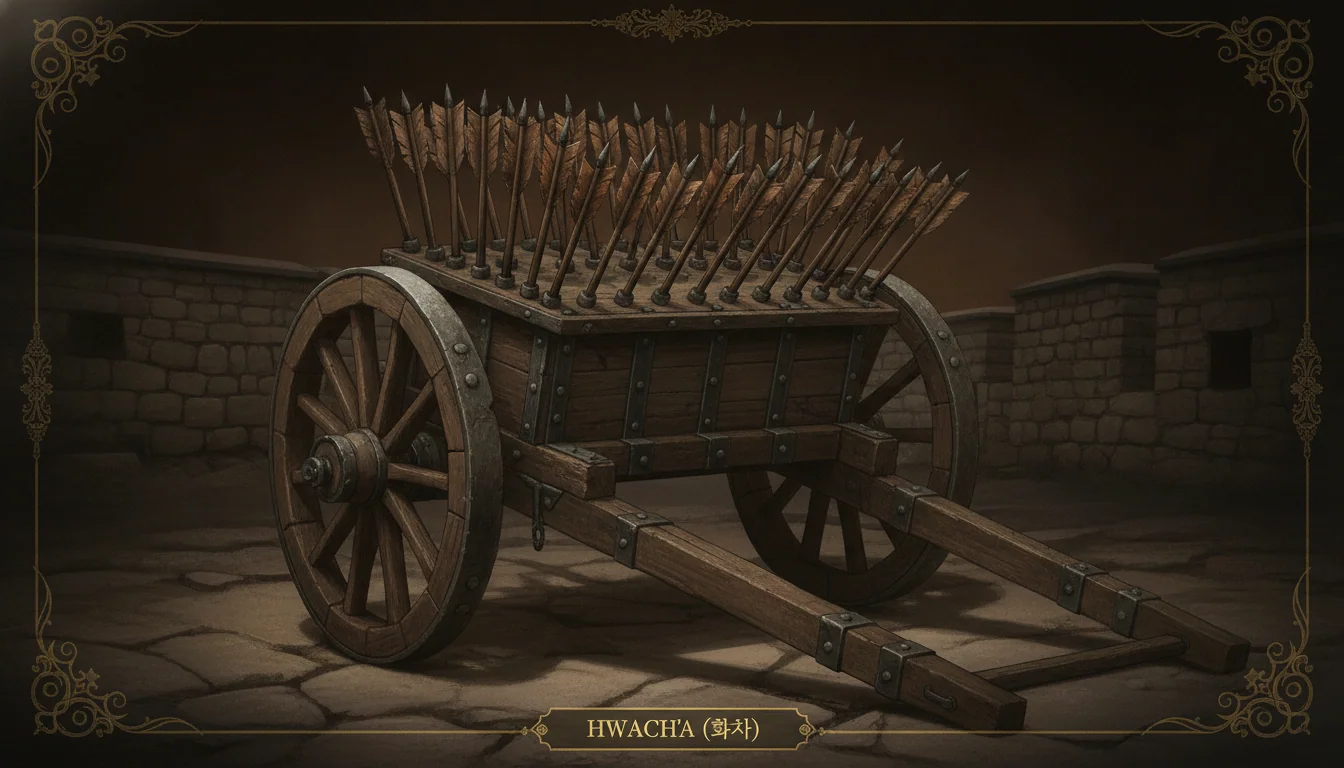
A wheeled cart rolls to the top of a fortress wall. In seconds, a hundred or more arrows leave it at once, each trailing a hiss of burning gunpowder, arcing down onto a besieging army below. This was not science fiction. It was 16th-century Korean military engineering, and it had a name: hwacha, literally "fire cart."
Origins and design
The hwacha's roots trace back to gunpowder-arrow technology developed under King Sejong the Great in the mid-15th century, a period of significant Korean investment in artillery and rocketry. The core projectile was the singijeon, a "signal fire arrow" fitted with a small paper or metal gunpowder tube lashed to its shaft. When ignited, the tube burned and propelled the arrow forward in essentially the same physical principle as a modern bottle rocket, giving the projectile far greater range than a bow could achieve on its own. Larger singijeon variants carried a small explosive charge in the arrowhead, turning the projectile into a crude but genuinely destructive incendiary and anti-personnel weapon rather than a simple fire arrow.
The hwacha itself was the delivery platform built to exploit this technology at scale. Engineers mounted a fan-shaped or multi-row wooden rack on a two-wheeled cart, with each slot in the rack holding one singijeon arrow. The arrows were connected by a fuse train, so that lighting one point could ignite a rapid cascading sequence, launching dozens or, in the largest documented designs, close to 200 rocket arrows within a short span, rather than one at a time as with conventional archery. The cart's wheels let crews reposition the weapon quickly along a defensive line or withdraw it if an enemy assault threatened to overrun the position, a mobility advantage that static artillery of the period generally lacked.
How it changed warfare
Before the hwacha, Korean defenders facing a numerically superior attacking force relied primarily on conventional archery, hand cannons, and fortress walls. The hwacha changed the calculus of a siege or open-field defense by giving a relatively small crew the ability to deliver a devastating volley of fire against a massed formation in a single coordinated launch, a saturation effect that individual archers, however skilled, simply could not replicate. Against the tightly packed infantry formations common to the period, a hwacha volley could inflict serious casualties and, just as importantly, break the cohesion and morale of an advancing force before it reached the defensive line.
The weapon also reflected a broader Joseon-era interest in centralizing and standardizing gunpowder weapons production under state control, part of King Sejong's wider military modernization program that included standardized cannon casting and organized artillery units, an unusually systematic approach to weapons development for its era anywhere in the world.
Key battles: Haengju, 1593
The hwacha's most celebrated moment came during the Imjin War, Japan's invasion of Korea that began in 1592 under the campaigns ordered by Toyotomi Hideyoshi. In early 1593, Korean general Kwon Yul fortified a hilltop position at Haengju, near modern Goyang, with a substantially outnumbered garrison facing a large besieging Japanese force. Korean accounts of the battle describe the defenders using hwacha units, alongside other weapons and, according to several traditional accounts, resourceful improvisation by the fortress's defenders including its women in supplying stones and materials to the fighters, to repel repeated waves of Japanese assault over the course of the engagement.
The defenders held the fortress, and the Battle of Haengju is remembered in Korean military history as one of the three major Korean victories of the Imjin War, alongside the naval campaigns of Admiral Yi Sun-sin. Modern historians generally treat the hwacha's role at Haengju as significant but caution that the battle's outcome, like most premodern engagements, depended on a combination of terrain, fortification, leadership, and morale rather than any single weapon acting in isolation. Contemporary and near-contemporary Korean sources nonetheless single out the hwacha specifically as a weapon that inflicted disproportionate casualties on the massed Japanese assault columns during the fighting.
Technical evolution
Over the following decades, hwacha design continued to develop, with variants differing in the number of arrow slots, the size of the singijeon used, and the addition of explosive warheads to some arrow types for greater destructive effect against personnel and light fortifications. Surviving Joseon-era military manuals, including sections of the Kukjo-oryeui and other technical treatises, describe construction specifications and operational procedures in enough detail that modern reconstructions of the weapon have been built and test-fired, confirming the basic mechanism of simultaneous rocket-arrow launch described in the historical record.
The hwacha represented a genuinely distinctive branch of gunpowder weapons development, diverging from the cannon-focused trajectory that dominated artillery evolution in China and Europe during the same centuries. Rather than concentrating explosive force into a single heavy iron ball fired from a tube, Korean engineers pursued a saturation approach: many smaller rocket-propelled projectiles launched together, trading the destructive power of a single shot for breadth of coverage against a massed target.
Decline and successor
As the 17th and 18th centuries progressed, conventional cannon technology matured considerably, offering greater range, accuracy, and destructive power per individual shot than the hwacha's saturation-volley approach could match. Standardized artillery pieces, easier to manufacture consistently and simpler to aim with precision at a specific target, gradually displaced the hwacha's specialized battlefield role. By the later Joseon period, the weapon appears to have persisted mainly in a reduced capacity, used in specific defensive or ceremonial contexts rather than as a primary field weapon, before effectively disappearing from active Korean military use as firearms and artillery continued to modernize through the 19th century under increasing Western and Japanese influence.
A weapon still under-told outside Korea
Despite its documented battlefield record and its genuinely inventive engineering, the hwacha remains little known outside Korean-language military history compared to contemporaries like the English longbow or the early European cannon. Part of the reason is straightforward: the weapon's use was concentrated in a relatively narrow window of Korean military history, tied closely to the specific pressures of the Imjin War, and it left behind no equivalent of the widely translated European treatises that carried weapons like the crossbow or the arquebus into broader Western historical memory. What survives, in Korean military manuals, in the archaeological reconstruction efforts of recent decades, and in the traditional accounts of battles like Haengju, describes a weapon that solved a specific tactical problem, overwhelming a numerically superior attacking force with concentrated, near-simultaneous fire, using a level of engineering coordination that few other 15th-century societies had attempted at the same scale.
Command and organization
The hwacha did not operate as an isolated curiosity within Joseon military planning; it was integrated into a broader, unusually systematic state approach to gunpowder weapons that also included standardized cannon casting, dedicated units trained specifically in rocket-arrow operation, and centrally administered arsenals that manufactured components to consistent specifications rather than leaving production to individual regional workshops. This state-directed approach to weapons standardization, reflected in surviving Joseon military administrative records, distinguished Korean gunpowder development from many contemporary societies where weapons manufacture remained more decentralized and inconsistent in quality. Crews assigned to hwacha units required specific training in the sequencing and safe handling of the fuse trains that connected each rack of singijeon, since a poorly maintained or improperly sequenced rack risked misfires that could endanger the operating crew as much as the intended target.
Modern reconstruction efforts
Interest in the hwacha has grown considerably in recent decades among Korean historians, military history enthusiasts, and museum curators seeking to document and preserve a weapons tradition that left comparatively few surviving physical examples. Full-scale working reconstructions, built from surviving Joseon-era technical descriptions and illustrations, have been test-fired at Korean historical demonstration events, confirming that the basic fuse-train mechanism described in period sources does function as recorded, launching multiple rocket arrows in rapid, near-simultaneous succession. These reconstruction projects have also helped clarify some of the more uncertain details in the historical record, including the likely effective range of the singijeon, generally estimated by researchers working from reconstructed models at several hundred meters depending on the specific arrow variant and gunpowder formulation used, figures that remain approximate given the incomplete state of surviving period specifications. The hwacha today occupies a prominent place in South Korean military museums and popular historical memory, cited as an example of indigenous technological ingenuity from an era when Korea sat between larger regional powers whose own histories have tended to dominate Western accounts of premodern East Asian warfare.
Quick Answers
Common questions about this topic
What was the hwacha?
The hwacha was a Korean wheeled cart mounted with a rack that could hold and launch up to roughly 100 to 200 singijeon, gunpowder-propelled rocket arrows, in rapid succession or near-simultaneous volleys. It was developed under the Joseon dynasty and saw its most famous use during the Imjin War against Japanese invasion in the 1590s.
How did the hwacha work?
Each singijeon arrow carried a small gunpowder tube attached to its shaft that ignited and propelled the arrow like a rocket, with some larger variants carrying an explosive charge at the tip. The hwacha's rack held rows of these arrows connected by a fuse train, allowing an operator to launch many arrows in a fast sequence rather than one at a time.
Was the hwacha used at the Battle of Haengju?
Yes. In 1593, Korean general Kwon Yul used hwacha units among the defenses of Haengju fortress against a much larger besieging Japanese force, and the battle is widely cited by Korean historians as one of the clearest documented examples of the weapon's battlefield effectiveness.
Why did the hwacha eventually disappear?
As artillery technology matured through the 17th and 18th centuries, more standardized cannons offered greater range, accuracy, and destructive power per shot than a cart-mounted rocket-arrow battery, and the hwacha gradually declined into a specialized or ceremonial role before falling out of military use.

Talk to the People Who Wielded These Weapons
Chat with the soldiers, smiths, and commanders whose lives were shaped by the weapons of their age.
Create your free account →No card required. Talk to anyone in history with 8 free credits a day. Some features require a paid plan.
Join the HistorIQly Club
Get smarter about the past.
Weekly stories, deep dives, and exclusive content straight to your inbox.