Arsenal: The Retiarius Trident
The retiarius trident, a fisherman's spear, let an unarmored gladiator fight Rome's arenas with only a net and dagger, in one of the most theatrical matchups staged.
Read Wikipedia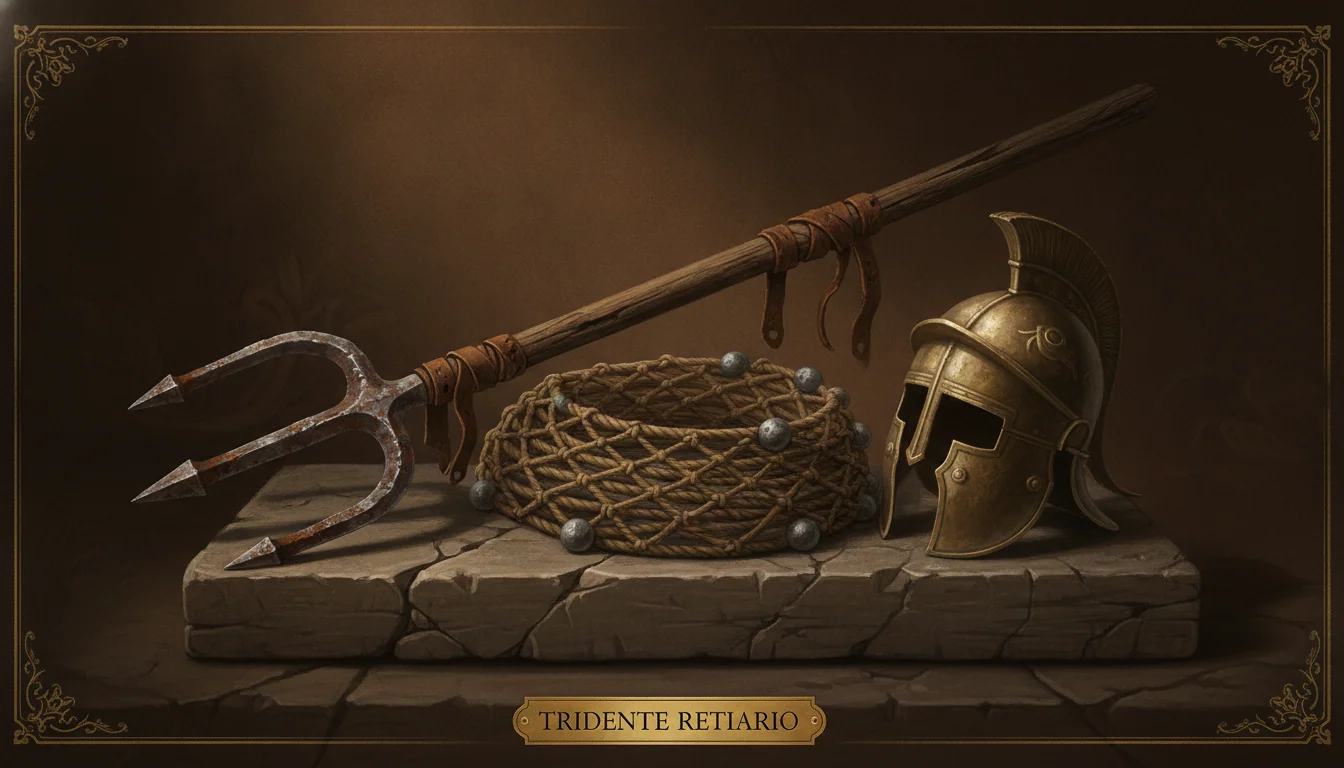
Of all the mismatched pairings the Roman arena staged for its crowds, none was more theatrically lopsided, at least on paper, than the retiarius against the secutor: a nearly naked man carrying a fishing net and a three-pronged spear, sent out against an opponent in a closed bronze helmet, a full-length shield, and the short, deadly Roman gladius. That the retiarius won often enough to remain one of the most popular gladiator types for centuries says something about how well a farming and fishing tool could be reengineered into a genuinely dangerous weapon of reach and speed.
Origins and design
The retiarius trident used in the arena, called the fuscina or tridens in Roman sources, was directly descended from ordinary fishing tridents used across the Mediterranean world for centuries before the games ever adopted it. It typically consisted of a wooden shaft several feet long tipped with three iron prongs, sturdy enough to thrust into an opponent at a distance a sword or dagger simply could not reach. Fishermen throughout the ancient Mediterranean used essentially the same tool to spear fish from small boats or shallow water, and the arena's version changed little beyond perhaps a sturdier shaft built to survive being used against an armored man rather than a fish.
In Roman mythology the trident already carried heavy symbolic weight as the signature weapon of Neptune, god of the sea, capable in myth of splitting rocks and calling up storms. Putting a variant of the god's own weapon in the hands of a gladiator gave the retiarius an air of theatrical menace that plain military equipment could not have matched, and Roman audiences steeped in that mythology would have recognized the visual reference immediately every time a retiarius entered the arena. The choice of a fishing implement over a proper battlefield spear was itself part of the arena's larger theatrical logic, since the games as a whole drew heavily on costuming and symbolic character types rather than a straightforward reenactment of military combat.
The retiarius fought as a set: trident in the dominant hand for reach, a weighted casting net, called a rete, to entangle an opponent from a distance, and a short dagger, the pugio, as a backup for close-range finishing once an opponent was down or tangled. Unlike almost every other gladiator class, the retiarius wore essentially no body armor beyond a padded arm guard and sometimes a shoulder guard called a galerus, protecting the side that would face an opponent's blade while the rest of the body stayed bare and mobile. That combination made the retiarius unusually reliant on skill and timing rather than protection, since a single well-placed blow from an armored opponent could end the fight quickly if the net and the trident's reach failed to keep that opponent at bay.
Training for the role appears to have emphasized footwork and distance management above all else, since a retiarius who let a secutor close inside the trident's reach lost virtually every advantage the style depended on. Surviving accounts and depictions suggest retiarii moved in a wide circling pattern around their armored opponents, using the net's threat to control where the secutor could safely step and the trident's greater reach to force pauses before any exchange of blows, a fighting rhythm closer to modern fencing at long range than to the close, static exchanges more typical of two similarly armed heavy gladiators.
How it changed the arena's spectacle
The retiarius's entire fighting style was built around distance and evasion rather than direct armored exchange, and that made the trident's reach essential rather than decorative. A retiarius who could keep an armored secutor at the far end of the trident's shaft, darting sideways and using the net to disrupt an opponent's footing or vision, could wear down a much better protected fighter over a longer, more suspenseful bout than the quick, brutal clashes typical of two similarly armored gladiators. Roman audiences, who watched enough of these matches to develop real expertise in reading them, prized the retiarius above all for skillful footwork and timing rather than raw strength, since the entire style depended on using the trident to control range against an opponent who could otherwise simply walk the fight down.
Key matchups and the secutor rivalry
The retiarius's defining opponent was the secutor, whose name means "pursuer" and whose helmet was famously designed with a smooth, rounded, fish-like crest and small eye holes, a design most historians read as a deliberate visual joke: the secutor was built to hunt the "fish" represented by the retiarius and his net. That helmet design, while symbolically apt, also came with a real cost. Its narrow eye slits limited the secutor's vision and made it harder to track the net as it came flying in, giving the more exposed but far more mobile retiarius a genuine tactical edge that offset his lack of armor. Mosaics and graffiti surviving from arenas across the empire depict these matchups repeatedly, suggesting they were among the most popular pairings staged, prized precisely because the outcome felt less predictable than a fight between two similarly equipped heavy gladiators.
Technical evolution
The trident itself changed relatively little over the centuries the games ran, since its core design, a long reach weapon paired with a controlling net, already solved the problem it was built for. What evolved more was the surrounding equipment and staging: the galerus shoulder guard grew more elaborate over time, nets were weighted differently for better casting distance and entanglement, and later depictions show variations in prong length and shaft weight that suggest individual gladiators or schools developed personal preferences, the ancient equivalent of a fighter favoring one weight of blade over another. Some later variants of the retiarius, sometimes called the retiarius tunicatus, fought wearing a short tunic rather than going bare-chested, a modification some historians read as reflecting later Roman sensibilities about public nudity rather than any change in fighting tactics. Amphitheaters across the empire, from Pompeii to provincial arenas in North Africa and Gaul, have yielded surviving depictions of retiarii in mosaic and relief, suggesting the type and its equipment traveled with the games wherever Rome exported them, with only minor regional variation in how the net and trident were rendered by local artists.
Decline and what replaced it
The trident and the retiarius who wielded it did not lose out to a better battlefield weapon, unlike frontline gear such as the Roman pilum, because it was never really a battlefield weapon to begin with; it was purpose-built entertainment equipment, refined for the specific theater of the arena rather than for war. Its disappearance tracked the decline of gladiatorial combat itself through the fourth century AD, as Christianity's growing influence across the Roman world turned public opinion and imperial policy against the games. Gladiatorial combat is traditionally said to have been formally banned under an edict associated with the emperor Honorius in 404 AD, though enforcement was gradual and some form of the games likely persisted in isolated pockets for a time afterward. When the arenas finally emptied for good, so did the strange, specific craft of turning a fisherman's tool into one of Rome's most enduring entertainment weapons. What survived instead was the image: the netted, unarmored fighter with his three-pronged spear remains, alongside the gladius and the recognizable crested helmets of the arena's other stock characters, one of the most immediately identifiable silhouettes to come out of Roman popular culture, still reproduced in film, illustration, and museum reconstruction long after the last actual retiarius stepped out of the sand.
Quick Answers
Common questions about this topic
What was the gladiator's trident called?
Roman sources refer to it as the fuscina or tridens, a long-shafted, three-pronged weapon adapted from ordinary fishing equipment for use in the arena, typically paired with a weighted net and a short dagger.
Who fought with a trident in the Roman arena?
The retiarius, a class of gladiator who fought unarmored and lightly equipped, using the trident's reach and a thrown net to control distance against more heavily armored opponents, most famously the secutor, whose helmet was designed with a fish-like crest to symbolize hunting the netted fighter.
Why did the retiarius fight without armor?
The lack of armor was deliberate, both for mobility and for spectacle. Roman audiences understood the retiarius as one of the lowest-status gladiator types precisely because of that vulnerability, which made the matchup against a fully armored secutor especially dramatic and gave the fight its distinctive rhythm of evasion and reach rather than direct armored clashes.
What eventually replaced the trident in the arena?
Nothing replaced it directly, since it was a specialized entertainment weapon rather than a battlefield tool. It disappeared along with the gladiatorial games themselves, which declined through the fourth century AD and were formally suppressed under Christian emperors, most notably by an edict traditionally associated with Honorius in 404.

Talk to the People Who Wielded These Weapons
Chat with the soldiers, smiths, and commanders whose lives were shaped by the weapons of their age.
Create your free account →No card required. Some figures and features require a paid plan.
Join the HistorIQly Club
Get smarter about the past.
Weekly stories, deep dives, and exclusive content straight to your inbox.