Arsenal: The Xiphos, the Greek Hoplite's Backup Blade
The xiphos sword was what a Greek hoplite drew only when the spear broke. A history of the leaf-bladed sidearm that outlasted the phalanx itself.
Read Wikipedia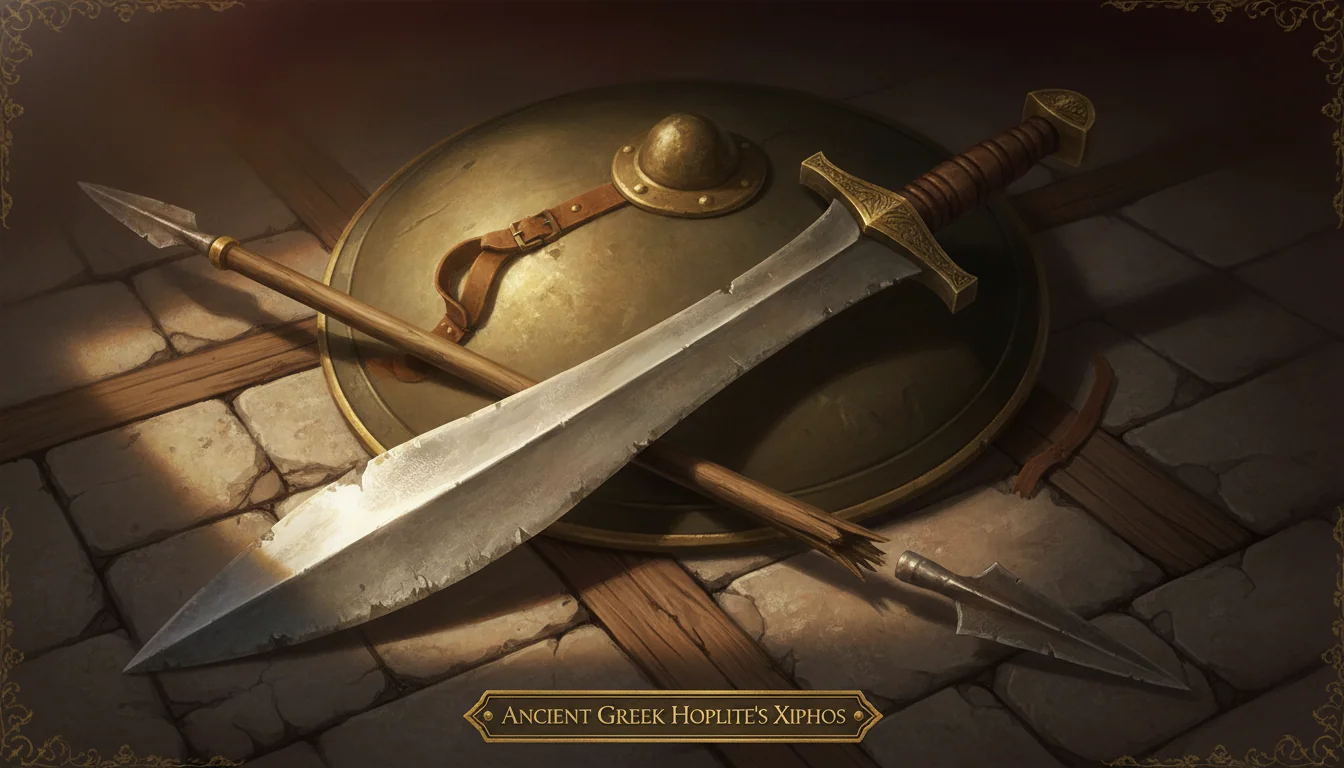
A Greek hoplite went to war carrying two weapons and hoping to use only one of them. The main weapon was the doru, a spear roughly eight feet long, the tool that won or lost battles at range and in the initial crash of two phalanxes meeting. The second weapon was a short, double-edged sword called the xiphos, and a hoplite drew it only when things had already gone wrong: the spear snapped, the shaft splintered against a shield boss, or the fighting collapsed into the kind of shoving, shieldbound chaos where an eight-foot weapon became a liability. The xiphos was the Greek world's backup plan, and for roughly four centuries it was a remarkably good one.
Origins and design
The xiphos appears in Greek art and burial finds from at least the 8th century BC onward, evolving out of earlier Bronze Age slashing swords that Mycenaean warriors had carried centuries before. By the Archaic period it had settled into its recognizable form: a straight, double-edged blade that flared outward into a broad leaf shape past the hilt before tapering hard to a reinforced point. That leaf profile was not decoration. The widened belly of the blade shifted weight forward, giving a cutting stroke more momentum, while the sharply tapered tip kept the weapon capable of a fast, precise thrust into the gaps of an opponent's armor.
Early examples were bronze, cast or worked into shape, but by the Classical period Greek smiths were forging xiphos blades from iron and, eventually, better-quality steel. The hilt was typically a simple cross-guard with a pommel to balance the blade, wrapped in wood, bone, or horn, sized for a single hand so the other arm stayed free for the hoplite's large round shield, the aspis.
The design has deeper roots than the word itself. Late Bronze Age Europe already produced long, straight, leaf-bladed cut-and-thrust swords, the so-called Naue II type, which spread across the Aegean and influenced the swords Homer describes his heroes carrying centuries before a formal hoplite phalanx existed. By the time Greek vase painters of the 6th and 5th centuries BC were decorating pottery with scenes of armed combat, the xiphos had become instantly recognizable, shown hanging in a scabbard at a warrior's hip or gripped underhand in the tight second-stage of a duel, evidence of just how central the weapon was to how Greeks pictured a fully equipped fighting man, not only how they actually fought.
Owning a xiphos, like the rest of a hoplite's panoply, was a personal expense. Hoplite service in most city-states was not a paid professional obligation but a duty tied to a property class, meaning the men who fought in the phalanx bought and maintained their own spear, shield, armor, and sword, and a fighter's sword often stayed in his family for a generation or more, repaired, resharpened, and eventually rehilted rather than discarded.
The last weapon in the crush
What made the xiphos essential was not its performance in the open field. It was what happened once two phalanxes actually met. Ancient battle accounts describe the moment of collision, the othismos, as a shoving match of shield against shield, spear points jabbing through narrow lanes, men packed shoulder to shoulder in a formation that left almost no room to swing anything long. Spears broke constantly in this crush, snapped against shield rims or simply shattered under the pressure of the shove. When that happened, a hoplite without a sidearm was fighting with a shield and his fists.
Herodotus's account of the last stand at Thermopylae in 480 BC captures exactly this progression. After the Spartan and allied spears were broken, he writes, the defenders fought on with their swords, for as long as they had them, and then with hands and teeth once even the swords were gone. That escalation, spear to sword to nothing, was the built-in life cycle of a hoplite's arsenal, and it is precisely why the xiphos mattered: it bought a fighter one more stage of the battle before he was reduced to grappling.
Key battles and the phalanx
The xiphos does not headline any battle the way a named siege engine or a decisive cavalry charge might. Its role was structural rather than dramatic; it shows up in the record as the thing hoplites are depicted drawing at Marathon in 490 BC, at Plataea in 479 BC, and in the long, grinding wars between Greek city-states through the 5th and 4th centuries BC, including the internecine Peloponnesian War. It was a sidearm for citizen-soldiers who trained part-time and fought in seasons, which is most of Greek warfare for most of this era.
The weapon's importance actually grew, rather than shrank, when Philip II and then Alexander the Great built the Macedonian phalanx around an even longer spear, the sarissa, which could run to nearly 18 feet. A sarissa was a devastating weapon in formation and completely useless the moment an enemy closed inside its reach or the line broke. Macedonian phalangites carried the xiphos, or its curved cousin the kopis, as the weapon of last resort for exactly that scenario, meaning the sidearm's job became more critical, not less, as the primary spear grew longer and more unwieldy. Alexander's campaigns through Persia and into India were won primarily by the sarissa phalanx and the Companion cavalry, but the short sword rode along as the answer to every moment those tactics broke down into a personal fight.
Technical evolution
Across the roughly four centuries the xiphos remained in wide use, its basic shape changed remarkably little, a sign of a design that had already solved its problem well. What did change was metallurgy and manufacturing consistency. Archaic bronze blades gave way to iron, and Greek ironworking through the Classical and Hellenistic periods gradually produced harder, more reliably tempered steel, improving edge retention and reducing the risk of a blade bending or snapping under stress. Regional variations existed, most famously the shorter, sturdier blades associated with Laconia, the Spartan homeland, built for close, brutal work rather than reach.
Decline and successor
The xiphos was not out-engineered. It was out-organized. Through the 3rd and 2nd centuries BC, Rome's legions fought their way through the Hellenistic kingdoms that had inherited Alexander's territory, and the encounters exposed a real weakness in the sarissa phalanx: it needed flat, unbroken ground and total formation cohesion to work. At battles like Cynoscephalae in 197 BC and Pydna in 168 BC, Roman legionaries, armed with the short, heavy gladius and the large rectangular scutum, exploited broken terrain and gaps that opened when the Macedonian phalanx tried to maneuver, closing to a range where the long sarissa could not be brought to bear and the phalanx's own sidearms could not compensate fast enough. The gladius, not a better version of the xiphos but a different solution built for a different kind of army, became the Mediterranean's dominant close-quarters blade as Roman power replaced Hellenistic power across the region.
Echoes
The xiphos never had the singular glamour of a named legendary blade, and it rarely gets billed as the weapon that won a war. It is instead the weapon that shows up in the background of every Greek battle for four hundred years, the thing a hoplite reached for when his spear was gone and the fight had turned into something closer and uglier than the tactics manual described. That quiet, constant presence, backup weapon to an entire civilization's way of war, is its own kind of historical importance. Long after the phalanx itself was obsolete, the leaf-shaped blade survived in museum cases and in film and television as the visual shorthand for Greek warfare itself, precisely because it was the weapon a hoplite actually touched at the worst moment of the fight.
Quick Answers
Common questions about this topic
What was a xiphos used for?
The xiphos was a hoplite's secondary weapon, drawn only after the primary weapon, a roughly eight-foot spear called a doru, broke or was lost in the crush of close combat. In the tight press of a phalanx battle line, its short double-edged blade could thrust or cut in the narrow gaps where a full-length spear was useless.
How long was a xiphos blade?
Most surviving and depicted examples run 45 to 60 centimeters, roughly 18 to 24 inches, though some Spartan-associated versions were shorter still, closer to 30 centimeters. The blade widened into a leaf shape past the guard before narrowing sharply to a reinforced point, a profile built for both a slashing cut and a stiff thrust.
Did the Spartans really use unusually short swords?
Later Greek writers preserved an anecdote about a Spartan soldier complaining that his sword was too short, answered with the suggestion that he simply add a step toward the enemy. The story may be more legend than literal fact, but archaeological finds do support that some Laconian-made blades ran shorter than the typical xiphos elsewhere in Greece.
What replaced the xiphos?
The xiphos was not defeated by a better sword so much as by a better army. As Rome absorbed the Hellenistic world through the 2nd century BC, the short, heavy Roman gladius, backed by legionary tactics that broke up rigid phalanx formations, became the dominant close-quarters blade of the Mediterranean.

Talk to the People Who Wielded These Weapons
Chat with the soldiers, smiths, and commanders whose lives were shaped by the weapons of their age.
Create your free account →No card required. Some figures and features require a paid plan.
Join the HistorIQly Club
Get smarter about the past.
Weekly stories, deep dives, and exclusive content straight to your inbox.