Arsenal: The M1 Carbine - America's Lightweight and Its Lasting Controversy
M1 Carbine history in brief: America's most-produced WWII firearm, carried by paratroopers and officers, and decades of debate over whether it actually worked.
Read Wikipedia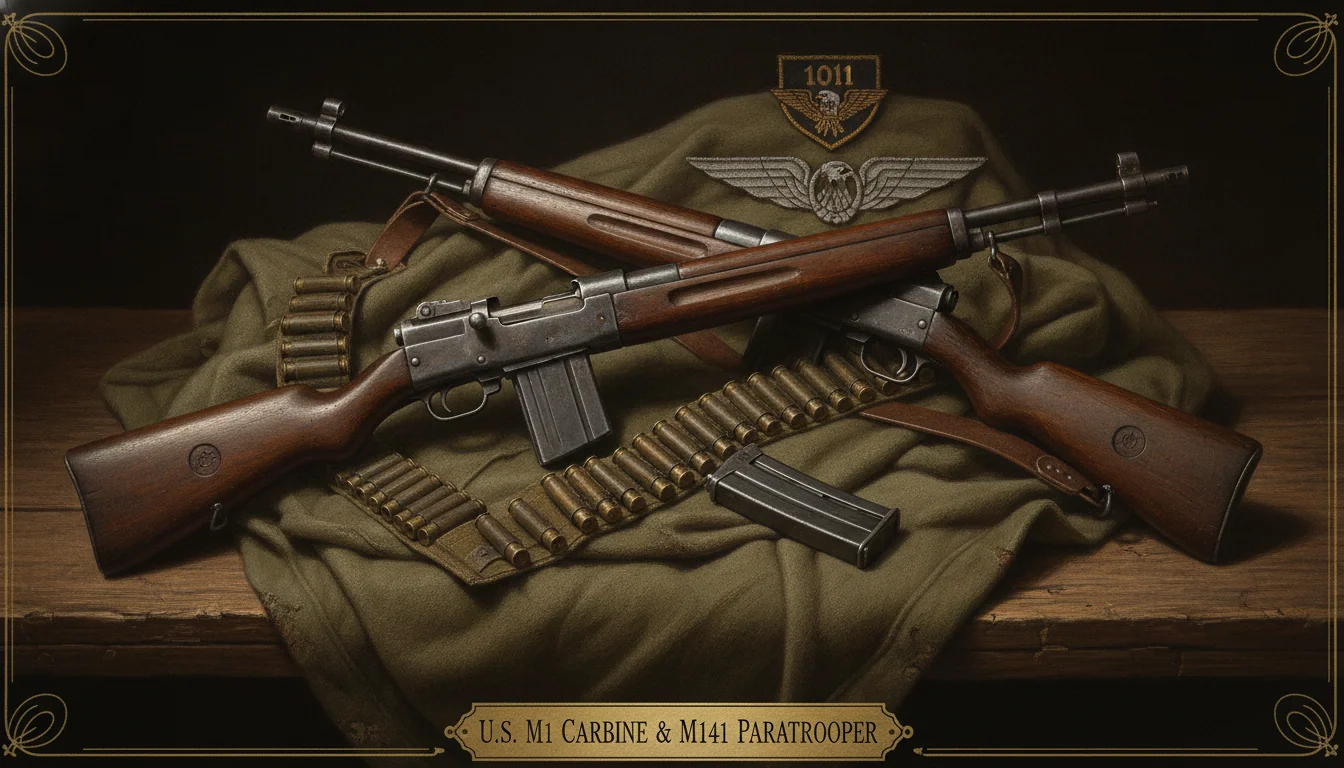
In September 1941, the United States Army adopted a new rifle that was not quite a rifle. Lighter than any standard infantry arm, shorter than a service weapon, chambered for a round that split the difference between a pistol and a real cartridge, the M1 Carbine was designed to solve a specific problem: what should an American officer, artillerist, radioman, or truck driver carry when a full rifle is too much but a pistol is not enough?
The answer weighed 5.2 pounds unloaded and held 15 rounds. Over the next four years, more than 6 million of them were built. Almost everyone who carried one had an opinion about it. Those opinions have never fully converged.
The design problem and the solution
By the late 1930s, the US Army recognized that the M1 Garand - its excellent standard infantry rifle - was inappropriate for a large portion of the soldiers who needed to carry something. The Garand weighs around 9.5 pounds empty and fires a powerful .30-06 Springfield cartridge designed for infantry engagement at several hundred yards. For the men most likely to use a personal weapon at very close range, or who needed their hands free for other equipment, the Garand was simply more rifle than the mission required.
The Army issued a specification in 1940 for a Light Rifle: something under 5 pounds, under 18 inches in barrel length, firing a cartridge lighter than the .30-06 but more powerful than any service pistol. Ten manufacturers submitted designs. Winchester's entry won.
The .30 Carbine cartridge - technically the 7.62x33mm - was developed alongside the rifle. It launches a 110-grain bullet at roughly 1,990 feet per second from the carbine's 18-inch barrel, producing about 967 foot-pounds of muzzle energy. That compares to the Garand's .30-06, which generates roughly 2,700 foot-pounds. The carbine round is closer in energy to a pistol cartridge than to a rifle cartridge, which matters a great deal at range and through barriers.
The design of the action is attributed primarily to David Marshall Williams, a firearms designer who worked for Winchester and had developed the short-stroke gas piston mechanism while serving time in a North Carolina prison for a killing. Williams himself later claimed full credit. Winchester's actual development team was a collaboration, and the extent of Williams's specific contribution has been debated by small-arms historians for decades. The film Carbine Williams (1952) starring James Stewart credits him with the entire invention; the truth is considerably more complicated.
What it was replacing
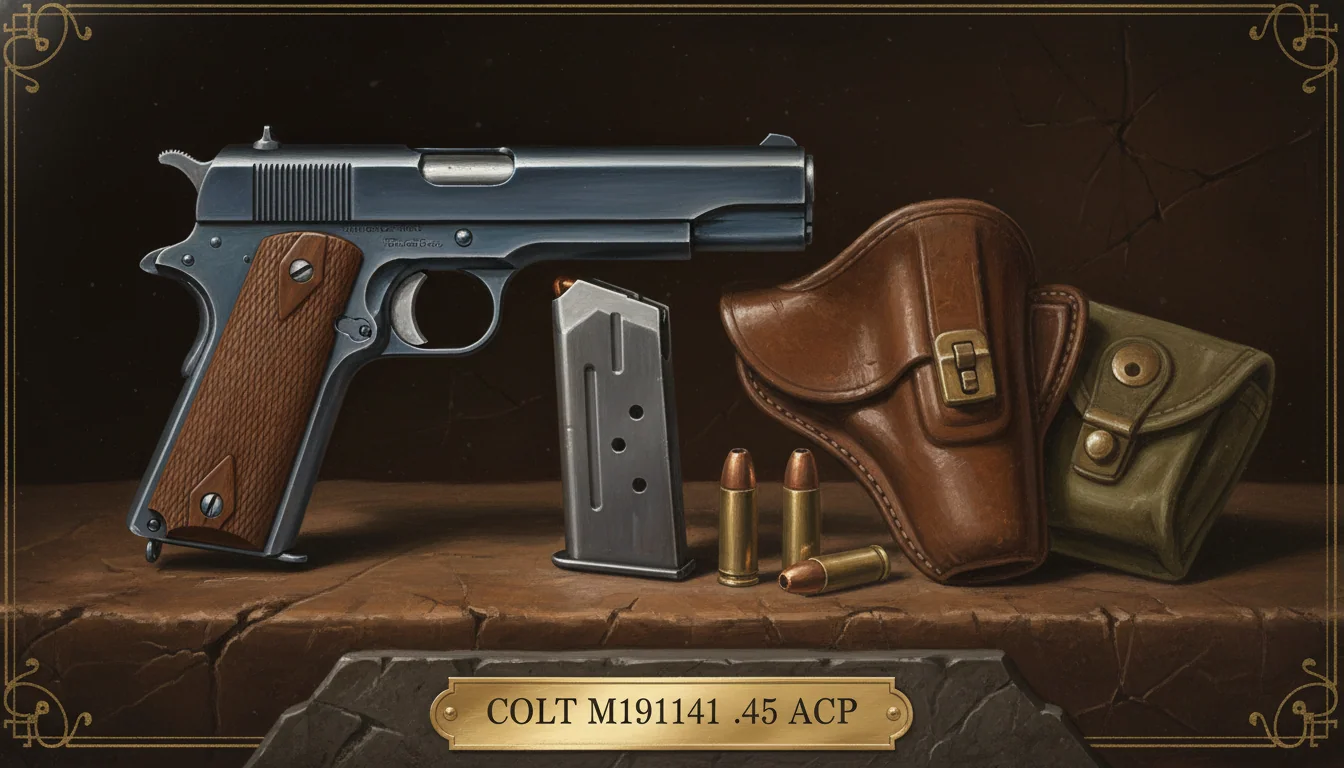
The M1 Carbine was issued to officers, NCOs, heavy weapons crews, vehicle operators, paratroopers, radiomen, and anyone else whose primary job was something other than infantry fire and movement. These were people who previously carried a Colt 1911 pistol - a fine sidearm at arm's length, nearly useless beyond 25 yards for most shooters.
Compared to the 1911, the Carbine was transformative. It gave support personnel a weapon they could actually use at 100 yards, with fifteen rounds of ammunition and minimal recoil that allowed rapid follow-up shots. At close to medium ranges against personnel who were not wearing substantial protective clothing, the weapon worked as intended.
Paratroopers who jumped in the M1A1 version - with its folding metal stock designed to reduce the silhouette during a jump - particularly valued the carbine. The 82nd and 101st Airborne divisions carried large numbers of them. At night, in close terrain, moving fast through Norman hedgerows or landing in Dutch fields, the light weight and controllability had genuine value.
The Pacific controversy
The M1 Carbine's reputation took its first serious hits in the Pacific Theater. Soldiers fighting in the dense jungle terrain of islands like Guadalcanal, Peleliu, and Okinawa reported that the .30 Carbine round frequently failed to stop enemy soldiers who were moving fast through heavy vegetation at close range. Some accounts describe soldiers hitting targets multiple times with no immediate effect.
The round's terminal ballistics at distance were poor. At 100 yards, the .30 Carbine has already lost substantial energy. At 200 yards it performs approximately as well as a standard pistol cartridge at close range - which is not very well, and certainly not well enough to reliably incapacitate a determined adversary wearing heavy clothing or carrying momentum downhill.
Marines in particular developed a low opinion of the carbine after Pacific combat. The preference for the M1 Garand or the Browning Automatic Rifle (BAR) among experienced infantry in the Pacific was strong and consistent. The carbine remained in use because supply considerations meant soldiers carried what they were issued, but requests to exchange carbines for Garands were common.
Korea and the cold weather problem
The M1 Carbine's reputation suffered its most documented crisis in Korea during the winter of 1950 to 1951. During the fighting around the Chosin Reservoir and the subsequent retreat, American soldiers reported that the carbine's terminal effectiveness dropped dramatically in extreme cold. Enemy soldiers wearing quilted winter clothing, advancing at night in Korean winter temperatures that regularly fell below -20 Celsius, were reportedly absorbing multiple carbine hits without stopping.
Whether the problem was purely ballistic or whether cold-weather lubricant failures also contributed to feeding and cycling issues has been debated. Both factors likely played a role. The carbine's relatively low-energy round was less forgiving than the Garand's when penetration mattered, and the winter experience in Korea confirmed what Pacific veterans had suspected: the .30 Carbine was adequate under certain conditions and inadequate under others.
The Army began issuing more M1 Garands and M1918A2 BARs to infantry units in Korea, and the carbine was gradually pushed back toward its intended role - support personnel and vehicle crews who were unlikely to face massed infantry assault in extreme cold.
Later variants and the M2
The M2 Carbine, a selective-fire variant capable of automatic fire, was developed late in World War II and issued more broadly during the Korean War. The M2's fully automatic mode was controversial; the .30 Carbine cartridge, already borderline in stopping power, does not become more effective when wasted in automatic bursts. The M2 was sometimes described as a way to make the carbine's shortcomings even more visible.
The M3 Carbine was fitted with an early infrared night-vision scope - the Sniperscope - for use by dedicated night-security personnel. It was experimental and cumbersome by modern standards, but represented genuinely early thinking about a capability that would eventually define modern infantry operations.
What eventually replaced it
The M1 Carbine remained in American military service through the Vietnam War, where it was issued to South Vietnamese forces and to American advisors in the early years of US involvement. Its replacement came in two stages: the M16 rifle replaced it in infantry use, and later the M9 Beretta pistol and then the M4 carbine addressed the need for a compact personal defense weapon among support personnel.
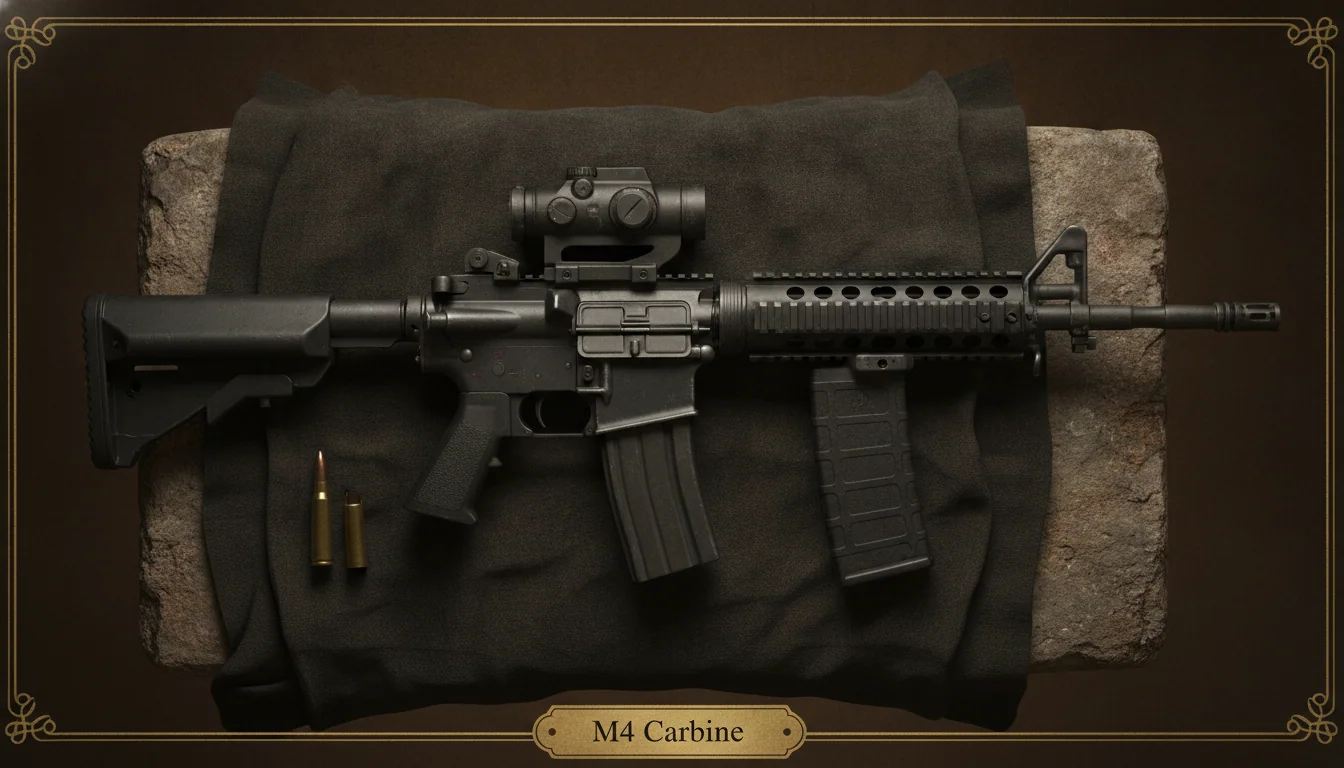
The modern M4 carbine - itself a shortened variant of the M16 - resembles the M1 Carbine's mission profile more than its mechanics: a lightweight, shoulder-fired arm for personnel who need more than a pistol but less than a full infantry rifle, firing an intermediate cartridge. The wheel has come around.
Legacy
Few chapters of M1 Carbine history are as contested as its reputation among the men who carried it. It occupies an unusual place in American military history. It was genuinely loved by the people it was designed for - paratroopers, officers in close terrain, support personnel who had previously been essentially unarmed - and genuinely distrusted by infantry who compared it directly to the Garand. Both groups were right. It did what it was designed to do reasonably well, and it failed when pressed into roles it was not designed for.
Its visual profile is clean, elegant, and unmistakable. It appears in almost every Hollywood depiction of World War II. In the hands of actors playing everyone from Eisenhower to Saving Private Ryan's characters, the M1 Carbine is part of how Americans picture the war. Whether it actually won firefights or lost them depended, as with most weapons, entirely on who was carrying it and what they were being asked to do with it.
Quick Answers
Common questions about this topic
What was the M1 Carbine designed for?
The M1 Carbine was designed to replace the pistol as a defensive weapon for officers, NCOs, support troops, vehicle crews, and other personnel who needed something more useful than a handgun but did not require a full-power infantry rifle. It was never intended to replace the M1 Garand in front-line infantry use.
Was the M1 Carbine effective in World War II?
The M1 Carbine received mixed reviews. In the European theater it was generally regarded as adequate for its role. In the Pacific, soldiers complained that the .30 Carbine round lacked sufficient energy to stop enemy soldiers reliably at longer ranges or through heavy vegetation. Many soldiers preferred the M1 Garand when they could get one.
How many M1 Carbines were produced?
Approximately 6.1 million M1 Carbines were produced during World War II, making it the single most mass-produced American firearm of the war. Production was spread across multiple manufacturers including Winchester, Inland, IBM, National Postal Meter, and Underwood.
What is the difference between the M1 and M1A1 Carbine?
The M1A1 was a variant developed for paratroopers, featuring a folding metal stock that allowed the rifle to be jumped with and deployed quickly after landing. The barrel, action, and caliber were identical to the standard M1 Carbine. The M1A1 was highly prized by airborne troops for its compact dimensions and relatively light weight of around 5.5 pounds loaded.

Talk to the People Who Wielded These Weapons
Chat with the soldiers, smiths, and commanders whose lives were shaped by the weapons of their age.
Create your free account →No card required. Some figures and features require a paid plan.
Join the HistorIQly Club
Get smarter about the past.
Weekly stories, deep dives, and exclusive content straight to your inbox.