Arsenal: The M4 Carbine - America's Go-Everywhere Rifle
M4 carbine history from Eugene Stoner's AR-15 to Iraq and Afghanistan: the shorter rifle that became America's standard infantry weapon through three decades of war.
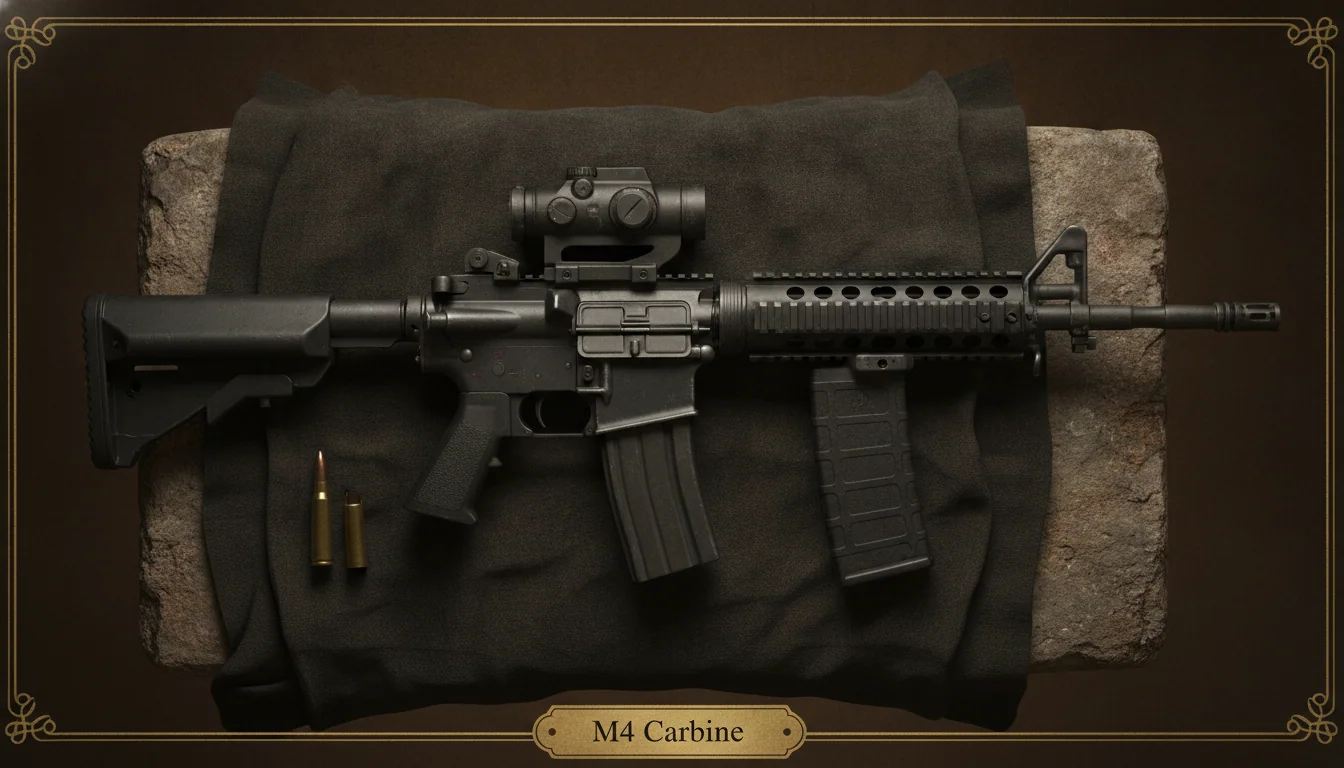
In 1994, the United States Army officially adopted a rifle that was shorter, lighter, and more maneuverable than anything it had issued before to standard infantry. The M4 carbine was not a new design - its lineage ran directly from Eugene Stoner's AR-15 through three decades of incremental military refinement - but it was the first formal acknowledgment that the 20-inch rifle of the Cold War era was no longer suited to how America's military actually fought.
The M4 carbine history spans thirty-two years and three major wars. It remains the rifle more American soldiers have carried into combat than any other weapon since the M1 Garand. It has been deployed to every significant American military operation since the mid-1990s, it has generated more aftermarket accessories than any other platform in history, and it has appeared in so many video games and action films that generations of young people grew up with a more intuitive understanding of its controls than they had of many other mechanical objects. It is, for better and occasionally for worse, the rifle of the American age of war.
From ArmaLite to the Army
The M4's lineage begins in the late 1950s at a small California firm called ArmaLite, where engineer Eugene Stoner developed a lightweight rifle using aircraft-grade aluminum alloys and glass-reinforced polymers at a time when every military rifle in the world was built from steel and wood. Stoner's AR-15 was chambered for a small-diameter, high-velocity cartridge - what became the 5.56x45mm NATO round - and weighed dramatically less than the M14 it was meant to replace.
Colt purchased the commercial rights to the AR-15 design in 1959. The US military, after years of institutional resistance, began issuing the rifle - designated M16 - to soldiers in Vietnam in 1963 and 1964. The early history was troubled: initial M16 rifles issued without cleaning kits to soldiers told the weapon was self-cleaning jammed repeatedly in combat with fatal consequences. Improvements including a chrome-lined barrel, a revised buffer system, a modified flash suppressor, and proper maintenance training eventually made the M16A1 a reliable field weapon.
The M16A2, adopted in 1983, added a heavier barrel, a new rifling twist optimized for heavier projectiles, and replaced the original full-automatic fire mode with a three-round burst. It was an accurate and robust rifle. It was also 39 inches long with the stock extended, and that length had become a problem.
Military experience in Vietnam, in counterterrorism operations, and in the training of helicopter crews and vehicle operators had demonstrated a consistent practical issue: the standard rifle was too long for the environments where it was increasingly being used. Soldiers in helicopters, in armored personnel carriers, in narrow village doorways, or in dense jungle had to choose between their weapon and their mobility. The 20-inch barrel that gave the M16 its long-range accuracy was a liability in close terrain.
Colt had been producing shortened variants under the CAR-15 designation for years, primarily for special operations use. These weapons had proved their value but existed outside the standard supply chain. The M4 formalized what special operators had been doing for a generation: it took the M16A2 action and trimmed it. The barrel went from 20 to 14.5 inches. The fixed stock became a collapsible four-position design. The result was 6 to 7 inches shorter than the M16 with the stock collapsed, and roughly half a pound lighter.
The Army adopted the M4 officially in 1994. Production contracts eventually shifted to FN Herstal of Belgium, which manufactures the rifle at its US facility in South Carolina.
What the shorter rifle changed
The M4 arrived for American forces during a decade shaped by operations where the traditional rifle's range advantage mattered less than its handling in confined and complex terrain. Peacekeeping deployments in the Balkans involved urban environments where long rifles were awkward. Operations in Haiti in 1994 required the same. The configuration of post-Cold War American military power was shifting toward smaller, faster-moving units operating in villages, compounds, and cities rather than across open European ground.
After September 2001, the M4 became the standard infantry weapon for what became the longest sustained period of American combat deployment since Vietnam. In Afghanistan, where fighting often occurred in mountain villages and narrow valley approaches, and in Iraq, where it was nearly entirely urban, the M4's compactness was a genuine tactical advantage. Throughout these deployments, the M4 faced adversaries most often armed with the AK-47 and its derivatives, a design engineered for exactly the kind of rugged, low-maintenance combat encountered in both theaters. Clearing rooms, moving through doorways, operating from vehicles, and keeping a weapon ready in helicopter seats were all meaningfully easier with the shortened platform.
Special operations forces used the M4A1 variant, which restored the full-automatic capability the standard M4 replaced with burst fire. Delta Force, Rangers, SEAL teams, and their partner units became among the most extensively deployed small-unit forces in American military history, and they did it primarily with the M4A1 platform.
The rifle system also became modular in ways Stoner could not have anticipated in the 1950s. The flat-top upper receiver, standard on the M4A1 and later adopted widely, replaced the fixed carrying handle with a Picatinny rail that accepted telescopic sights, red-dot optics, laser aiming devices, infrared illuminators, and combination fore-grips without gunsmith work. The SOPMOD kit - Special Operations Peculiar Modification - developed a set of interchangeable accessories that let a soldier configure the same rifle for night fighting, room clearing, or longer-range precision by swapping components in the field. The M203 grenade launcher attached under the barrel as it had on the M16; the M320 eventually replaced it as the standard under-barrel grenade system.
The reliability controversy
The M4's performance record in sustained high-volume firefights was damaged by documented failures during several engagements in Afghanistan. The Battle of Wanat in 2008, in which a small American outpost was assaulted by a large force and the defenders fired thousands of rounds over a short period, produced clear evidence of multiple M4 stoppages caused by heat-induced carbon fouling and barrel overheating. Nine American soldiers were killed in that engagement.
Critics of the direct-impingement gas system used by the M16 and M4 - which vents propellant gas directly into the bolt carrier rather than operating a separate piston - argued that it accumulated fouling faster than piston-operated designs under sustained cyclic fire. The Army conducted comparative studies and concluded that while the M4 had measurable disadvantages in high-cyclic-rate sustained fire, its accuracy, reliability in normal use, and logistical simplicity still met the requirements for most infantry scenarios.
Incremental improvements continued. The M4A1, already standard in special operations, was extended more broadly. Modified bolt carriers and buffer systems addressed some of the heat and fouling complaints. Adoption of the M855A1 Enhanced Performance Round, an improved 5.56mm cartridge with a hardened steel penetrator tip, improved performance against protected targets and hard cover.
In games and on screen
No rifle in history has been reproduced in entertainment media as thoroughly as the M4. From the mid-1990s through the 2020s, it appeared as the default visual marker of American military capability in film, television, and video games at a rate that made it more recognizable to civilian audiences worldwide than any other modern firearm.
Call of Duty 4: Modern Warfare, released in 2007, placed the M4A1 in the hands of millions of players and created a generation of users who could operate the game version with intuitive fluency. Counter-Strike series variants of the M4A1 became among the most-played weapon configurations in competitive gaming. Military thrillers and action films from this era used the M4 as visual shorthand for "American soldier" in the same way that the Colt Single Action Army revolver had once signaled "frontier lawman." The real weapon and its digital representation became difficult to disentangle in popular culture.
Where the M4 stands now
In 2022, the US Army selected the SIG Sauer XM5 - chambered in a new 6.8x51mm cartridge designed to defeat emerging body armor threats at extended ranges - as the winner of the Next Generation Squad Weapon program. The XM5 is heavier and more powerful than the M4, and represents a significant shift in the Army's assumptions about what infantry rifles need to accomplish.
As of 2026, the M4 and M4A1 remain the primary issued rifles for the large majority of American military personnel. The transition to the XM5 has proceeded for selected units but has not displaced the M4 across the force. The logistical investment in the M4 platform - billions of dollars in inventory, training infrastructure, accessories, and institutional familiarity - means the rifle will remain in American service long after any formal replacement program is announced.
The weapon that Eugene Stoner designed as a lighter alternative to the heavy rifles of the Cold War has outlasted most of the strategic frameworks that produced it. It began as a jungle counterinsurgency weapon, spent twenty years in European alliance planning, and then served for three decades as the primary tool of American expeditionary operations in the Middle East and Central Asia. What follows it will inherit a standard that took thirty years to set - and will find it not easy to improve on what the M4 got right.
Quick Answers
Common questions about this topic
When was the M4 carbine adopted by the US military?
The M4 carbine was officially adopted by the United States military in 1994. It was designed as a shorter, lighter alternative to the M16A2, with a 14.5-inch barrel instead of 20 inches and a collapsible four-position stock. It became the primary service rifle for US Army infantry, replacing the M16 in most frontline roles through the 2000s.
What is the difference between the M4 and the M4A1?
The standard M4 has a three-round burst fire mode and a single-fire mode. The M4A1, issued primarily to special operations forces, has a full-automatic capability instead of burst fire. The M4A1 also typically has a heavier barrel profile to handle sustained fire. Both use the same basic platform, chambered in 5.56x45mm NATO.
What replaced the M4 carbine?
In 2022 the US Army selected the SIG Sauer XM5, chambered in a new 6.8x51mm cartridge, as the winner of the Next Generation Squad Weapon competition. As of 2026, the M4 and M4A1 remain the primary issued rifles for the large majority of American military personnel, with the XM5 transition underway for selected units.
How accurate is the M4 carbine?
The M4 has an effective range of approximately 500 meters against point targets and 600 meters against area targets, using standard 5.56x45mm NATO ammunition. Its shorter barrel reduces muzzle velocity compared to the full-length M16, which slightly reduces terminal effectiveness at longer ranges. For the close to medium distances of most urban and jungle engagements, this tradeoff was considered acceptable.

Talk to the People Who Wielded These Weapons
Chat with the soldiers, smiths, and commanders whose lives were shaped by the weapons of their age.
Talk to a WarriorJoin the HistorIQly Club
Get smarter about the past.
Weekly stories, deep dives, and exclusive content straight to your inbox.