Arsenal: The Colt 1911 Pistol - America's Sidearm for Three Wars
Colt 1911 history: John Browning's .45 ACP design survived a 6,000-round test in 1910 and carried American soldiers through four conflicts over 74 years of continuous service.
Read Wikipedia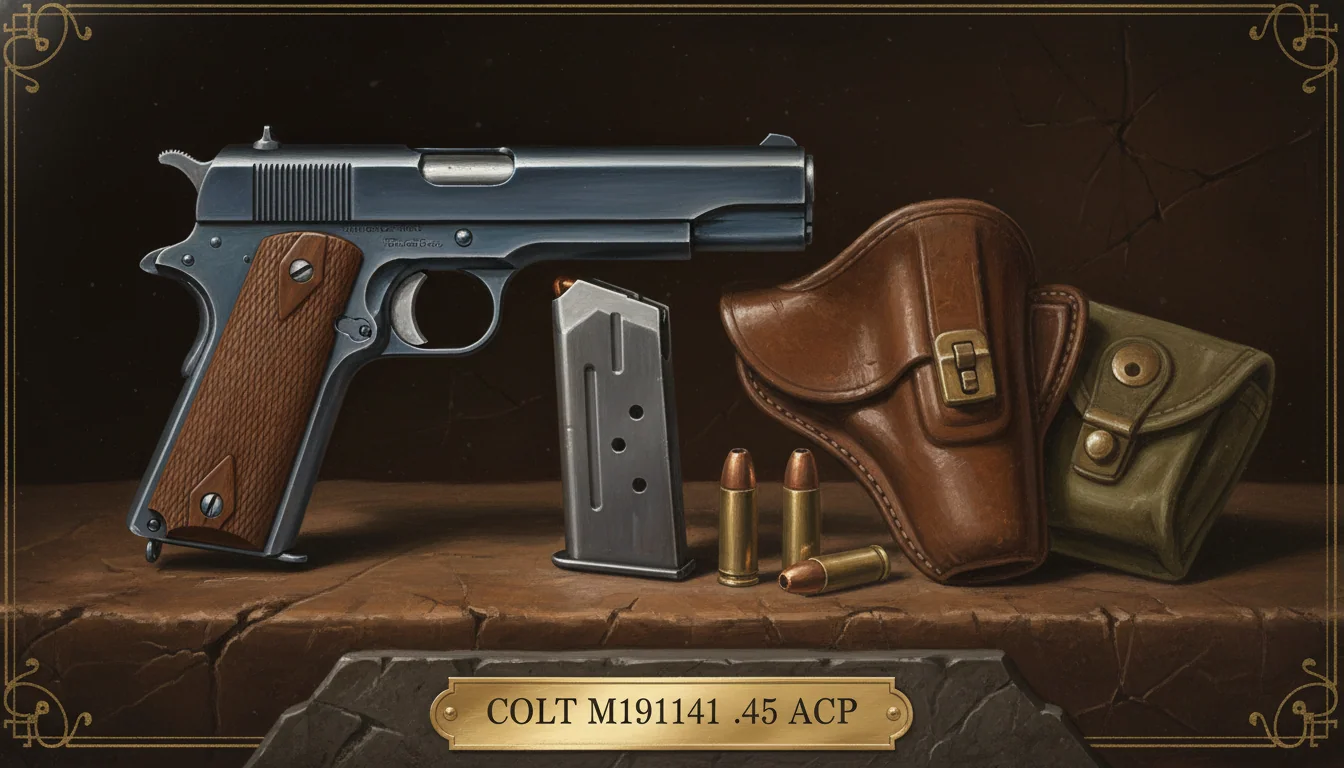
In the spring of 1910, the United States Army conducted a pistol trial that was, by the standards of weapons testing, something close to brutal. The competing designs were each required to fire 6,000 rounds over two days, cooling by submersion in water between strings of fire. If the pistol ran hot during a string, it was dunked in a bucket of cold water and immediately put back into action.
One design survived this without a single malfunction.
It was submitted by John Moses Browning, working through Colt, and it chambered a new cartridge Browning had designed specifically for the trial: the .45 Automatic Colt Pistol. On March 29, 1911, the Army formally adopted it as the Model 1911. American soldiers would carry versions of it for the next 74 years.
The problem it was built to solve
The 1911's existence begins with a complaint from the Philippines. During the insurrection that followed the Spanish-American War of 1898, American forces engaged opponents - primarily Moro warriors in the southern islands - who did not stop when hit with the standard .38 Long Colt revolver. The .38 Long Colt fired a light, low-velocity projectile that was technically adequate against most opponents and demonstrably insufficient against those whose determination to keep fighting exceeded the round's ability to discourage them.
The Army convened a board, which issued a specification: any replacement pistol must be self-loading (semi-automatic), and it must chamber a cartridge of at least .45 caliber. The logic was terminal performance - a heavier bullet moving at moderate velocity would transfer more energy to tissue and produce more reliable incapacitation than lighter, faster alternatives.
Browning heard the specification and went to work. He had already produced successful designs for automatic pistols in various calibers, and he understood the mechanism problems that caused earlier semi-automatics to malfunction under field conditions. His solution was the short-recoil locked-breech design that would become one of the fundamental operating principles of the 20th century pistol: when fired, the barrel and slide recoil together briefly before the barrel unlocks and the slide continues rearward, ejecting the spent case and chambering a fresh round as it returns forward.
The specific genius of the 1911's mechanism was not the principle - Browning had used it before - but the refinement. The tolerances were set generously enough to function reliably with dirty ammunition in muddy conditions, while remaining tight enough for reasonable accuracy. The grip angle was designed around the human hand's natural pointing posture. The single-action trigger, once cocked, broke cleanly at a weight that allowed accurate shooting under stress.
The M1911A1: evolution in the details
The original 1911 had a slightly longer trigger, a flat mainspring housing, and a shorter grip safety spur than the variant most people recognize. Soldiers in WWI provided feedback that the design, while reliable, could be improved for hands of different sizes and for ease of use under field conditions.
The M1911A1, standardized in 1924, incorporated the changes: a shorter trigger, an arched mainspring housing, a longer grip safety tang, a wider front sight, and revised cutouts in the frame. These were not fundamental redesigns - a 1911 magazine feeds in an M1911A1, and the internal mechanism is essentially identical - but they addressed the genuine ergonomic complaints that came back from the Western Front.
The M1911A1 would be the configuration carried through WWII, Korea, and Vietnam. It is the variant usually meant when someone says "the 1911."
WWI: the pistol meets real war
The United States entered WWI in April 1917 with a relatively small professional army and an immediate need to arm an enormous conscripted force. The 1911 had been in production for six years, but production capacity had not been built for industrial-scale war. Colt's plant in Hartford was supplemented by Remington Arms, which produced a substantial quantity of 1911s under that designation.
The pistol went to the Western Front carried by officers, non-commissioned officers, artillerymen, machine gunners, and aviators - anyone who needed a personal defensive weapon rather than or in addition to a rifle. For trench warfare, where combat could occur at distances measured in feet rather than yards, the 1911's power and reliability made it genuinely useful rather than merely symbolic.
One of the most documented uses of a 1911 in WWI involved Sergeant Alvin C. York of the 82nd Division, who in October 1918 in the Meuse-Argonne engaged a German machine gun position, killing multiple soldiers with his rifle and then, when a bayonet charge came at close range, killing the attackers with his pistol - the standard .45 ACP 1911 he carried. York received the Medal of Honor. The 1911 is specified in most accounts of the engagement.
WWII: scale production and global service
WWII required pistols at a scale WWI had not. Production was distributed across multiple manufacturers: Colt, Ithaca Gun Company, Remington-Rand Corporation, and Union Switch and Signal. Even Singer Manufacturing Company, better known for sewing machines, produced a small run of 1911A1s early in the war before being shifted to other military production. More than 1.9 million M1911A1 pistols were manufactured between 1940 and 1945.
The pistol was carried by American officers, paratroopers, aircrew, tankers, and a wide range of enlisted personnel in both the European and Pacific theaters. Its .45 ACP round, which had originally been specified against Moro warriors in the Philippines, proved useful against Japanese soldiers in similar close-range fighting in the Pacific island campaigns.
Photographs of the campaign in the Pacific, and later of European combat, show the 1911 in holsters, tucked into waistbands, and held in hands at the moment before or after a firefight. It is one of the visual signatures of the American soldier in the Second World War alongside the M1 Garand rifle and the GI helmet.
The design that never really went away
The Beretta M9 replaced the M1911A1 as the US military's standard sidearm in 1985, after NATO standardization pressures pushed toward a common 9mm cartridge. The transition was not without critics. The Army had used the same pistol design for 74 years, and the institutional attachment to .45 ACP was genuine.
Some of that attachment was cultural, and some was ballistic. Combat experience in the 2000s produced renewed debate about 9mm terminal performance versus .45 ACP, and several specialized units - most prominently elements of the Marine Corps Forces Special Operations Command - formally returned to 1911-pattern pistols, typically in enhanced configurations from manufacturers such as Springfield Armory and Colt. The argument in 2006 was essentially the argument made in 1906: the .45 caliber pistol stops people more reliably than lighter alternatives.
The 1911 in its contemporary commercial form is manufactured by dozens of companies and carried daily by a substantial portion of the American civilian shooting market. It has been in continuous production for well over a century. The basic mechanism Browning finalized around 1909 has been refined but not fundamentally altered in the century-plus since.
What Browning gave us
John Moses Browning died in 1926 in Liege, Belgium, at the Fabrique Nationale d'Armes de Guerre factory where he had gone to supervise production of another design - the pistol that would be completed after his death as the Browning Hi-Power. He left behind more than 120 patents and weapons designs that collectively define the modern firearm industry: the M2 machine gun that is still in production; the Browning Automatic Rifle; the Winchester Model 1894 lever-action rifle; and the 1911, which is the most copied pistol design in history.
The 1911 is a product of a specific historical moment: the early years of the semi-automatic pistol, when the operating principles had been established but not yet consolidated into standard practice. What Browning contributed was not the invention of those principles but their perfection into something that could survive a 6,000-round torture test, be manufactured in the millions by companies that made sewing machines and typewriters, and continue doing its job in the mud of the Meuse-Argonne, the sand of the Pacific, the cold of Korea, and the jungle of Vietnam.
The Army replaced it in 1985. The decision was defensible on logistic grounds. But the 1911 keeps getting picked back up, by special operations units, by competitive shooters, and by the civilian market, which votes with purchasing decisions that are not obviously wrong. A design that has been in continuous production for 115 years and keeps returning to active military service is not simply nostalgic. It is a solution to a problem that has not changed.
For the rifle that served alongside the 1911 through WWII and Korea, see Arsenal: The M1 Garand. For the controversial weapon that replaced the Garand in Vietnam, see Arsenal: The M16 Rifle.
Quick Answers
Common questions about this topic
Who designed the Colt 1911?
The Colt 1911 was designed by John Moses Browning (1855-1926), one of the most prolific and influential firearms designers in history. Browning also designed the .45 ACP cartridge it chambers, and he submitted the design through Colt's Patent Firearms Manufacturing Company after years of development and refinement following Army trial feedback.
How long did the 1911 serve as the US military's standard sidearm?
The M1911 was formally adopted by the US Army on March 29, 1911, and remained the standard military sidearm until 1985, when it was replaced by the Beretta M9 in 9mm. That is 74 years of continuous service, spanning World War I, World War II, the Korean War, and the Vietnam War.
What is .45 ACP?
.45 ACP stands for .45 Automatic Colt Pistol, a cartridge Browning designed specifically for this pistol. It fires a 230-grain bullet at roughly 830 feet per second from a 5-inch barrel. The Army specified a caliber of at least .45 after the underpowered .38 Long Colt revolver proved inadequate against determined adversaries in the Philippines during 1899-1902.
Why did some military units return to the 1911 after adopting the M9?
Several specialized units, including MARSOC and certain USMC elements, returned to 1911-pattern pistols in the 2000s after concerns arose about the 9mm M9's terminal performance in combat conditions. The .45 ACP's heavier projectile was seen as more reliably effective in certain combat scenarios, echoing the same terminal-performance argument that produced the original 1911 a century earlier.

Talk to the People Who Wielded These Weapons
Chat with the soldiers, smiths, and commanders whose lives were shaped by the weapons of their age.
Create your free account →No card required. Talk to anyone in history with 8 free credits a day. Some features require a paid plan.
Join the HistorIQly Club
Get smarter about the past.
Weekly stories, deep dives, and exclusive content straight to your inbox.