Arsenal: The Blunderbuss
The blunderbuss armed pirates, Royal Navy sailors, and stagecoach guards for two centuries. How a flared brass muzzle became the ultimate close-quarters gun.
Read Wikipedia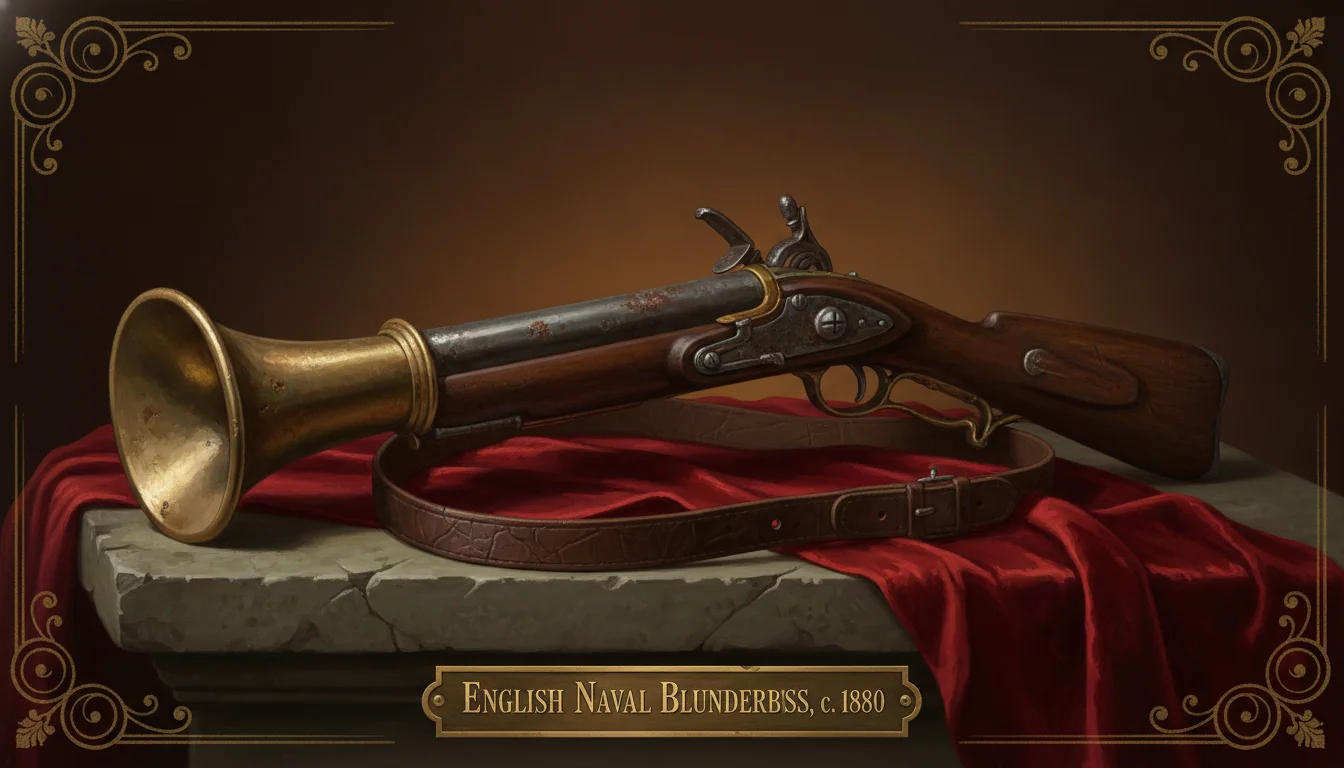
A blunderbuss does not look like it belongs to the same family as a musket or a rifle. Its barrel flares outward at the muzzle like the bell of a trumpet, its stock is often stubby enough to be fired from the hip, and the whole object reads less like a precision instrument than a piece of applied intimidation. That impression is not wrong. The blunderbuss was built for a narrow, brutal job: putting a wall of shot into anyone standing within a few paces, in the seconds available before that person reached you with a cutlass or a knife. For roughly two centuries it did that job in ships' companionways, on the roofs of stagecoaches, and behind the doors of private homes, before faster and more accurate firearms made it obsolete.
A short, wide gun for a short, wide problem
The blunderbuss emerged from the general family of European smoothbore firearms sometime in the late 16th or early 17th century, as gunsmiths in the Low Countries and Germany experimented with short-barreled guns designed to fire a charge of loose shot rather than a single ball. The exact lineage is murky, as it often is with practical tools that many gunsmiths across many workshops converged on independently rather than any single inventor patenting a breakthrough. What is clear is that by the middle of the 1600s, short, flare-muzzled guns loaded with shot were recognizable and named across Dutch, German, and English gunmaking traditions.
The name itself is Dutch. Blunderbuss is an English mangling of donderbus, literally "thunder tube," a fitting label for a gun that produced a deep, booming report and a visible gout of flame and smoke. English usage of the word is attested from the mid-1600s onward, tracking closely with the weapon's adoption by English sailors, guards, and householders.
The defining feature, the flared muzzle, is often assumed to have scattered the shot into a wider pattern. Careful examination of surviving barrels and modern replica testing both suggest this is largely a myth. The taper was too short and too gradual to meaningfully redirect shot traveling at speed. What the flare did do was make loading dramatically easier. A powder charge and a fistful of shot, poured or funneled in under stress, in the dark, on a heaving deck, or from the swaying roof of a moving coach, is far more likely to actually go down the barrel when the opening is three or four inches wide instead of three-quarters of an inch. The flare was a practical answer to a practical problem: how do you reload a muzzleloader fast when your hands are shaking and the ground will not hold still.
There was also a second effect, harder to quantify but well attested in period accounts: the flared muzzle looked like the mouth of a small cannon when pointed at a person. Sailors and travelers who left no doubt they were being threatened by one seem to have taken the hint. A blunderbuss did not need to be fired to do useful work.
Anatomy of a thunder tube
A typical blunderbuss carried a smoothbore barrel of brass or iron, usually somewhere between twelve and thirty inches, dramatically shorter than the three-foot-plus barrels standard on contemporary muskets. Brass was popular for naval and maritime versions because it resisted the corrosion of salt air far better than iron, an important consideration for a weapon that spent months at a time in a ship's arms locker or strapped near an open deck. The stock was usually walnut, sometimes fitted with a large trigger guard sized to accommodate a gloved hand, and the better examples carried engraved brass or silver furniture that marked out the piece as belonging to an officer or a gentleman rather than common issue.
Ignition followed the same path as every other European smoothbore of the era. Early blunderbusses used matchlock or wheellock mechanisms; by the mid-1600s the flintlock had become dominant and remained so for most of the weapon's working life. In the closing decades of its use, into the early 1800s, some blunderbusses were converted to or built new with percussion cap ignition, which eliminated the flintlock's exposed pan and made misfires from wind or damp spray considerably less common, a real advantage on a ship's deck. Percussion blunderbusses are less common than flintlock survivors, largely because the weapon's overall decline was already underway by the time percussion ignition became widespread in the 1820s.
The load was the point of the whole design. Rather than a single ball, a blunderbuss was typically charged with a fistful of lead shot, sometimes mixed with whatever scrap metal, nails, or gravel was at hand in a genuine emergency. At the ranges it was meant for, a few paces at most, this produced a devastating spread capable of striking multiple targets or multiple parts of a single target at once. Accuracy beyond perhaps ten to fifteen yards fell off sharply, but accuracy was never the point.
Repelling boarders
The blunderbuss found its most famous role at sea. Naval combat in the age of sail regularly ended in boarding actions, with two crews crammed into a confined space, fighting hand to hand among rigging, hatches, and gun carriages. In that environment, a long-barreled musket was nearly useless. There was no room to level it, no time to reload it, and no need for its range. A blunderbuss, by contrast, could be fired one-handed if necessary, reloaded quickly even in a panic, and used to sweep a companionway or a boarding party crowded at the rail with a single blast.
The British Royal Navy issued blunderbusses to petty officers and marines for exactly this purpose through the 1700s and into the Napoleonic Wars, often mounting larger swivel-gun versions of the same concept on the rail itself to rake an enemy deck before boarding. Pirates and privateers of the late 1600s and early 1700s, operating in the Caribbean and along the American coast during the period historians now call the golden age of piracy, adopted the same weapon for the same reason: it was cheap, forgiving of poor maintenance, and lethal in exactly the chaotic, close-range melee that a boarding action produced. A pirate crew rushing an enemy deck, or defending their own from a Royal Navy cutting-out party, had far more use for a gun that could hit several men in a doorway than one that could hit a single man at two hundred yards.
Guarding the coach road
On land, the blunderbuss found an equally natural home defending travelers against highwaymen. Britain's road network in the 18th century ran through long stretches of open country where armed robbers could work with little fear of pursuit, and a stagecoach or mail coach carrying cash, mail, and passengers was an obvious target. Coach guards, and the British Post Office in particular once it began formally arming mail guards in the later 1700s, favored the blunderbuss for reasons that mirrored its shipboard use: it could be reloaded on a moving, jolting vehicle far more reliably than a musket, it required no careful aim against an attacker at close range on a dark road, and its wide muzzle sent an unmistakable message to anyone thinking about approaching the coach. Guards typically carried a blunderbuss alongside a brace of pistols, prepared to use the long gun on the first attacker and the pistols on whoever kept coming.
The same logic extended into private life. A blunderbuss kept by a bed or a front door did not require the owner to be a skilled marksman. In a dark room, at close range, against an intruder, its wide, forgiving pattern made it one of the most practical personal-defense weapons available before the era of reliable repeating firearms. Wealthier households sometimes kept elaborately finished blunderbusses as much for display as defense, but the plainer working examples that survive in large numbers today attest to how ordinary a piece of household equipment it had become by the 18th century.
Being outpaced
The blunderbuss's decline tracks the broader story of 18th- and 19th-century firearms development. The double-barreled shotgun, increasingly available from the later 1700s, offered a second shot without reloading at all, undercutting the blunderbuss's main advantage of forgiving, quick reloads. Percussion ignition in the 1820s made conventional shotguns and pistols more reliable in wet weather, closing the gap that had once favored the blunderbuss's simple, robust mechanism. The arrival of paper and later metallic cartridges by the mid-1800s let a double-barreled gun be reloaded faster than a blunderbuss could manage its single wide barrel, and the rise of the practical revolver gave individuals a multi-shot handgun that solved the same close-range problem the blunderbuss had always addressed, without the bulk.
By the middle of the 19th century, the blunderbuss had effectively vanished from serious use, surviving mainly as an antique curiosity, a stage prop, or a decorative piece over a mantelpiece. Its working life, roughly from the 1600s to the early 1800s, had spanned the entire age of sail and the golden age of piracy, and it left behind an enduring visual shorthand: to this day, the flared brass muzzle is instantly recognizable as the mark of a pirate, a highwayman's victim, or an 18th-century household on guard.
The blunderbuss belongs to a broader story of firearms adapting to the specific violence of their era. Its predecessor in spirit, the flintlock musket, solved the problem of arming mass infantry formations with a weapon anyone could learn quickly, while its eventual successor in personal defense, the Colt Peacemaker, answered the same close-range problem the blunderbuss had always faced with a faster, more accurate, multi-shot design. Between those two poles sits the thunder tube: crude, loud, and for two hundred years exactly right for the fight it was built to win.
Quick Answers
Common questions about this topic
Did the flared muzzle of a blunderbuss spread the shot wider?
Not meaningfully. Modern tests on original and reproduction barrels show the flare had little effect on shot pattern. Its real purposes were faster reloading, especially in a moving boat or coach, and the visual effect of a gaping brass mouth pointed at an attacker.
Why was the blunderbuss so popular with pirates and the Royal Navy?
Boarding actions were fought at arm's length in cramped, crowded spaces where aiming carefully was impossible. A blunderbuss loaded with a fistful of shot, nails, or scrap could hit several attackers at once without requiring precision, which made it far more useful than a single-ball musket in that setting.
What replaced the blunderbuss?
Double-barreled shotguns, which became widely available from the late 1700s onward, offered a second shot without reloading. Percussion ignition in the 1820s and metallic cartridges by the mid-1800s made shotguns and revolvers faster and more reliable, and the blunderbuss had largely disappeared from practical use by the mid-19th century.
Where does the name blunderbuss come from?
It comes from the Dutch word donderbus, a combination of donder, meaning thunder, and bus, meaning tube or barrel. English speakers reshaped the pronunciation into blunderbuss over the course of the 17th century.

Talk to the People Who Wielded These Weapons
Chat with the soldiers, smiths, and commanders whose lives were shaped by the weapons of their age.
Create your free account →No card required. Some figures and features require a paid plan.
Join the HistorIQly Club
Get smarter about the past.
Weekly stories, deep dives, and exclusive content straight to your inbox.