Arsenal: The Kukri, the Gurkha Blade That Never Retired
The kukri knife history spans two centuries: Gurkha soldiers have carried this forward-curved blade through two world wars without it ever leaving service.
Read Wikipedia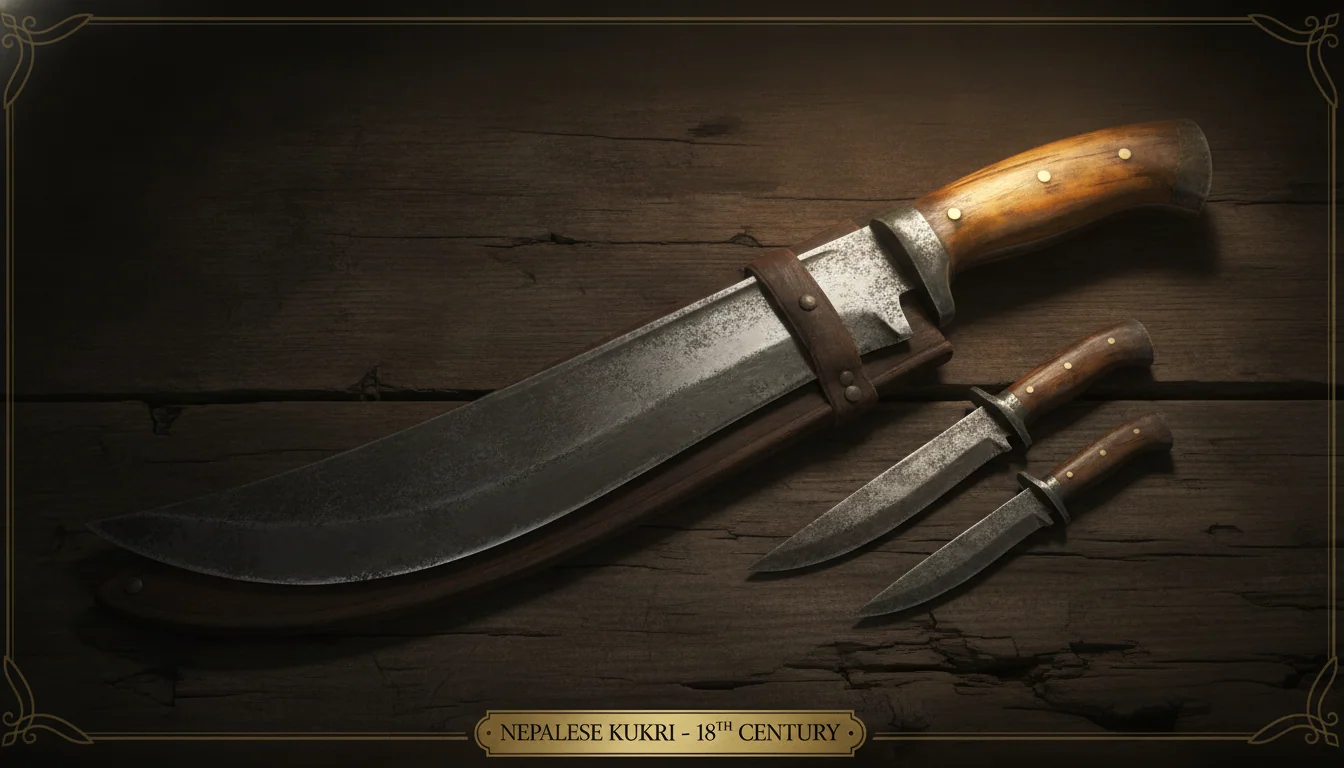
Most edged weapons in a museum arsenal have a clear retirement date, the moment gunpowder, industrial steel, or changing tactics made them obsolete. The kukri never got that memo. Two centuries after it became standard equipment for Nepalese hill soldiers, it is still carried by Gurkha regiments in the British and Indian armies, still issued for both ceremonial and practical purposes, and still, by multiple documented accounts, used in genuine close-quarters combat as recently as the wars in Afghanistan and Iraq. Few weapons in this series have a service record this long or this current.
Origins in the hills of Nepal
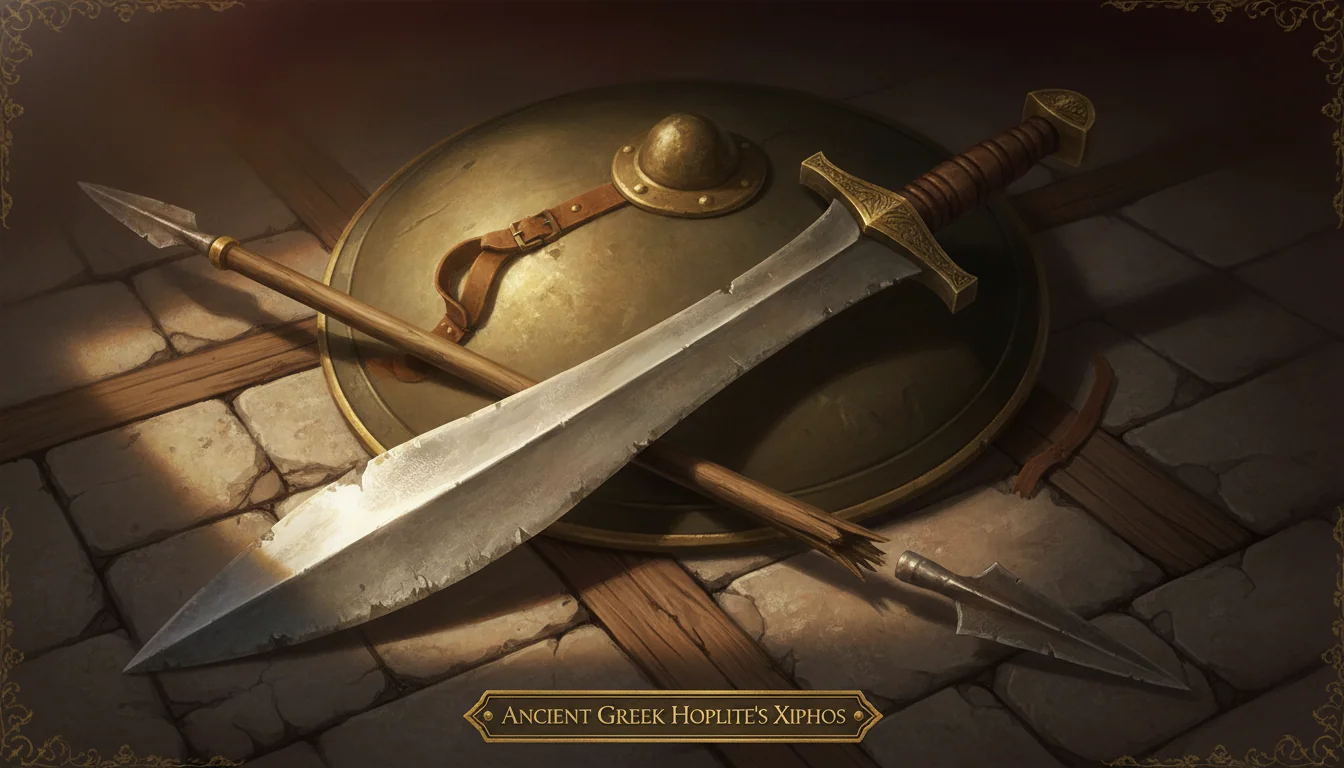
The history of the kukri knife begins in debate. Specialists disagree about its direct ancestry, with some tracing elements of its inward-curved profile to older South Asian blades and even to Greek kopis-family swords carried east through centuries of trade and conquest, though a direct unbroken lineage is difficult to prove. What is better documented is that the weapon in its recognizable modern form became closely associated with the Gorkha Kingdom during its rapid territorial expansion under Prithvi Narayan Shah in the second half of the 18th century, as the kingdom consolidated the hill principalities that would become Nepal.
By the time of the Anglo-Nepalese War of 1814-1816, the kukri was firmly established as the standard sidearm of Gorkhali soldiers. That war ended in a negotiated peace that left the East India Company deeply impressed by the fighting quality of the forces they had struggled to defeat, and it directly led to the recruitment of Nepalese hill soldiers into British colonial service, the beginning of the Gurkha regiments that carry the blade to this day.
Anatomy of an unusual blade
The kukri's silhouette is immediately recognizable: a broad, heavy blade that curves forward and inward, with the cutting edge on the concave side, tapering to a point that angles back toward the handle. This is a distinctly different geometry from most world swords and knives, which are either straight or curve away from the wielder along the cutting edge.
The forward curve concentrates weight and momentum toward the front third of the blade, so that a chopping stroke delivers force disproportionate to the weapon's relatively short length, typically 30 to 45 centimeters. A small notch near the base of the blade, called the kaudi or cho, appears on many traditional kukris and has been explained variously as a blood-drip stop, a symbolic representation of a cow's foot or a deity's trident, or simply a manufacturing feature that helps sharpen the blade evenly to the hilt. No single explanation is universally agreed upon, and the notch's meaning likely varies by region and maker.
The handle is traditionally hardwood, horn, or in higher-status examples, ivory or metal, fitted without a full crossguard, relying instead on the blade's natural geometry and the user's grip to prevent the hand from sliding onto the edge during a forward chopping stroke. A well-made kukri is typically issued with two smaller companion blades tucked into the same sheath: a chakmak, a small blunt tool for sharpening and striking fire, and a karda, a small utility knife.
The blood-before-sheathing legend
No discussion of the kukri avoids the popular claim that once drawn, it must draw blood before it can be put away, even if that means a small cut on the owner's own finger. This story circulates widely in Western accounts of Gurkha culture and has become a kind of shorthand for the weapon's fearsome reputation.
The reality is less absolute. Some individual and regional traditions do involve small ceremonial cuts associated with specific ritual or religious contexts, particularly around Dashain festival sacrifices where kukris are used in animal sacrifice, but it is not a universal military rule that every Gurkha soldier follows for every kukri drawn in daily use. Like many good weapon legends, this one contains a real cultural thread stretched into an absolute rule that makes for a better story than a strict military regulation would.
Two world wars, one unchanged design
The 20th century gave the kukri its widest stage. Gurkha regiments serving under British command fought in both world wars, and the kukri traveled with them to the trenches of the Western Front, the mountains of Italy, the jungles of Burma, and North Africa. Wartime accounts, some from British officers and some from opposing forces, repeatedly describe the psychological effect the weapon had in close-quarters night raids, where Gurkha soldiers gained an outsized reputation for silent infiltration tactics culminating in kukri use at extremely close range.
Some of these accounts have been embellished over decades of retelling, as tends to happen with weapons that acquire folkloric reputations. But the documented core is solid: Gurkha units were consistently rated among the most effective infantry of both world wars, and the kukri was their signature edged weapon throughout, issued alongside standard rifles as both a tool and a close-combat backup.
From colonial service to modern militaries
After Indian independence in 1947, the Gurkha regiments split, with some transferring to the newly independent Indian Army and others remaining with the British Army under a formal tripartite agreement between Britain, India, and Nepal. Both branches retained the kukri as standard-issue equipment, a rare instance of a 19th-century edged weapon surviving intact into modern professional militaries not as a ceremonial relic but as genuinely issued kit.
The kukri's continued relevance rests on practicality rather than nostalgia. Its heavy chopping geometry makes it useful for clearing brush, preparing camp, and general field utility tasks well beyond combat use, functioning much like a machete with a more aggressive cutting profile. This dual identity, working tool and close-combat weapon, is likely the single biggest reason it never fell out of service the way purely combat-specialized blades eventually did.
Gurkha units have been documented using the kukri in actual combat as recently as the conflicts in the Falklands, Afghanistan, and Iraq, both in close-quarters engagements and in the broader psychological role the weapon has carried since the 19th century. British and international press coverage of these incidents has occasionally overstated individual episodes, but the underlying pattern, that Gurkha soldiers continue to carry and, when necessary, use the kukri in genuine modern combat, is well established.
Manufacturing and variety
Traditional kukris are hand-forged by Nepalese craftsmen known as kamis, using techniques passed down through specific blacksmithing lineages, particularly around the town of Bhojpur, long regarded as a center of quality kukri production. Blade steel, handle material, and decorative fittings vary enormously depending on whether a given kukri is intended for military issue, ceremonial presentation, or the tourist and collector market that has grown substantially since the weapon became internationally famous through 20th-century war reporting.
Military-pattern kukris issued to modern Gurkha regiments are more standardized than the historical hand-forged versions, produced to consistent specifications for durability and interchangeability, while ceremonial and presentation kukris, often given as gifts to visiting dignitaries or retiring officers, retain elaborate traditional decoration, ornate sheaths, and precious metal fittings.
A weapon that outlived its era by design
Most weapons in this series eventually gave way to something more effective for the tactical problems of their time, the gladius to the spatha, the longbow to gunpowder, the saber to the semi-automatic pistol. The kukri's persistence is unusual precisely because it never needed to compete on those terms. It was never primarily a battlefield equalizer against superior enemy technology, the way, say, a crossbow or a rifle was. It has always functioned as a hybrid tool, equally at home splitting firewood and settling close engagements, which means the technological pressures that retired other edged weapons largely did not apply to it.
Two centuries after Gorkhali soldiers carried it against East India Company forces who then decided they would rather recruit these soldiers than keep fighting them, the kukri remains issued, sharpened, and, when circumstances require it, still drawn.
For another edged weapon whose reputation and function outlasted the empire that fielded it, see our history of the Zulu iklwa, and for a curved blade built on a similarly forward-weighted cutting geometry, see our history of the Egyptian khopesh.
Quick Answers
Common questions about this topic
What makes the kukri's shape distinctive?
The kukri has a forward-curved, inward-angled blade with a heavy belly toward the tip, concentrating mass and cutting force where the blade meets the target. This design lets a relatively short blade deliver chopping power closer to that of a much longer weapon, while the curve keeps the edge oriented correctly through a natural swinging or drawing motion.
Is it true a kukri must draw blood before being sheathed?
This is a widely repeated legend rather than a documented universal rule. Some regional customs and individual traditions do involve a small ritual cut before resheathing a ceremonial kukri, but it is not a binding law observed by all Gurkha soldiers, and many kukris are drawn, used practically, and resheathed with no ritual at all.
When did the kukri first appear in its modern form?
Kukri-type blades have roots in earlier Nepalese and South Asian edged weapons going back centuries, but the form recognized today crystallized during the Gorkha Kingdom's expansion in the late 18th century, and it was firmly established in military use by the time of the Anglo-Nepalese War of 1814-1816.
Do Gurkha regiments still carry the kukri today?
Yes. Gurkha soldiers serving in the British Army and the Indian Army continue to carry the kukri as both a standard-issue tool and a ceremonial and combat weapon, making it one of the very few edged weapons from the early 19th century still in active military service in the 21st century.

Talk to the People Who Wielded These Weapons
Chat with the soldiers, smiths, and commanders whose lives were shaped by the weapons of their age.
Create your free account →No card required. Some figures and features require a paid plan.
Join the HistorIQly Club
Get smarter about the past.
Weekly stories, deep dives, and exclusive content straight to your inbox.