Bleeding the Patient: Two Thousand Years of Bloodletting and the Four Humors
Bloodletting history's most famous case: George Washington's doctors bled him four times in his final hours, following centuries of medical theory on the four humors.
Read Wikipedia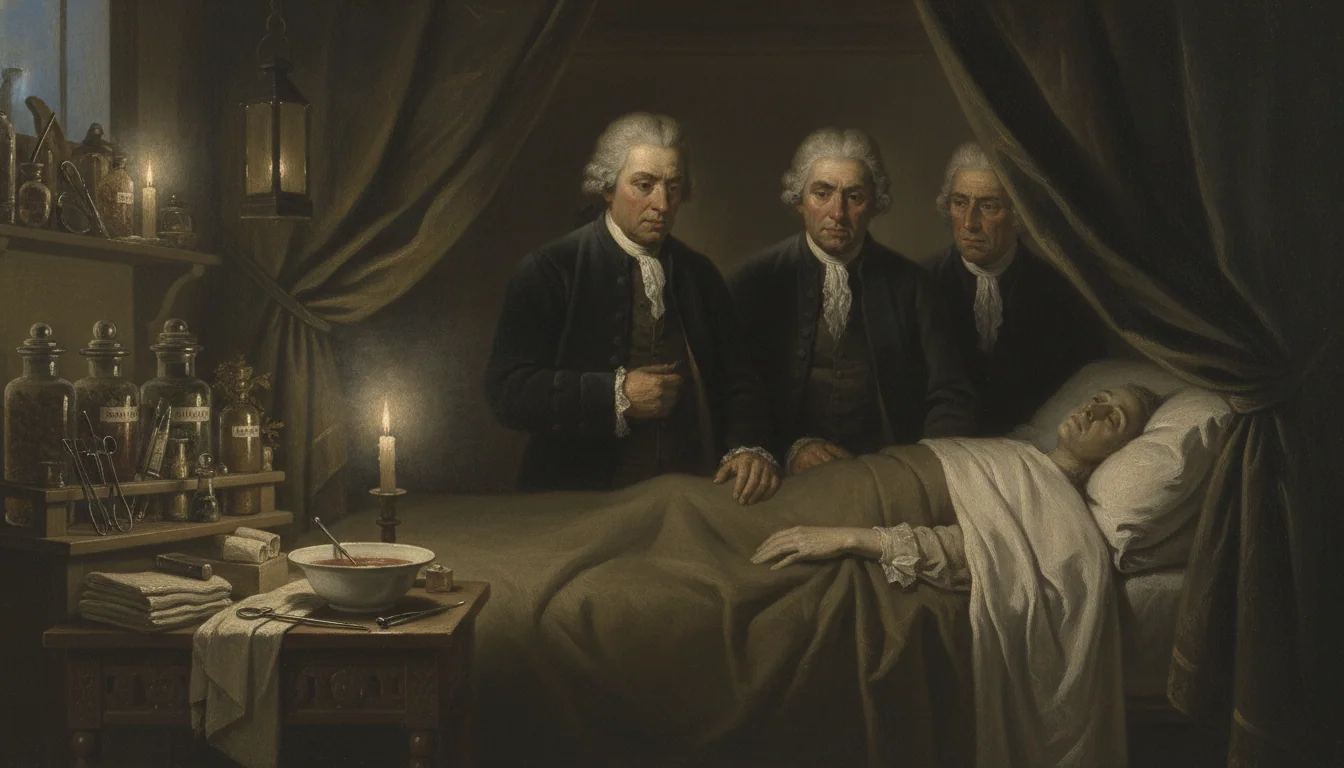
On the night of December 14, 1799, George Washington lay in bed at Mount Vernon with a swollen throat and a fever that had come on suddenly the day before. Over roughly ten hours, he was bled four separate times, first by an estate worker and then by three physicians who arrived through the course of the day. Estimates of the total vary, but several accounts put it at around five pints, more than a third of an average adult's total blood supply, on top of blistering agents applied to his throat, an emetic, and a strong purgative. Washington died that evening. His doctors had done exactly what the best medicine of 1799 told them to do.
This was not quackery in the sense we usually mean the word. It was the disciplined, centuries-old application of a coherent theory of how the body worked, one that had guided Western medicine since before the Roman Empire and would not be seriously dismantled until the century after Washington's death. To understand why intelligent, well-trained doctors kept opening veins for two thousand years, you have to start with what they believed was actually happening inside the body.
Bloodletting History Begins
Bloodletting predates written medicine. Ancient Egyptian and Mesopotamian healers practiced forms of it, and ancient Greek and Indian medical traditions developed their own rationales for it independently. But the version that would dominate Western medicine came out of the Hippocratic school of the 5th and 4th centuries BC. A text in that tradition, usually dated to around 400 BC and traditionally credited to Hippocrates' son-in-law Polybus, laid out the theory of the four humors: blood, phlegm, yellow bile, and black bile. Health was a matter of these four fluids sitting in the correct proportion. Illness was an imbalance.
The theory found its most influential systematizer in Galen of Pergamon, a Greek physician who treated Roman emperors in the 2nd century AD. Galen did not just describe the humors; he built an elaborate clinical system around correcting them, matching the amount of blood removed to the patient's age, the season, the location of the complaint, and the color and texture of the blood itself. His authority was so total that his writings, translated into Arabic and then back into Latin, remained the backbone of medical education in Europe and the Islamic world for well over a thousand years. A doctor training in Paris or Baghdad in the 12th century and a doctor training in Philadelphia in the 1790s were, on this point, working from essentially the same playbook.
What people believed
The four humors were not an arbitrary list. Each was tied to an element, a season, a pair of qualities, and an organ: blood to air, spring, and warmth and moisture, seated in the liver; phlegm to water, winter, and cold and moisture, seated in the brain and lungs; yellow bile to fire, summer, and heat and dryness, seated in the gallbladder; black bile to earth, autumn, and cold and dryness, seated in the spleen. A person's temperament, sanguine, phlegmatic, choleric, or melancholic, reflected which humor tended to predominate in them naturally.
Disease, in this framework, meant one humor had become excessive or corrupted, typically blood, since it was the humor most associated with fullness and plethora, a state of being dangerously overfull. A fever, a headache, a difficult childbirth, even melancholy itself could plausibly be explained as an excess that needed draining. Removing the offending humor, by opening a vein, applying cups, placing leeches, or inducing vomiting and purging for the other three humors, was not a desperate last resort. It was the logical, mechanical fix for a logically diagnosed problem, and it often produced an immediate, visible effect: the patient grew calmer, or fell asleep, which looked to everyone in the room like relief.
What the doctors tried
In practice, bloodletting took several forms. Venesection, opening a vein directly, usually at the inner elbow, with a small blade called a lancet or a spring-loaded fleam, was the most common method for a general excess of blood. Cupping used heated glass vessels to draw blood to the skin's surface, sometimes combined with small cuts to draw it further, known as wet cupping. Leeches offered a gentler, more targeted alternative, especially useful near sensitive tissue like the gums, temples, or eyes.
For centuries this work was done as often by barbers as by physicians. Barber-surgeons handled bloodletting, tooth extraction, and minor surgery as routine trade alongside haircuts and shaves, a tradition often credited with giving the barber pole its red and white stripes. Physicians supervised the theory; barbers frequently supplied the blade.
The practice reached something close to a mania in early 19th-century France, where the physician Francois Broussais argued that nearly all disease originated from localized inflammation that leeches could draw out directly. French pharmacies and hospitals reportedly imported tens of millions of leeches a year at the height of Broussais's influence, and the medicinal leech was hunted so heavily across European wetlands that wild populations collapsed in some regions.
American medicine embraced an especially aggressive version of the theory. During the catastrophic yellow fever epidemic that struck Philadelphia in 1793, the physician Benjamin Rush, a signer of the Declaration of Independence and one of the new nation's most respected doctors, treated patients with repeated, heavy bleedings alongside a purgative he called his "ten and ten," ten grains of calomel and ten grains of jalap. Rush argued that a patient could safely lose up to four-fifths of their blood, a claim that alarmed even some of his own colleagues. He believed, sincerely, that he was saving Philadelphia.
Washington's case followed the same script six years later. An estate worker trained in venesection performed the first bleeding before any physician arrived, at Washington's own request. When Dr. James Craik, his longtime friend and physician, arrived with two colleagues, they continued the treatment through the day. The youngest of the three doctors present, Elisha Cullen Dick, reportedly proposed a then-radical alternative: cutting an opening directly into the windpipe to ease Washington's breathing. His two senior colleagues overruled him as too experimental. They continued bleeding and blistering instead.
Who got blamed
When a bled patient recovered, the treatment got the credit. When a bled patient died, as Washington did, the treatment itself was rarely blamed. Contemporaries far more often pointed to the severity of the underlying "putrid" fever, the patient's own weak constitution, or the tragedy of a remedy applied too late rather than too aggressively. The theory itself was treated as sound; only the execution was ever in question.
That deference did not extend evenly. When outcomes turned bad, barber-surgeons and lower-status practitioners, the ones actually holding the lancet, bore more of the practical blame, sometimes losing customers or standing accused of a botched cut into a nerve or artery, while the physicians who had ordered the bleeding kept their authority largely intact.
Criticism of bloodletting itself, when it came, could be dangerous to voice. The English-born pamphleteer William Cobbett, writing in Philadelphia under the pen name Peter Porcupine, mocked Rush's bleed-and-purge regimen in print during the 1790s, arguing it had helped kill patients rather than save them. Rush sued him for libel. A Pennsylvania court found for Rush and awarded him damages reportedly around five thousand dollars, a fortune at the time. Cobbett left for England shortly afterward. The doctor who had bled hundreds of Philadelphians nearly to death won; the man who said so publicly lost everything he had in America.
What finally worked
The theory did not collapse from a single discovery so much as it was slowly outvoted by evidence. The decisive blow came from the French physician Pierre Charles Alexandre Louis, who in the 1820s applied what he called the "numerical method" to the question: he tracked outcomes for pneumonia patients bled early and aggressively against those bled later or less, and counted the results rather than trusting impressions. He found no benefit to earlier or heavier bleeding, and some evidence that it made things worse. Published in the 1830s, his work is now considered a founding text of medical statistics and of what would later be called evidence-based medicine.
Acceptance came slowly even after that. Bloodletting persisted in reduced form for much of the 19th century, defended by physicians who had built entire careers on it, and it did not disappear from ordinary Western medical practice until germ theory and a growing body of comparative clinical evidence gave doctors a better account of what actually caused disease. The habit outlived Galen by roughly seventeen centuries.
Bloodletting never entirely vanished from medicine, either. Therapeutic phlebotomy, drawing blood on purpose, remains a genuine treatment today for a small number of conditions where the body actually does hold too much of something in the blood: hereditary hemochromatosis, in which the body absorbs too much iron, and polycythemia vera, in which the bone marrow overproduces red blood cells. In both cases, removing blood is not a theory. It is measured, monitored, and it works. Galen would have recognized the gesture, if not the reasoning behind it, and he almost certainly would have insisted on doing it to a Founding Father with a sore throat too.
For two other treatments that later generations came to see very differently, see the ice pick lobotomy and Victorian women poisoning themselves for beauty.
Quick Answers
Common questions about this topic
What was bloodletting supposed to do?
Bloodletting was built on the theory of the four humors: blood, phlegm, yellow bile, and black bile. Illness meant one humor, usually blood, had become excessive, so doctors removed some of it by opening a vein, applying cups, or using leeches to restore the body's balance.
How much blood did George Washington lose before he died?
He was bled four times over roughly ten hours on December 14, 1799, first by an estate worker at his own request and then by his physicians. Estimates vary, but several accounts put the total at around five pints, more than a third of an average adult's blood supply, on top of blistering and purging treatments. He died that same night.
When did doctors stop bloodletting?
Acceptance eroded gradually. The French physician Pierre Charles Alexandre Louis published statistical evidence in the 1830s showing bloodletting did not help pneumonia patients and may have harmed them. The practice persisted in reduced form for decades afterward and faded only as germ theory gave doctors a better explanation of disease.
Is bloodletting still used in medicine today?
In a narrow, medically supervised form, yes. Therapeutic phlebotomy is a standard treatment for hereditary hemochromatosis, in which the body absorbs too much iron, and for polycythemia vera, in which the bone marrow overproduces red blood cells.

Consult the Physicians
Chat with the healers and survivors who lived through history's outbreaks.
Create your free account →No card required. Some figures and features require a paid plan.
Join the HistorIQly Club
Get smarter about the past.
Weekly stories, deep dives, and exclusive content straight to your inbox.