The Ice Pick Lobotomy: Walter Freeman's Ten Minute Cure for the Mind
Walter Freeman toured America performing transorbital lobotomies through the eye socket in about ten minutes, sometimes with no surgeon present at all.
Read Wikipedia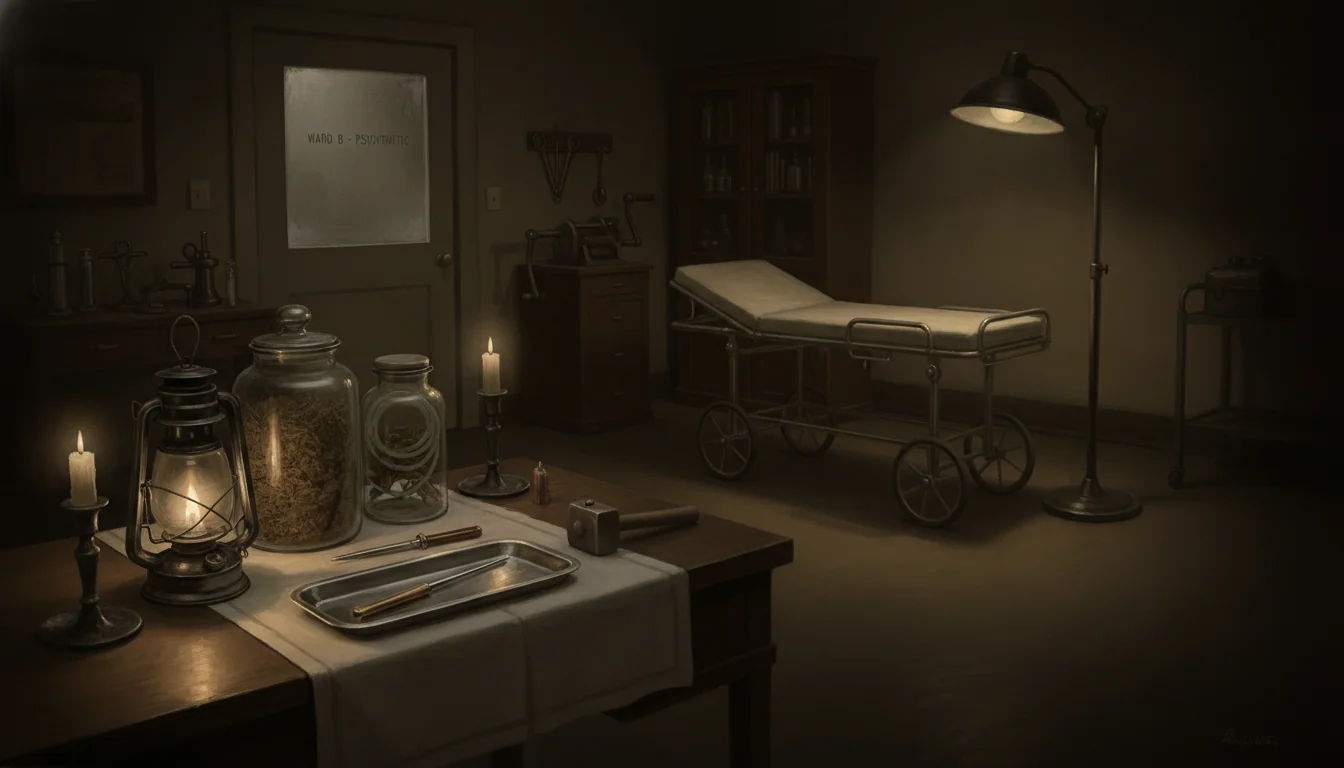
For roughly ten minutes, in a room that might be a hospital office or a rented hotel suite, a patient lay unconscious while a doctor who was not a surgeon slid a thin metal spike under an eyelid, tapped it through a sliver of bone with a small mallet, and swept it back and forth inside the skull. When it was over, the patient woke up, often within the hour, sometimes able to walk out the same day. This was the transorbital lobotomy, and for a stretch of the mid-twentieth century, it was presented to the American public as a fast, humane fix for the country's most intractable psychiatric suffering.
A neurologist looking for a shortcut
Walter Freeman was an American neurologist, not a trained neurosurgeon, working at George Washington University in the 1930s. He and his surgical partner, Dr. James Watts, had adopted the prefrontal lobotomy pioneered by Portuguese physician Antonio Egas Moniz, who drilled openings into the skull to reach and disrupt the frontal lobes. Moniz would later receive the Nobel Prize in Physiology or Medicine in 1949 for the technique, a fact that lent it considerable scientific respectability at the time even as doubts about it were already accumulating.
Freeman and Watts performed prefrontal lobotomies through the 1930s and into the 1940s, always requiring an operating room, general anesthesia, and a surgical team. Freeman found this cumbersome. He wanted something faster, cheaper, and deployable in ordinary psychiatric hospitals that had no surgical facilities and desperately overcrowded wards. Drawing on earlier work by the Italian physician Amarro Fiamberti, who had experimented with reaching the frontal lobes through the eye socket, Freeman developed the transorbital approach around 1946. He reportedly tested the concept at home first using an actual ice pick from his kitchen before commissioning a purpose-built instrument called an orbitoclast, a slender leucotome shaped much like one.
What psychiatry believed it was treating
To understand why doctors accepted this, it helps to see the theory behind it fairly. Mid-century psychiatry had few effective tools against severe schizophrenia, agitated depression, and other conditions that could leave patients violent, catatonic, or permanently institutionalized. State hospitals were overcrowded and understaffed, and many patients spent decades locked away with no real prospect of release. Neurologists of the era believed that disordered emotion and thought were generated by faulty circuits connecting the frontal lobes, the seat of judgment and personality, to deeper brain structures governing emotion. Sever those connections, the theory held, and you could blunt the destructive emotional charge driving a patient's illness without necessarily destroying intellect. It was a genuine, if ultimately mistaken, scientific hypothesis, not simple quackery, and it emerged from real desperation about a population of suffering patients that existing medicine could not otherwise help.
The procedure itself
The transorbital method dispensed with almost everything associated with surgery. There was no shaved scalp, no drilled skull opening, and often no anesthesiologist. Freeman typically rendered patients unconscious with electroconvulsive shock rather than anesthetic drugs, since the shock alone produced a brief period of insensibility long enough to work. He would lift the upper eyelid, position the orbitoclast against the thin bone at the top of the socket, and tap it through with a small hammer to a measured depth. Once inside, he pivoted the instrument to sweep an arc through the white matter connecting the prefrontal cortex to the rest of the brain, then repeated the process on the other side. The entire operation could be finished in well under fifteen minutes, and Freeman came to prize speed as proof the method was practical for hospitals with thousands of patients and no surgical budget.
Because it required no operating room, Freeman began performing the procedure outside conventional medical settings entirely, in his own office and in hospital rooms never intended for surgery, frequently with no surgeon present at all, since he was not a surgeon and needed none for this version of the operation. He drove around the country in a van that acquired the nickname "the lobotomobile," visiting state hospitals and demonstrating the technique to staff and, at times, to observers drawn simply by the spectacle. He sometimes worked both eyes at once with an orbitoclast in each hand, a flourish that impressed onlookers as much as it unsettled them. Estimates suggest roughly forty to fifty thousand lobotomies were performed in the United States over the era, with Freeman personally responsible for several thousand of them.
Who paid the price
The patients who suffered most from this rapid spread deserve the center of this story. Some recipients did have severe, treatment-resistant psychiatric illness, and a portion of those patients or their families reported that agitation eased afterward. But the procedure was also used far more broadly than that, on patients institutionalized for reasons that had little to do with what we would now call serious mental illness: rebellious teenagers, people with intellectual disabilities, and adults whose families or caretakers simply found them difficult to manage. Freeman lobotomized children as young as adolescence. The operation carried a documented risk of death, commonly cited around five percent of cases in various series, along with frequent and severe permanent impairment: personality flattening, loss of initiative, incontinence, and profound cognitive decline.
No case illustrates the ethical failure more starkly than Rosemary Kennedy. The daughter of Joseph P. Kennedy, Rosemary had experienced mood swings and mild learning difficulties that her family found increasingly hard to manage as she reached adulthood. In 1941, at age twenty-three, she underwent a prefrontal lobotomy, the earlier skull-drilling technique, performed by Dr. James Watts with Freeman present, not the transorbital method Freeman would develop several years later. The operation left her permanently and severely disabled, unable to walk or speak normally, and she was institutionalized for the rest of her life. Her family concealed the details for decades. Her case became, once it became public, the clearest symbol of how a procedure marketed as psychiatric treatment could be used instead to silence someone whose behavior a powerful family found merely inconvenient.
What finally stopped it
Lobotomy's decline came from several directions at once. The introduction of chlorpromazine, the first effective antipsychotic medication, in the mid-1950s gave psychiatrists a genuine alternative that could calm agitation and reduce psychotic symptoms without surgery. Its rapid adoption in American and European hospitals sharply reduced demand for irreversible surgical intervention almost overnight. At the same time, long-term follow-up studies and mounting case reports made the procedure's real costs harder to dismiss, documenting the deaths, the personality changes, and the patients left in worse condition than before. The Soviet Union had already banned the procedure outright in 1950, declaring it contrary to the principles of humanity, a striking early rebuke from a country not typically cited as a model of medical ethics. Professional standards in the United States shifted more slowly, but by the 1970s the operation had been almost entirely abandoned as informed consent norms strengthened and psychiatry moved decisively toward pharmaceutical and later behavioral treatment. What had briefly been promoted as a swift, humane cure came to be remembered instead as one of American medicine's starkest cautionary tales about speed, showmanship, and the ease of harming the most powerless patients in the name of treatment.
Quick Answers
Common questions about this topic
What was an ice pick lobotomy and how did it work?
It was a transorbital lobotomy, a procedure Walter Freeman developed and popularized starting in 1946, in which a thin instrument called an orbitoclast was tapped through the thin bone above the eye and swept side to side to sever connections in the prefrontal cortex. Freeman based the approach on earlier work by the Italian physician Amarro Fiamberti and originally tested it with an actual kitchen ice pick.
Did Walter Freeman perform the operation on Rosemary Kennedy?
No. Rosemary Kennedy's 1941 lobotomy was performed by Dr. James Watts, Freeman's surgical partner at the time, using the earlier prefrontal lobotomy technique that required drilling through the skull. Freeman had not yet developed the transorbital ice pick method, which he introduced roughly five years later.
Who did doctors perform lobotomies on?
Lobotomies were performed on patients with severe, treatment-resistant conditions like schizophrenia and major depression, but also, notoriously, on institutionalized people whose behavior was simply inconvenient or nonconforming, including some who by later standards had no serious mental illness at all.
Why did lobotomies stop being performed?
The introduction of chlorpromazine and other antipsychotic medications in the mid-1950s gave psychiatry a far less destructive treatment option, while mounting evidence of lobotomy's harm, including deaths and severe permanent impairment, and shifting medical ethics pushed the procedure out of favor through the following decades.

Consult the Physicians
Chat with the healers and survivors who lived through history's outbreaks.
Create your free account →No card required. Some figures and features require a paid plan.
Join the HistorIQly Club
Get smarter about the past.
Weekly stories, deep dives, and exclusive content straight to your inbox.