Boston Strangler vs. History: How Accurate Is the 2023 Hulu Film?
Boston Strangler 2023 accuracy review: the Hulu film follows journalists who identified the killer first. We fact-check DeSalvo's confession and the 2013 DNA evidence.
Read Wikipedia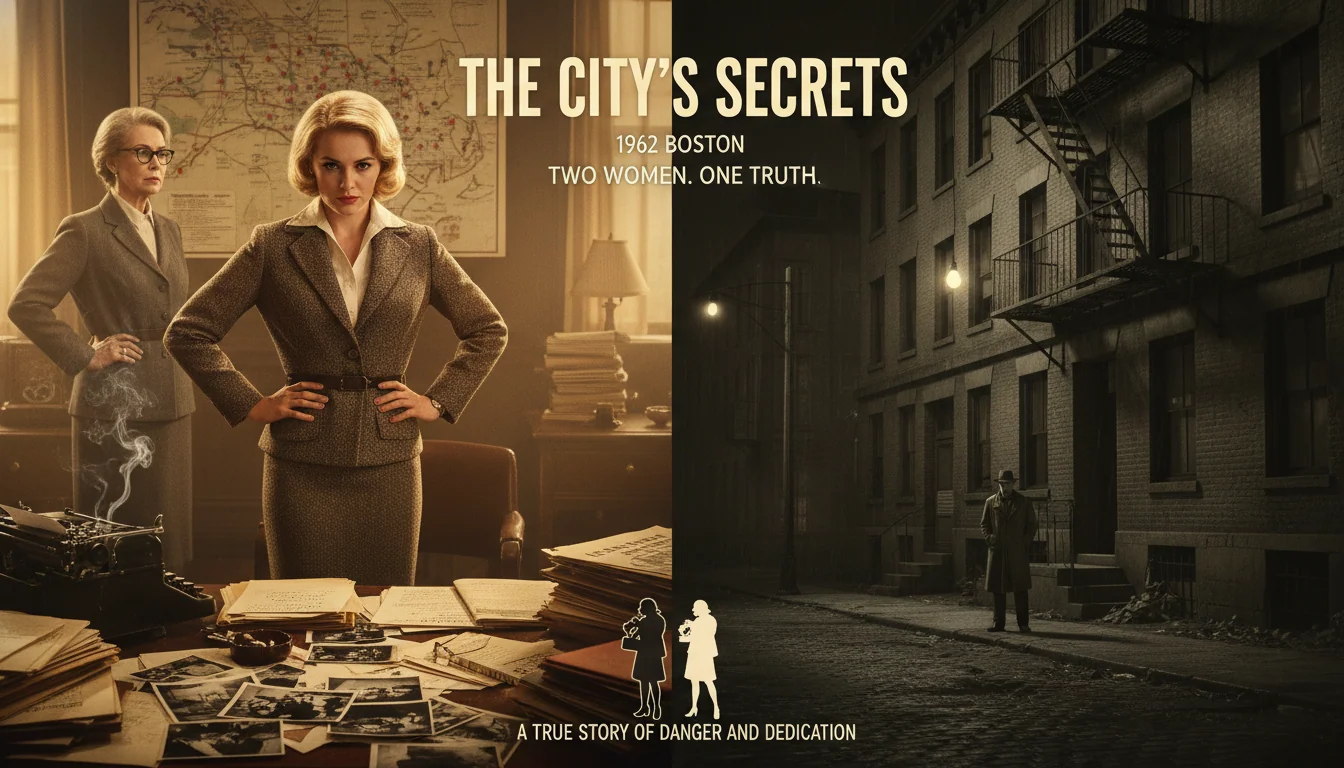
Between June 1962 and January 1964, thirteen women were murdered in their apartments across the Greater Boston area. The victims ranged in age from nineteen to eighty-five. Most were strangled. Most were found in positions suggesting a ritualized staging. The police departments of Boston, Cambridge, and surrounding communities initially treated the killings as separate incidents handled by separate jurisdictions, and the result was an investigation that moved slowly for months while a city pulled its deadbolts and stopped answering the door.
The 2023 Hulu film Boston Strangler, written and directed by Matt Ruskin, focuses not on the killer but on two women at the Boston Record American who figured out what was happening before the authorities coordinated their response. Keira Knightley plays Loretta McLaughlin, and Carrie Coon plays Jean Cole. The question the film implicitly poses is whether those two journalists did more to advance public understanding of the case than the police apparatus ever did. Based on the history, the answer is uncomfortably close to yes.
What Hollywood Got RIGHT
Loretta McLaughlin was first
The film's central factual claim is accurate: Loretta McLaughlin was the first journalist to publicly connect several of the murders and frame them as the work of a single killer. She identified the pattern after reviewing case reports independently and published a piece in the Record American that coined, or at least popularized, the term "Boston Strangler." Police initially pushed back. The public would not have known what they were dealing with as quickly without her work.
The film's portrayal of McLaughlin as a tenacious reporter working against institutional resistance is grounded in the historical record. She was a society-page and feature writer who pushed for the crime investigation beat, and her editors were skeptical in ways that contemporary accounts confirm. This was a real obstacle, not a Hollywood invention.
Jean Cole's partnership
Jean Cole was a real journalist and a real partner in McLaughlin's investigation. The film's depiction of their collaboration - two women navigating a newsroom and a police culture that was not built for them - is grounded in both their later accounts and in general historical evidence about 1960s journalism. Cole's role was less well-known than McLaughlin's publicly, and the film's decision to center both of them is accurate to how the investigation actually worked.
Albert DeSalvo and the confession
The film accurately represents the basic arc of DeSalvo's confession: he admitted to all 13 killings in 1965 while at Bridgewater, was never tried for the stranglings, and was convicted and sentenced for the separate series of sexual assaults for which he was known as the "Green Man." His attorney F. Lee Bailey negotiated the terms under which DeSalvo spoke to investigators, and the resulting statement was never subjected to cross-examination in a murder trial.
DeSalvo's death in 1973 - stabbed to death by fellow inmates at Walpole - is depicted accurately. He died before the full implications of his confession could be resolved.
The DNA link to Mary Sullivan
The film incorporates the 2013 DNA development, which is real. Investigators working with the DeSalvo family exhumed his body and matched his DNA to biological material recovered from Mary Sullivan, the last victim, killed January 4, 1964. A water bottle discarded by his nephew provided an additional confirming sample. The match strongly supported the claim that DeSalvo killed Sullivan, and effectively ended the strongest version of the argument that DeSalvo had invented the entire confession.
The victims' demographics
The film accurately reflects the way the murders shifted in apparent profile over time. The earliest victims were elderly women living alone. The later victims were younger. This demographic shift was noticed by investigators at the time and has been noted by criminologists since as a possible indicator of different psychological motivations across the series, or possibly different perpetrators.
What Hollywood Got WRONG
The multiple-killer theory gets more screen time than the evidence
The film's most significant departure from the historical record is giving substantial weight to the theory that Albert DeSalvo did not commit all thirteen murders and may have been one of several killers active in Boston during the same period. This theory has been discussed seriously by some investigators and researchers, particularly before the 2013 DNA evidence linked DeSalvo to Sullivan. But the film presents it with more force than the evidence actually supports.
As of 2023, no alternative suspect has been identified, charged, or credibly connected to any of the Boston Strangler murders. The film implies more investigative traction behind the multiple-killer theory than existed in reality, giving viewers the impression that official doubt was more widespread than it was.
McLaughlin's personal life is dramatized
The film invents or substantially elaborates several elements of McLaughlin's personal life to drive the narrative. Her home situation, the strains in her marriage, the tensions with her family over her career investment in the case - these are not well-documented in the historical record. They function as character scaffolding for a story that needs a personal cost, and they are handled competently, but viewers should understand they are largely invented.
Specific police officials are compressed
The film consolidates several real Boston-area law enforcement officials into composite characters or attributes specific actions to individuals in ways that compress the historical record. The actual investigation involved multiple police departments, the office of the state Attorney General, and eventually a specially constituted task force. The film streamlines this into a smaller cast, which is understandable but produces some inaccurate impressions about who knew what when.
The timeline is rearranged for dramatic rhythm
Several events in the film are placed out of their actual chronological order. McLaughlin's initial article, the police response, and the later stages of the investigation are shuffled to produce a cleaner dramatic arc. The rearrangement is not egregious by the standards of true-crime biopics, but specific moments that appear to happen in sequence in the film were separated by considerably more time in reality.
The investigation's geographic scope is understated
The Boston Strangler killings were not confined to the city of Boston. Murders in Cambridge and in suburbs well outside the city limits were part of the series, and the fact that different police departments treated them as separate local incidents for months was a genuine investigative failure. The film touches on jurisdictional friction but concentrates the action within a narrower frame than the case actually occupied. The city-wide panic, which closed schools and emptied apartment buildings as women refused to open their doors, gets less space than the newsroom conflict.
Historical Accuracy Score: 7/10
Boston Strangler gets the two most important things right: Loretta McLaughlin's pioneering role in connecting the murders and the fundamental ambiguity of Albert DeSalvo's story. The film is at its strongest when it focuses on the newsroom dynamics and on the institutional failures that allowed thirteen women to die across multiple uncoordinated jurisdictions.
What it gets most right: the factual core of McLaughlin's investigation, the DeSalvo confession, and the 2013 DNA evidence.
What it gets most wrong: overweighting the multiple-killer theory and inventing personal drama around McLaughlin's home life.
For a true-crime film covering a case that is sixty years old and still not fully resolved, 7 out of 10 is respectable. The film is honest about what it doesn't know and gives both McLaughlin and Cole the credit history spent too long withholding. The liberties it takes are mostly narrative conveniences rather than distortions of the record. The Boston Strangler movie accuracy is strongest where it shows institutional failure and most questionable where it imagines McLaughlin's home life.
The Boston Strangler case ended without a trial and without certainty. The film lives in the same uncomfortable space.
For other true-crime historical films put to the fact-check, see Lizzie Borden and the Axe Murders and Gilgo Beach and Rex Heuermann.
Quick Answers
Common questions about this topic
Is the 2023 Boston Strangler film based on a true story?
Yes. The film centers on two real journalists - Loretta McLaughlin and Jean Cole of the Boston Record American - who investigated the Boston Strangler killings of 1962 to 1964. McLaughlin was the first reporter to connect several murders as the work of a single killer, and Cole joined her as a partner in the investigation. The film dramatizes their work and the obstacles they faced as women in a male-dominated newsroom and police environment.
Did Albert DeSalvo actually confess to the Boston Strangler murders?
Yes. Albert DeSalvo confessed to all 13 killings in 1965 while confined at Bridgewater State Hospital for the criminally insane. However, he was never tried for the murders. He was convicted of unrelated sexual assault charges and sent to Walpole State Prison, where he was killed by fellow inmates in 1973. The lack of a trial meant the confession was never tested in court.
What did the 2013 DNA evidence prove?
In 2013, investigators used DNA from a water bottle discarded by a nephew of Albert DeSalvo to match a sample taken from Mary Sullivan, the last confirmed victim, murdered in January 1964. The match strongly linked DeSalvo to Sullivan's death. However, some researchers have continued to argue that different killers may have been responsible for other victims in the series.
Was Loretta McLaughlin really the first journalist to connect the Boston Strangler murders?
Yes. McLaughlin, then a reporter at the Boston Record American, was the first journalist to publicly connect the killings of multiple women in the Boston area and publish an article framing them as the work of a single killer. Police initially resisted the theory and were not uniformly receptive to her reporting. The term Boston Strangler originated with the press, not the police.

Debate the Accuracy with the Real Figures
Ask the real people what Hollywood got wrong about their lives.
Create your free account →No card required. Talk to anyone in history with 8 free credits a day. Some features require a paid plan.
Join the HistorIQly Club
Get smarter about the past.
Weekly stories, deep dives, and exclusive content straight to your inbox.