Corsage vs. History: How Accurate Is the Empress Elisabeth Film?
Corsage (2022) reimagines Empress Elisabeth of Austria at 40 with deliberate anachronism. Here is what the Vicky Krieps film gets right and where it openly breaks from fact.
Read Wikipedia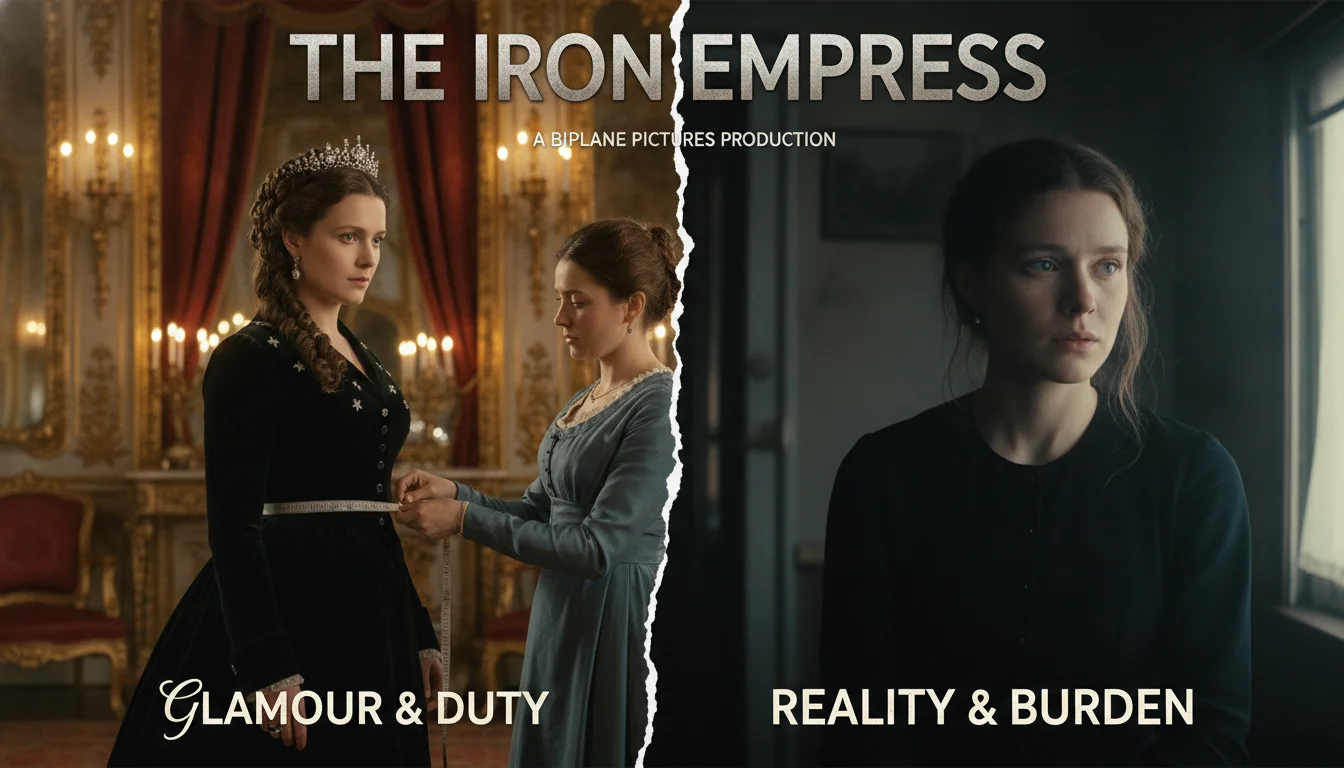
Marie Kreutzer's 2022 film Corsage opens on Empress Elisabeth of Austria turning 40 in December 1877, an age contemporaries openly treated as the beginning of a woman's decline, and the film spends its runtime watching her rage, quietly and then not so quietly, against that verdict. Vicky Krieps plays Elisabeth with a controlled, simmering exhaustion that earned her the Cannes award for Un Certain Regard. The film has been widely praised for its performance and its formal daring. It has also been misunderstood by some viewers as a conventional biopic, which it very much is not.
Kreutzer has said in interviews that she was not interested in making a straightforward historical drama. She wanted a film about the psychological experience of being a woman trapped inside a role and a body that both belonged to the public. That framing matters for judging what Corsage gets right and where it deliberately steps outside the documented record.
What Corsage Got Right
Elisabeth's extreme physical discipline was real
The film's obsession with Elisabeth's waist, her diet, her exercise, and her physical appearance is not an invention. The historical Elisabeth was famous across Europe for maintaining a corseted waist reportedly near 16 inches well into her thirties and forties, achieved through severe fasting, punishing horseback riding, gymnastics installed in her own palace rooms, and a diet that alarmed even her own household. Contemporary accounts describe meals of little more than broth, egg whites, and orange juice, sometimes for days at a stretch. The film's tight-lacing scenes, its depiction of Elisabeth being sewn into her clothing, and its fixation on weighing and measuring her body are all grounded in the documented historical obsession, not artistic exaggeration.
Her restlessness with court life is well documented
Elisabeth genuinely chafed against the rigid protocol of the Habsburg court, and the film's portrait of a woman who preferred travel, horses, and escape to the ceremonial duties of an empress tracks with the historical record. She spent long stretches of her adult life away from Vienna, touring England and Ireland for fox hunting, visiting Madeira and Corfu for her health, and generally treating the Austrian court as something to be endured rather than inhabited. Her relationship with her husband, Emperor Franz Joseph, is also captured with reasonable fidelity: affectionate at a distance, formal and strained in person, a marriage that had cooled into a kind of managed coexistence by the years the film depicts.
The depression and psychological strain are grounded in the record
Historians have long noted Elisabeth's documented struggles with what would today likely be described as depression and possibly disordered eating, compounded by the loss of her son Crown Prince Rudolf's mental stability in later years and her own withdrawal from public life. The film's portrayal of a woman experiencing genuine psychological distress, not merely vanity, has real support in biographical accounts of Elisabeth written by historians who had access to her personal letters and the observations of her ladies-in-waiting.
What Corsage Got Wrong
The ending is invented, and Kreutzer says so
The film's final act departs from documented history in ways the director has been transparent about in interviews and press materials. Without spoiling the specific imagery, the ending is not a depiction of how Elisabeth actually died. The real empress lived another two decades past the film's 1877-1878 setting and was assassinated in Geneva in 1898 by Luigi Lucheni, an Italian anarchist who stabbed her with a sharpened needle file as she boarded a lake steamer, reportedly not even realizing at first how badly she was hurt because the wound was so narrow. Kreutzer's ending is a deliberate piece of fiction meant to grant Elisabeth an act of agency the real woman was never permitted, not a hidden historical claim.
The anachronistic music and camerawork are intentional breaks, not errors
Viewers unfamiliar with the film's formal approach sometimes mistake its use of a Kris Kristofferson cover, a Rolling Stones needle drop, and a brief handheld sequence showing a fictional documentary crew as sloppy anachronism. These are deliberate choices, confirmed by Kreutzer in multiple interviews, meant to signal that Corsage is not attempting a museum-accurate 1877 but rather using the trappings of that period to talk about a timeless experience of being watched, measured, and confined. The anachronism is the film's argument, not an accident.
The specific palace incidents are largely fictionalized
Many of the film's individual scenes, including a visit to an asylum, a fencing lesson, and several intimate encounters, are Kreutzer's inventions rather than documented events from Elisabeth's actual 1877-1878 calendar. The film uses real biographical facts, Elisabeth's documented visits to relatives, her genuine interest in unconventional medicine and asylums of the era, her real skill on horseback, as raw material for scenes that did not necessarily happen as shown, or happened differently, or happened at other points in her life compressed into this one year.
Elisabeth's political influence is understated
The film focuses tightly on Elisabeth's interior life and largely leaves out her documented, if inconsistent, political engagement, including her sympathy for Hungarian autonomy and her real influence in securing the 1867 Austro-Hungarian Compromise that created the dual monarchy. That achievement predates the film's timeframe, but the broader picture of Elisabeth as occasionally politically consequential, not merely a decorative and tormented figure, gets little space in Corsage's tighter psychological focus. Historians who have studied her correspondence with Hungarian statesman Gyula Andrassy describe a woman who understood court leverage well enough to use her popularity with the Hungarian nobility as a genuine bargaining chip, a dimension the film has no real interest in exploring.
The children are almost entirely absent
By 1877, Elisabeth had four children, though her eldest daughter had died in infancy decades earlier, and her relationship with the surviving three, particularly her son and heir Crown Prince Rudolf, was documented as distant and often strained, shaped by a rigid Habsburg tradition that removed royal children from their mothers' direct care in favor of governesses and tutors chosen by the imperial household. The film gives this dynamic only glancing attention, focusing instead on Elisabeth's relationship with her own body and her staff. The real toll of that estrangement, including Rudolf's later psychological collapse and his death in an apparent murder-suicide at Mayerling in 1889, sits entirely outside the film's chosen timeframe, but it is part of the biographical context the film's tighter focus leaves out.
Historical Accuracy Score: 6/10
Corsage earns real credit for its unflinching, well-researched portrait of Elisabeth's physical discipline, her marital estrangement, and her psychological unraveling under the pressure of aging in a role that prized youth and beauty above all else. Those elements are grounded in genuine biographical sources and given weight the film clearly respects.
But Corsage is not trying to be a factual record, and its own director has said so repeatedly. The invented ending, the anachronistic soundtrack, and the many fictionalized individual scenes are the point of the exercise, a deliberate argument about Elisabeth's confinement rather than a documentary reconstruction of her final Vienna years. Judged as a biopic chasing accuracy, it earns a middling score. Judged as what it actually is, a psychological portrait using real biographical bones to build a fictional meditation on aging and control, it succeeds almost entirely on its own terms.
For other royal women reduced by their own courts to their appearance and utility, see Elizabeth vs. History and Victoria and Abdul vs. History, both of which wrestle with the same gap between the private woman and the public image built around her.
Quick Answers
Common questions about this topic
Is Corsage historically accurate?
Corsage is accurate about Empress Elisabeth's documented obsessions with her waist size, diet, and physical fitness, and about the real constraints of court life she chafed against. It is deliberately inaccurate about specific events, most notably the ending, which director Marie Kreutzer invented rather than depicted as fact.
Did Empress Elisabeth really die the way Corsage shows?
No. The film's ending is an invented scene that director Marie Kreutzer has openly described as fiction. The real Elisabeth was assassinated in Geneva, Switzerland, in 1898 by an Italian anarchist named Luigi Lucheni, who stabbed her with a sharpened file as she boarded a steamship.
Why does Corsage use anachronistic music and details?
Director Marie Kreutzer deliberately mixed modern elements, including songs by Kris Kristofferson and The Rolling Stones and a handheld camera and a fictional film crew appearing in one scene, into an otherwise 1877-set story to signal that the film is a subjective, present-minded interpretation of Elisabeth's psychology rather than a strict costume-drama recreation.
What was Empress Elisabeth's real relationship with her body and diet?
The historical record supports the film's portrait of extreme discipline. Elisabeth was documented as maintaining a waist near 16 inches into middle age through fasting, punishing exercise regimens, and tight lacing, and contemporaries described her diet as sparse to the point of concern.

Debate the Accuracy with the Real Figures
Ask the real people what Hollywood got wrong about their lives.
Create your free account →No card required. Talk to anyone in history with 8 free credits a day. Some features require a paid plan.
Join the HistorIQly Club
Get smarter about the past.
Weekly stories, deep dives, and exclusive content straight to your inbox.