Thirteen Lives vs. History: How Accurate Is Ron Howard's Cave Rescue Film?
Thirteen Lives accuracy checked against the real 2018 Tham Luang cave rescue, including criticism that British divers overshadowed the wider Thai-led effort.
Read Wikipedia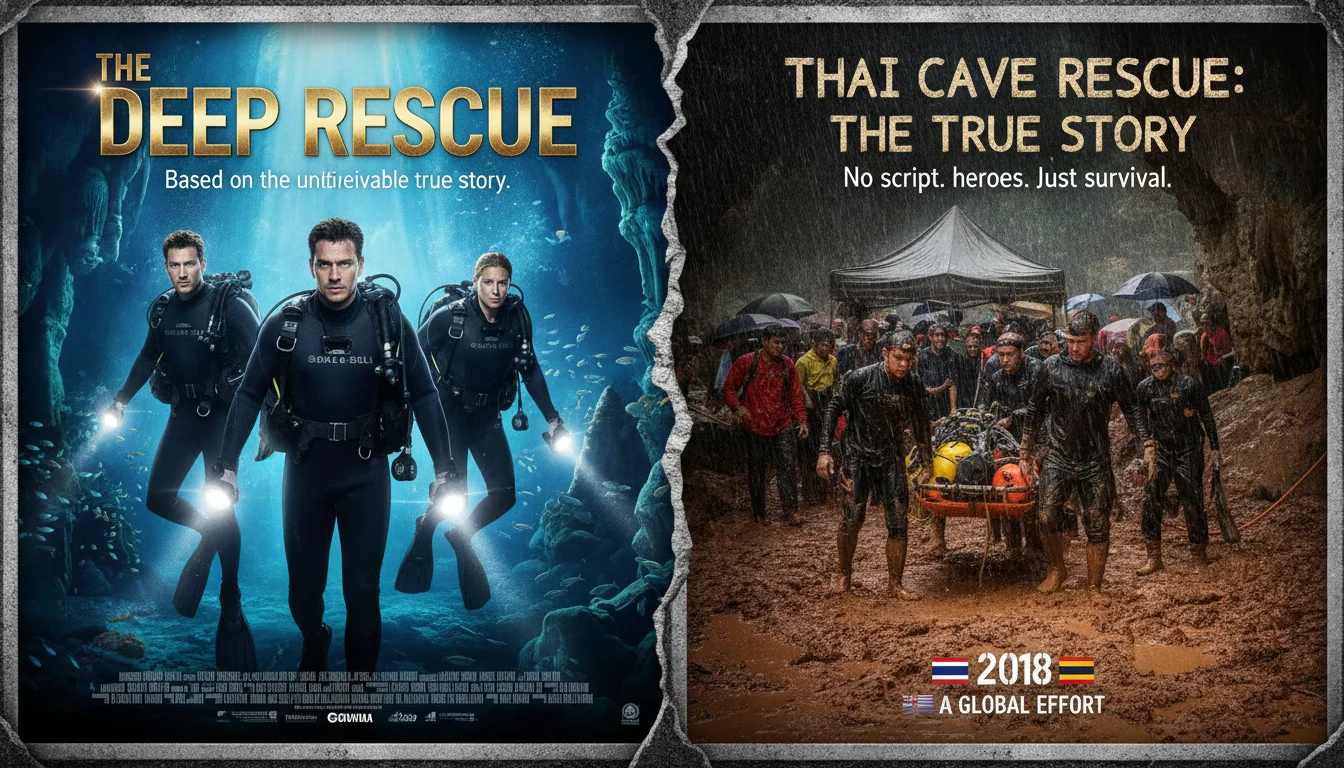
Ron Howard likes stories about ordinary competence under extraordinary pressure, and the Tham Luang cave rescue is about as extraordinary as that premise gets. In June 2018, twelve boys from a youth football team and their 25-year-old assistant coach became trapped inside a flooded cave system in northern Thailand after a training excursion was cut off by sudden monsoon rain. The rescue that followed, which stretched over roughly two and a half weeks, became one of the most closely watched news events of the decade, drawing in Thai Navy SEALs, foreign cave-diving specialists, engineers, and volunteers from more than a dozen countries.
Thirteen Lives (2022) tells that story with a deliberately unglamorous eye, focusing heavily on the British amateur cave divers who first found the boys and on the medical gamble that got them out. It is a well-researched film by Hollywood standards, made with input from some of the real participants. But it has also drawn a specific and recurring criticism: that in narrowing its focus to a small group of Western divers, it flattens a rescue that was, in reality, a massive and genuinely international effort led on the ground by Thai authorities.
Accuracy score: 7/10
This Thirteen Lives accuracy check lands at a 7: the film gets the mechanics and the emotional stakes of the rescue largely right, and it resists the urge to invent a single Hollywood hero. Where it loses points is in scale and framing: it underplays the size and leadership of the Thai-led operation and gives limited screen time to the Chinese, American, Australian, and other international teams who also took part.
What Hollywood got right
The basic timeline holds up. The boys, aged roughly 11 to 16, entered Tham Luang Nang Non with their coach on June 23, 2018, and became trapped when rising floodwater blocked their exit route. They were not located until July 2, roughly nine days later, when Volanthen and Stanton found them huddled on a ledge deep inside the cave. The full extraction did not happen until July 8-10, meaning the boys spent roughly two and a half weeks underground in total. The film keeps this sequence intact rather than compressing it into an artificially tidy few days.
John Volanthen and Richard Stanton are depicted with real specificity. Both men were experienced volunteer cave divers with backgrounds in unrelated day jobs (Volanthen in IT, Stanton as a retired firefighter), and both had been called in by Thai authorities because of their specialized rebreather and cave-diving experience. Their now-famous exchange with the boys, generally reported as beginning with a version of "how many of you," is treated in the film with something close to the understated tone eyewitness accounts describe.
Dr. Richard Harris's role and moral dilemma are central, as they should be. Harris, an Australian anesthetist and cave diver, was flown in specifically to advise on sedating the boys for the dive out, since untrained children panicking underwater in narrow flooded passages would have been fatal for themselves and their rescuers. Reporting at the time and since has described Harris's own doubt about the plan's survival odds as genuine and significant, and the film's depiction of that anguish appears to reflect accounts he and others have given.
Saman Gunan's death is included. Saman, a retired Thai Navy SEAL who volunteered to help place oxygen tanks along the guide line through the flooded tunnels, lost consciousness while diving and died on July 6, 2018, two days before the extraction began. His death was a real and sobering turning point in the operation, underscoring just how dangerous the cave conditions were even for trained military divers, and the film does not skip past it.
The engineering and water-diversion effort is acknowledged. Alongside the diving operation, teams worked to divert water away from the cave entrance and pump floodwater out, including agricultural engineers and volunteers who worked on rerouting water from the hillside above the cave. The film gives this parallel effort real weight rather than treating the story purely as a diving narrative.
The extraction method reflects the widely reported account. Each boy was reportedly fitted with a wetsuit and full-face diving mask, sedated to keep him calm and still, and guided through the flooded passages by pairs of divers over a multi-day operation, with the extraction split across three days to manage rescuer fatigue and risk. Some specifics of exactly how sedation was administered and maintained during the multi-hour dives have been described somewhat differently across interviews and reports, so it is worth treating the finer technical detail with some caution rather than as settled fact.
What Hollywood got wrong
The scale of the Thai-led operation is significantly compressed. In reality, the rescue involved an estimated 10,000 or more people at its peak, including roughly 100 divers and personnel from more than a dozen countries, coordinated under Thai government leadership with the Thai Navy SEALs at the operational core throughout. The film's tight focus on a handful of British and Australian divers, dramatically useful as it is, leaves the impression of a smaller and more foreign-led effort than what actually happened on the ground.
This is the criticism that has followed the film most persistently. Several people connected to the real rescue, along with commentators in Thailand, have argued that centering British divers as the film's protagonists sidelines the Thai Navy SEALs, Thai provincial officials, and the boys' own families and community, who were present throughout and whose knowledge of the region and coordination made the rescue possible in the first place. Some critics have also noted the relatively limited presence of the substantial Chinese, American, and other international contingents who contributed equipment, expertise, and personnel. The filmmakers have said they aimed for a "no single hero" approach, and the film does spread credit across multiple nationalities rather than inventing an American savior, but critics argue the framing and screen time still lean heavily toward the two British lead divers.
Some individual contributions may be understated or reordered for drama. Reporting since 2018 has credited a wide range of specialists, from American and Chinese rescue teams to Thai park rangers and local volunteers, with contributions that are difficult to compress into a two-hour film. Exactly how particular decisions were made, and by whom, in the real command structure is not something a single film (or a single article) can fully reconstruct, and some of the finer chain-of-command details in Thirteen Lives are best treated as dramatized approximation rather than verified fact.
The interior geography and pacing of individual dives are stylized. Cave-diving sequences in the film are shot for tension and visual clarity, with murky water, tight squeezes, and disorientation conveyed cinematically. The real cave system's layout, the precise conditions divers faced on each trip, and how visibility and current varied day to day are difficult to verify in exact technical detail from public sources, and the film's version should be read as an approximation rather than a shot-for-shot record of the actual dives.
The coach's guilt and the boys' experience inside the cave are dramatized. The film portrays assistant coach Ekkapol Chanthawong grappling with guilt over leading the team into the cave, which aligns with public accounts of his state of mind, and shows the group using meditation techniques, reportedly drawing on his background, to stay calm. The exact texture of those days underground, what was said, how morale held, is necessarily reconstructed rather than directly witnessed by filmmakers.
The bottom line
Thirteen Lives does not invent a fake American hero or stage a shootout that never happened, and that alone puts it ahead of many disaster dramatizations. It gets the broad shape of the rescue right: the timeline, the central role of Volanthen, Stanton, and Harris, the sedation gamble, Saman Gunan's death, and the engineering work above ground. Where it falls short is proportion. A rescue that was fundamentally a Thai-led, internationally supported operation, involving thousands of people, becomes on screen a story mostly about a few outsiders who happened to be in the right cave at the right time. That is a real and fair criticism, and it is worth keeping in mind alongside everything the film gets right.
For another true story of a rescue against the odds, see our accuracy check on Apollo 13, and for a very different kind of survival ordeal, see our accuracy check on Society of the Snow.
Quick Answers
Common questions about this topic
Is Thirteen Lives based on a true story?
Yes. The 2022 Ron Howard film dramatizes the June-July 2018 rescue of twelve boys and their assistant coach from the flooded Tham Luang cave in Chiang Rai province, Thailand, an operation that involved Thai Navy SEALs, foreign volunteer cave divers, and thousands of support personnel.
Did a former Thai Navy SEAL really die during the rescue?
Yes. Saman Gunan, a retired Thai Navy SEAL who volunteered to help ferry oxygen tanks through the flooded passages, lost consciousness underwater and died during the operation on July 6, 2018. The film includes his death, though some viewers have felt the tribute to him and other Thai rescuers is comparatively brief.
Were the cave divers in the film based on real people?
Yes. The film centers on British cave divers John Volanthen and Richard Stanton, played by Colin Farrell and Viggo Mortensen, who located the boys, and Australian anesthetist Dr. Richard Harris, played by Joel Edgerton, who sedated them for the extraction. All three are widely credited as central to the rescue in contemporaneous reporting.
How were the boys actually extracted from the cave?
According to widely reported accounts, each boy was fitted with a wetsuit and a full-face diving mask, sedated by Dr. Harris to prevent panic underwater, and guided out by pairs of divers through several kilometers of flooded, narrow passageways over multiple days. Exact technical details of the extraction have varied slightly across public accounts and were never fully disclosed by all parties involved.

Debate the Accuracy with the Real Figures
Ask the real people what Hollywood got wrong about their lives.
Create your free account →No card required. Some figures and features require a paid plan.
Join the HistorIQly Club
Get smarter about the past.
Weekly stories, deep dives, and exclusive content straight to your inbox.