Debunked: Carrots Do Not Give You Night Vision, It Was WWII Propaganda
The RAF supposedly credited carrots for its pilots' night kills. The real reason was secret radar. Here is what the science and the record actually show.
Read Wikipedia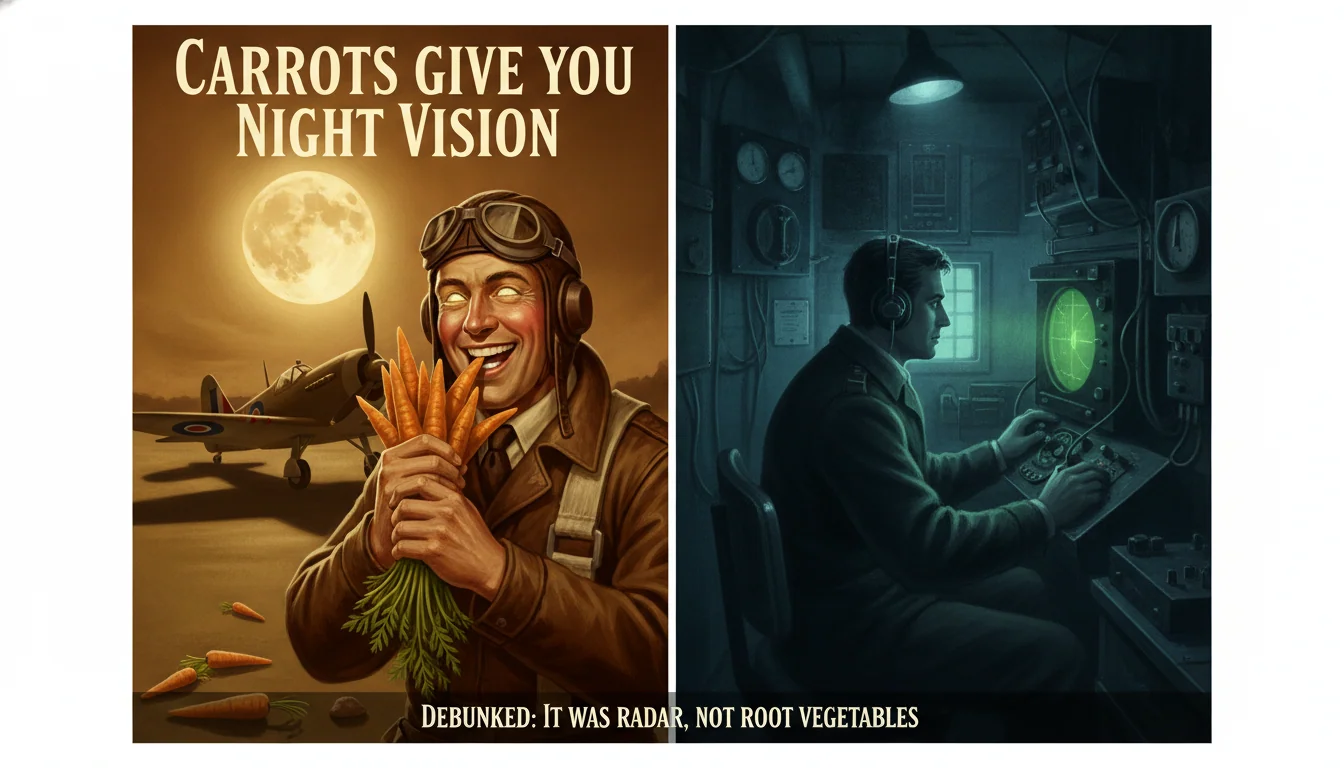
Somewhere in every childhood is an adult insisting that finishing your carrots will help you see in the dark. It is delivered with total confidence, usually at a dinner table, usually about a vegetable a kid was already trying to avoid. The claim has just enough scientific backing to survive decades of retelling: carrots really do contain a nutrient your eyes need. The rest of the story, the part about a British flying ace and a secret ingredient in his salad, is where things get more interesting than the myth itself.
The myth, stated fairly
The claim, at full strength, goes like this: carrots are packed with vitamin A, vitamin A is essential to the eyes, and eating enough carrots will measurably sharpen your night vision, maybe even to the point of letting you spot things in near-total darkness that an ordinary person would miss entirely. The most vivid version of the story attaches a real-world proof: during World War II, the story goes, a Royal Air Force pilot became so good at shooting down enemy bombers at night that the public was told it was because he ate enormous quantities of carrots, and Britain's wartime government urged the rest of the country to do the same so everyone could see better during the blackouts. It is a satisfying package because it comes with a hero, a mechanism, and a patriotic public health campaign all wrapped together, and it has been repeated in classrooms, cookbooks, and family kitchens ever since.
Why it is so believable
This myth earns its staying power honestly, because it is not built on nothing. Carrots are genuinely rich in beta-carotene, which the body converts into vitamin A, and vitamin A is genuinely required for healthy vision. It is a direct ingredient in rhodopsin, the light-sensitive pigment in the rod cells of the retina that does the heavy lifting for low-light and night vision. People who are severely deficient in vitamin A develop a real, documented condition called night blindness, in which the eyes struggle badly to adjust in dim light. So the underlying chemistry checks out, which is exactly why the exaggeration is so easy to swallow. It is a classic case of a small true fact getting stretched well past what it can support. If vitamin A deficiency causes bad night vision, it feels like common sense that more vitamin A should cause better than normal night vision, and that leap is where the myth actually lives.
Where it actually came from
The traceable origin runs through the RAF's night-fighter squadrons in the early years of World War II. As German bombing raids on Britain intensified, the RAF began fitting fighter aircraft with Airborne Interception radar, a bulky and highly classified onboard system that let crews detect enemy bombers in pitch darkness long before a human eye could pick anything out of the night sky. John Cunningham, a night-fighter pilot who became one of the RAF's most successful practitioners of this new radar-guided interception, racked up a striking number of nighttime kills and earned the nickname "Cat's Eyes." The commonly told version of events says the Air Ministry floated the idea that Cunningham's success came from a carrot-heavy diet, giving the press and the public a folksy explanation for his kill rate while the real answer, that Britain now had aircraft equipped with radar, stayed secret from German intelligence.
That version of events is worth stating plainly, but it is also worth hedging just as plainly. It is well documented that Cunningham was real, that his squadron's night-fighter successes were real, and that airborne radar was the genuine reason behind them and was tightly guarded as a wartime secret. What is less settled among historians is how deliberate, centralized, and carrot-specific the "cover story" actually was as a piece of top-down intelligence deception, as opposed to being one strand of a much broader, looser wave of wartime nutrition messaging that later writers wove into a tidier legend. The carrots-as-secret-weapon anecdote makes for a great story precisely because it is so clean, and clean stories about wartime propaganda are exactly the kind that tend to get smoothed out and sharpened with each retelling.
Who spread it
Whatever the truth of the Cunningham anecdote specifically, Britain's Ministry of Food was, separately and verifiably, running an enthusiastic campaign to get civilians eating more carrots throughout the war. Carrots grew easily in British soil, did not need to be imported through submarine-infested shipping lanes, and could be produced domestically as part of the broader "Dig for Victory" push to get ordinary households growing their own vegetables during rationing. The Ministry even created a cheerful cartoon mascot, Doctor Carrot, to sell the vegetable to children and homemakers as a versatile, patriotic staple, complete with recipes for carrot jam, carrot cake, and carrot-flavored everything. Some of that messaging did lean on the vitamin A and eyesight angle, since it was a genuine, provable selling point that fit neatly with wartime blackout conditions, when everyone really was straining to see in unlit streets. Over time, the specific radar-secrecy anecdote and the general home-front vegetable campaign got folded together in popular memory into one tidy story: eat carrots, see in the dark, beat the Luftwaffe.
What the primary sources actually say
Modern nutritional science is not shy about what vitamin A does and does not do, and it does not support the supercharged version of the myth. Vitamin A is essential for producing rhodopsin in the retina's rod cells, the mechanism the eye uses to detect low levels of light, and a genuine deficiency causes measurable, documented night blindness. That much is settled, mainstream physiology, not a folk claim. But nutrition research is equally clear that once a person's vitamin A levels are adequate, which for most people eating a normal varied diet they already are, consuming more of it does not improve vision beyond that normal baseline. There is no dose-response relationship where extra carrots buy extra night vision on top of what a healthy eye already has. Vitamin A is also fat-soluble, meaning the body stores rather than simply flushes out any excess, and sustained high intake, especially from concentrated supplements rather than vegetables, can cause a real toxic condition called hypervitaminosis A, with symptoms that range from headaches and nausea to, in severe or prolonged cases, liver damage. So the honest reading of the primary nutritional evidence cuts against the myth in both directions: not enough vitamin A genuinely hurts your night vision, but piling on more once you have enough does not help it, and overdoing it can actively harm you.
What is true instead
The real story is arguably better than the myth, not smaller. Vitamin A deficiency causing night blindness is real medicine, still relevant today in parts of the world where diets lack enough vitamin A. Carrots are a perfectly good source of that nutrient, and eating them is a healthy habit worth keeping regardless of any wartime legend. But the dramatic night-vision powers attributed to them were never real, and the actual explanation for why RAF crews like Cunningham's could find enemy bombers in total darkness was one of the most consequential technological secrets of the early war: airborne radar, refined and fitted into British night fighters years before it appeared in most other air forces. That is the part worth remembering. Not a vegetable, but an invisible beam of radio waves bouncing off enemy aircraft in the dark, doing the job no amount of carrots ever could.
Quick Answers
Common questions about this topic
Is it true that carrots improve night vision?
Not the way the legend claims. Vitamin A is genuinely essential for vision and a deficiency causes night blindness, but if you already eat a normal healthy diet, adding more carrots will not sharpen your eyesight or let you see in the dark like an owl.
Did the RAF really credit carrots for a pilot's night kills?
The commonly told story is that the RAF publicized night-fighter ace John 'Cat's Eyes' Cunningham's carrot-eating during World War II to explain his kills while hiding that his squadron used secret airborne radar. Historians broadly agree wartime carrot messaging existed, though some question how deliberate and centralized this specific cover story really was.
What actually explains how RAF pilots shot down bombers at night?
Airborne Interception radar, a classified onboard system developed in the early 1940s that let night-fighter crews detect enemy aircraft in the dark well before any human eye could, carrots or otherwise.
Can eating too much vitamin A be harmful?
Yes. Vitamin A is fat-soluble and builds up in the body, so consistently high doses, especially from supplements rather than food, can cause hypervitaminosis A, with symptoms ranging from headaches and nausea to liver damage in severe cases.

Ask What Really Happened
Chat with the figures behind the myths everyone still believes.
Create your free account →No card required. Some figures and features require a paid plan.
Join the HistorIQly Club
Get smarter about the past.
Weekly stories, deep dives, and exclusive content straight to your inbox.