Debunked: Did Columbus Prove the Earth Was Round?
Did Columbus prove the Earth was round? No, educated Europeans already knew it was; the real Salamanca dispute was over the planet's size.
Read Wikipedia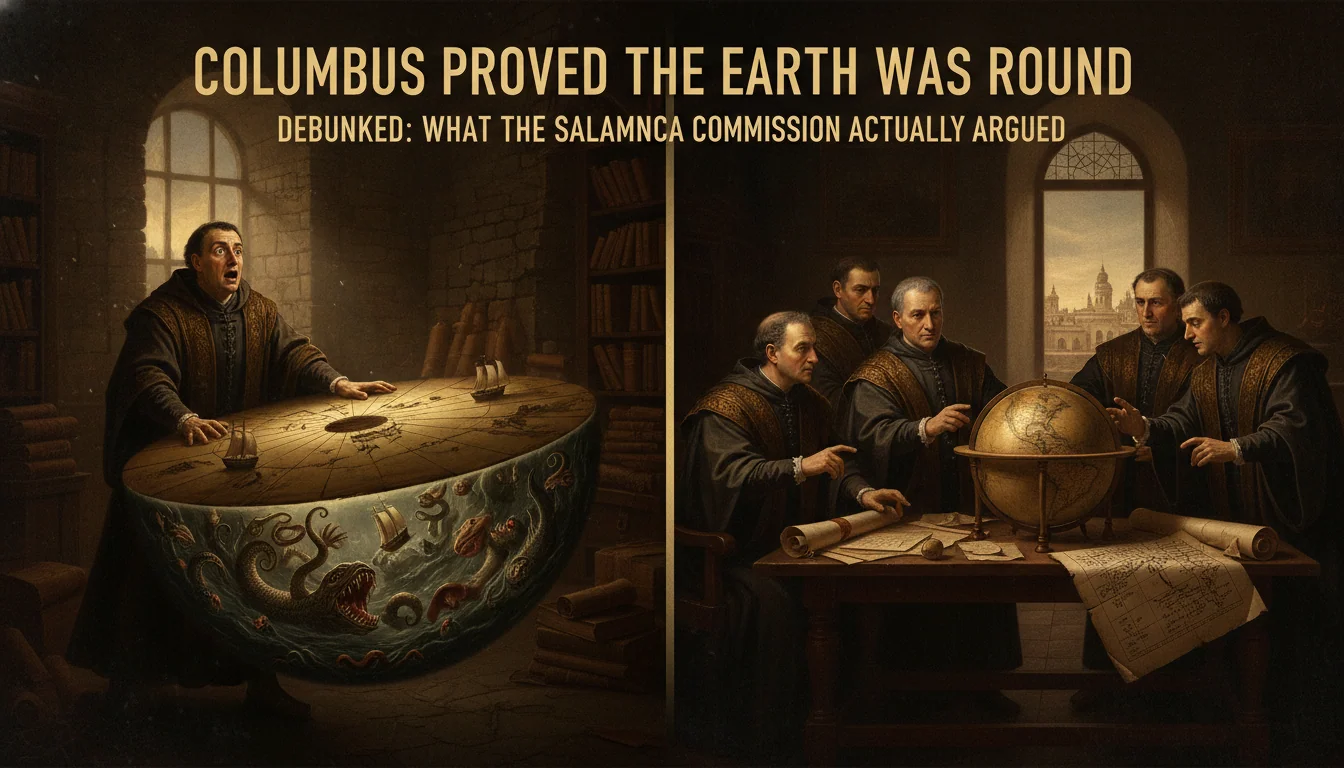
Ask most people what made Columbus's 1492 voyage so daring and you will likely hear some version of the same story: that everyone at the time believed the Earth was flat, that sailors feared falling off its edge, and that Columbus's crossing proved them wrong. It is a tidy, dramatic tale of a lone visionary defying the ignorance of his age. It is also almost entirely fiction, and the real dispute that surrounded Columbus's voyage is, if anything, more interesting than the myth.
The myth, stated fairly
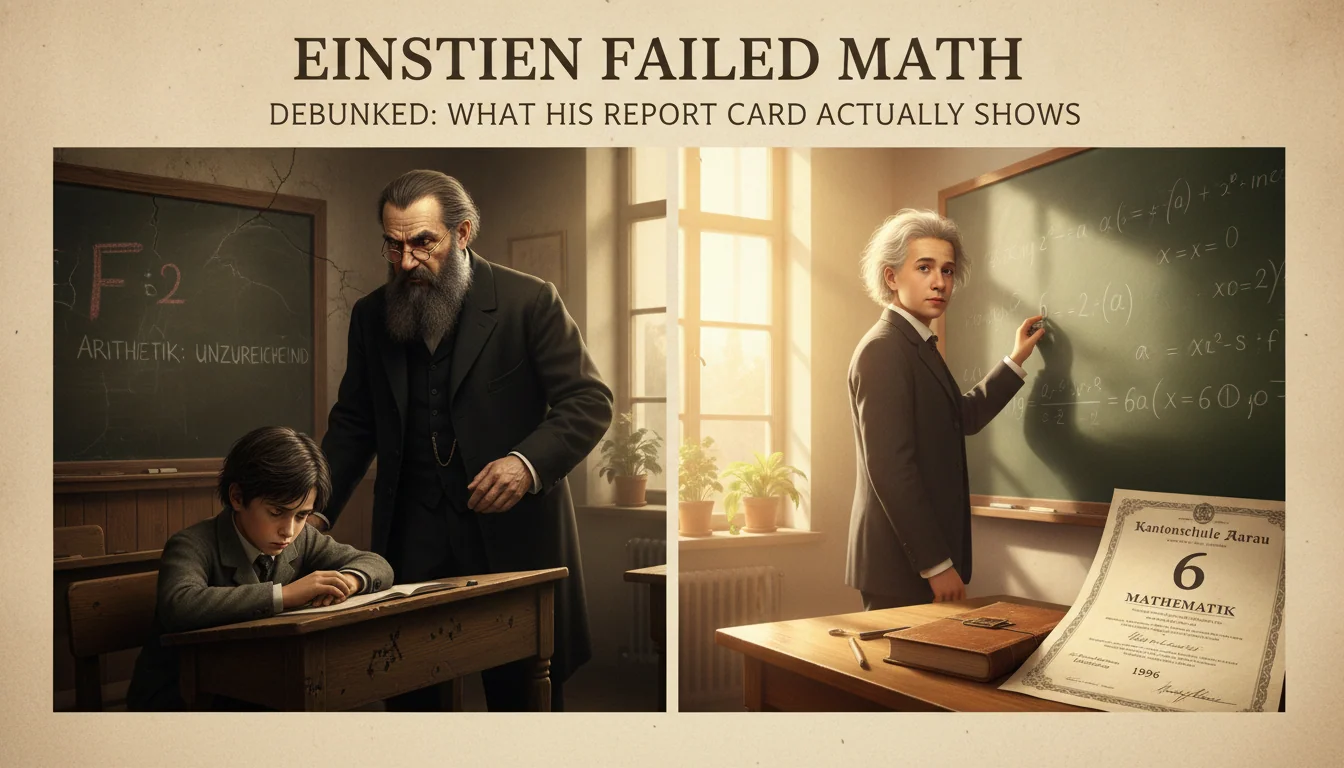
The story goes that in 1490s Europe, ordinary people, and even most educated ones, believed the world was a flat disc, and that a ship sailing far enough out to sea risked plunging over its edge or encountering monsters at the world's rim. Columbus, in this telling, had to fight against ignorant churchmen and a superstitious public to secure funding for a voyage that would prove the planet was round, facing down a commission of skeptical scholars who insisted his crew would sail off the map entirely. When his ships returned safely, the myth holds, he had settled the question once and for all, dragging Europe out of a medieval fog of ignorance through sheer daring. It is a compelling story precisely because it flatters the explorer as a lone rational man surrounded by superstition, and it has been taught with that framing in American classrooms for well over a century.
Why it is so believable
The story sticks because it fits a satisfying pattern: a lone rational hero overturning superstitious authority, a shape familiar from countless other tales of scientific progress. It also plays on a real and understandable confusion between two very different questions: whether the Earth is round, which was never seriously disputed among educated people of Columbus's era, and how big the Earth actually is, which was genuinely, hotly contested and turned out to matter enormously for Columbus's own voyage.
Where it came from
The most direct source for the modern myth is Washington Irving's 1828 book "A History of the Life and Voyages of Christopher Columbus." Irving, a popular American author better known for fiction like "Rip Van Winkle" and "The Legend of Sleepy Hollow," dramatized a supposed showdown in which Columbus argued against flat-earth churchmen at a commission convened to evaluate his proposal. Historians who have examined the actual records of that commission, associated with the University of Salamanca, have found no evidence that the debate concerned the Earth's shape at all. Irving appears to have invented or heavily embellished the confrontation for narrative effect, in keeping with the loose historical standards common to biography writing of his era.
Who spread it
Irving's version proved durable because it was vivid, quotable, and morally satisfying, and it was picked up wholesale by American textbook writers through the nineteenth century, who repeated the flat-earth showdown as established fact for generations of schoolchildren. It fits a broader pattern of nineteenth- and twentieth-century storytelling adding vivid, invented details after the fact, the same impulse behind the popular but similarly unsupported picture of medieval Europeans as flat-earth believers or of Vikings charging into battle wearing horned helmets, neither of which holds up against the historical record. The myth found further fuel later in the century from writers pushing a broader narrative that religious authority had long suppressed scientific truth, a framing that made the invented Salamanca confrontation useful as a stand-alone parable regardless of what the actual historical commission had argued about. School pageants, children's biographies, and eventually early film treatments of Columbus's voyage all leaned on the same dramatic beat: the visionary explorer defying a flat-earth establishment. By the time historians began systematically challenging the story in the twentieth century, most notably the historian Jeffrey Burton Russell in his 1991 book "Inventing the Flat Earth," the myth had already become fixed enough in popular culture that correcting it has remained an uphill task ever since, resurfacing in classroom materials and casual conversation long after professional historians had thoroughly debunked it.
What the primary sources actually say
The spherical shape of the Earth was established science among educated Europeans long before Columbus was born. The Greek scholar Eratosthenes calculated the Earth's circumference with striking accuracy around 240 BC, using shadow measurements at different latitudes, and later Greek and Roman writers treated a spherical Earth as basic astronomical knowledge. Medieval Christian scholars carried this forward rather than rejecting it: the English monk Bede wrote of a round Earth in the eighth century, and Thomas Aquinas, writing in the thirteenth century, referenced the Earth's spherical shape as an uncontroversial premise in his broader theological arguments. Ships' navigators of Columbus's own era used calculations that assumed a curved Earth as a matter of routine.
What the Salamanca commission and other scholars who reviewed Columbus's proposal actually disputed was the size of the planet and, by extension, the width of the ocean he proposed to cross. Columbus, drawing on a combination of older, since-discredited geographic estimates, including an inflated figure for Asia's eastward extent from Marco Polo's travel accounts and a miscalculation of the length of a degree of longitude, argued that Asia lay only around 2,300 or so nautical miles west of the Canary Islands. Most contemporary scholars, working from Eratosthenes-derived figures that were far closer to the Earth's true circumference, argued the distance was several times greater, closer to the correct figure of roughly 10,600 nautical miles to Japan from that starting point.
On the mathematics available to both sides, the commission was right and Columbus was wrong. His ships would very likely have run out of food and fresh water long before reaching Asia had an entire pair of continents, unknown to either side of the debate, not happened to sit in the way. Columbus himself never fully accepted this once he made landfall in the Caribbean; he spent much of the rest of his life insisting he had reached the outer islands of Asia rather than an unknown landmass, a stubbornness historians attribute partly to the same confident miscalculation that got his voyage approved in the first place. The commission's skepticism, in other words, was not superstition losing an argument to reason. It was reasonably good geography losing to a wrong number that happened to work out by accident.
Why it is so believable
Part of what makes the myth so sticky is that it borrows real, documented history and simply relabels it. The Salamanca commission's skepticism was genuine, the debate genuinely delayed Columbus's project for years while he sought royal backing, and the voyage genuinely carried real risk of running out of supplies, since the calculation of distance really was the crux of the disagreement. The myth takes that authentic tension and swaps out its actual subject, size, for a more dramatic one, shape, that makes for a punchier classroom story about ignorance versus enlightenment. It also plays into a broader and older narrative, popular especially in the nineteenth century, that cast the medieval Church as reflexively hostile to scientific reasoning, a caricature many professional historians of science now regard as considerably overstated when applied to actual medieval scholarship on astronomy and geography.
What is true instead
So did Columbus prove the Earth was round? He did not, because the question had already been settled centuries earlier. The real story of Columbus's 1492 voyage is not a triumph over flat-earth ignorance but a case of a persistent, somewhat reckless gambler benefiting from being wrong about geography in a way that happened to work out. He did not need a round Earth explained to him, and neither did the churchmen who reviewed his plan; both sides already agreed on that point. What separated them was a dispute over scale, and on that count the historical record is unambiguous about who had the better math. The interesting story, as usual, is not the one that survived in the textbooks.
Quick Answers
Common questions about this topic
Is it true that Columbus proved the Earth was round?
No. Educated Europeans, including virtually every scholar, navigator, and churchman of the period, already accepted that the Earth was a sphere, a fact known since antiquity. The real dispute when Columbus pitched his voyage was over the planet's size and the distance to Asia, not its shape.
Did people in Columbus's time think the Earth was flat?
No credible evidence supports this. Ancient Greek scholars had calculated the Earth's spherical shape and even its approximate circumference centuries before Columbus, and medieval Christian scholars, including figures like the Venerable Bede and Thomas Aquinas, wrote about a spherical Earth as settled fact.
What did the scholars at Salamanca actually argue with Columbus about?
The commission that reviewed Columbus's proposal in Spain, associated with the University of Salamanca, argued that his estimate of the distance to Asia was too small and that his ships would run out of supplies long before reaching land. On the actual math available to them, they were correct; Columbus was only saved by the unexpected existence of the Americas.
Where did the flat-earth myth about Columbus come from?
The myth is largely traced to Washington Irving's 1828 biography of Columbus, which dramatized a fictional debate over a flat Earth that historians say did not happen as described. The story was then repeated and amplified by nineteenth-century textbooks until it became fixed in popular memory.

Ask What Really Happened
Chat with the figures behind the myths everyone still believes.
Create your free account →No card required. Some figures and features require a paid plan.
Join the HistorIQly Club
Get smarter about the past.
Weekly stories, deep dives, and exclusive content straight to your inbox.