Debunked: Catherine the Great Did Not Die Having Sex With a Horse
The Catherine the Great horse myth, a viral tale of death by horse, is 18th-century political slander. Here is what the household actually recorded that day.
Read Wikipedia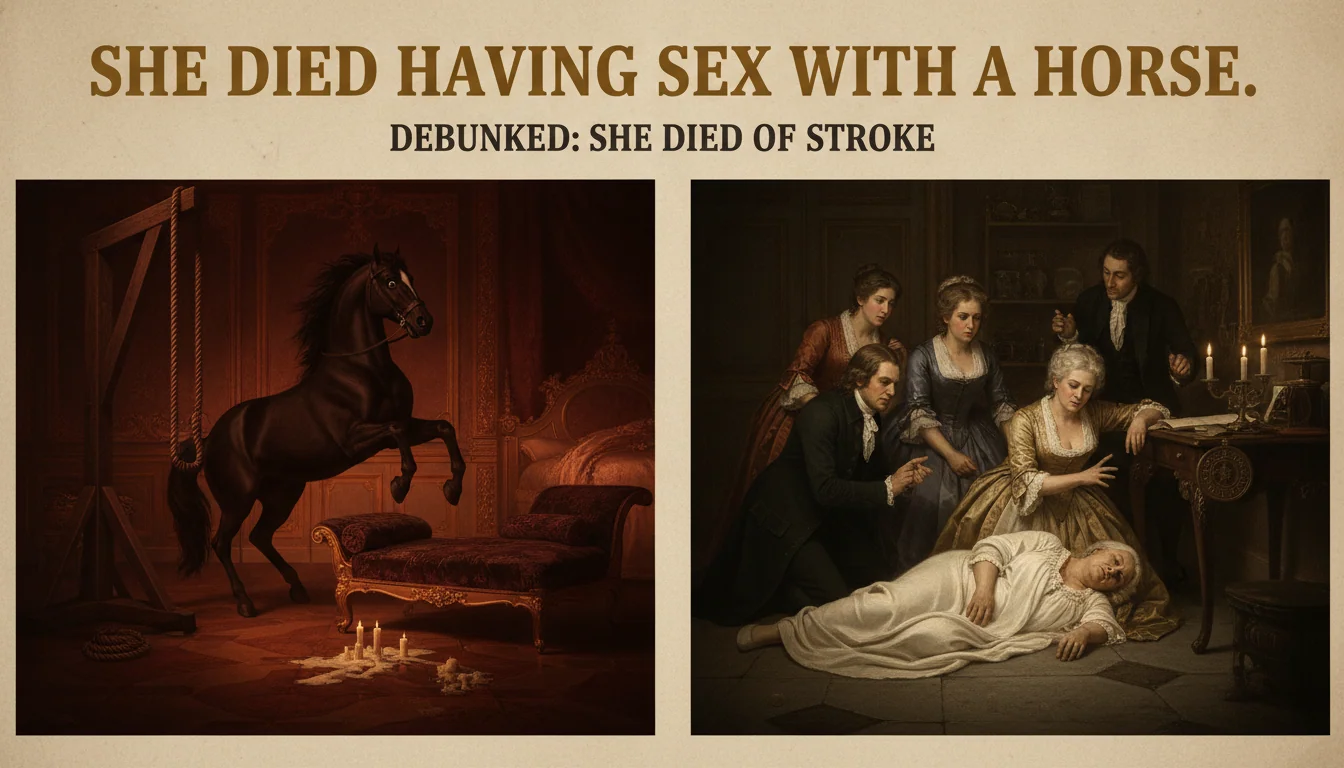
Ask almost anyone what they know about Catherine the Great, and sooner or later someone brings up the horse.
The story, in its most vivid form, goes like this: the Empress of Russia, insatiable after decades of taking young lovers, ordered a horse suspended above her by a specially rigged sling so she could have intercourse with the animal. The sling snapped. The horse's full weight came down on her, and one of history's most powerful women died crushed beneath a stallion in her own bedroom, an absurd and undignified end for a monarch who had ruled a sixth of the world's land for more than three decades.
It is a spectacular story. It has survived in bar trivia, late-night television bits, half-remembered high school history classes, and countless internet comment sections. Part of its staying power is the very outrageousness of it: people repeat it precisely because it sounds too strange to have been invented. It is also, as far as any historian has ever been able to establish, entirely fabricated.
Why the Story Is So Believable
The Catherine the Great horse myth endures because it plugs neatly into things that actually happened. Catherine did have an active and fairly public romantic life. Over her 34-year reign she kept a documented sequence of official favorites, around a dozen men across her lifetime, several of whom she elevated to genuine political power rather than quietly kept out of view. Grigory Orlov helped put her on the throne in 1762 and stayed at her side for years. Grigory Potemkin became her most important statesman and, by some accounts, her secret husband, remaining her closest advisor long after their romance had cooled. Her last favorite, Platon Zubov, was decades younger than Catherine, roughly forty years her junior, and the age gap between them was genuine gossip fodder at courts across Europe.
Unlike most kings, who kept mistresses quietly tucked away, Catherine conducted her romantic life openly, with titles, apartments, and gifts attached to it. For a female ruler in the 18th century, that openness read as scandalous in a way it simply did not for her male counterparts, who faced no equivalent rumors about how their indulgences might kill them. Catherine's contemporaries, and generations of writers after them, did not extend her the same courtesy.
There is also a darker thread feeding the myth: Catherine came to power in a 1762 palace coup against her own husband, who did not survive it for long. A woman capable of taking a throne that way was, in the eyes of hostile contemporaries, capable of anything, and that reputation for ruthlessness made an outlandish story about her private life easier to swallow.
So the myth borrows real material: a genuinely unconventional and public love life, genuine unease at a woman wielding that much power for that long, and a reputation for ruthlessness earned by how she took the throne in the first place, and grafts onto all of it a grotesque, physically impossible detail that makes the whole thing unforgettable.
Where the Story Actually Came From
No version of the horse story appears in any letter, diary, dispatch, or pamphlet written during Catherine's lifetime or in the years immediately following her death in 1796. That silence matters. Catherine's death was a major European event, reported by ambassadors and picked over in courts from Vienna to London by people who had every incentive to gossip about her. None of that surviving correspondence mentions a horse.
What does survive from her lifetime is a steady stream of hostile, sexualized political commentary, much of it from rivals unhappy with Russia's growing reach. Catherine was one of the chief architects of the partitions of Poland, and the courts she outmaneuvered on that front had every reason to prefer her remembered as depraved rather than shrewd. This was also the era of the scurrilous political pamphlet, the kind of anonymous, often pornographic satire European writers used to destroy the reputations of the powerful. Marie Antoinette, Catherine's near contemporary, endured a similar campaign: pamphleteers accused her of orgies and incest, invented claims that were later thrown at her during her own trial.
Catherine's version of this slander, that she was so sexually insatiable it eventually killed her, fits the same tradition. The horse itself appears to be a later flourish, most likely stitched onto the older "depraved empress" gossip sometime after her death, and it hardened into the familiar version told today only well after any eyewitness who could have contradicted it was gone.
How a Slander Becomes "Common Knowledge"
Catherine's own son gave the rumor mill fresh material to work with. Paul I resented his mother, who had sidelined him from real power for most of her reign, and the moment she died he moved quickly to rehabilitate his father, Peter III, whom Catherine had deposed in 1762 and who died in custody within weeks under circumstances nobody at court believed were natural. Paul had his father's remains exhumed and reburied beside Catherine's in a state funeral, reportedly forcing surviving men implicated in Peter's death to march in the procession. A new ruler openly working to discredit his predecessor's legacy created exactly the climate in which unflattering stories about that predecessor could spread unchallenged.
From there the slander had a long runway. Nineteenth-century writers hostile to Russian autocracy in general, and unconcerned with the facts of a dead foreign empress's private life, kept the "depraved Catherine" tradition alive in sensational histories and salon gossip. It's the same mechanism behind other durable historical myths, like the persistent claim that Napoleon was unusually short, a story pushed by his political enemies that stuck around long after the facts were settled. By the 20th century the tale had picked up the horse and the broken sling as a fixed, gruesome detail, and it spread the way durable urban legends do: through repetition, into textbooks and pop trivia, each retelling treated as confirmation of the last rather than what it actually is, a copy of a copy of a slander.
What the Primary Sources Actually Say
The documented facts of Catherine's death are unglamorous, and they come from people who were actually in the room. On the morning of November 16, 1796, Catherine's valet found her collapsed on the floor of her dressing room, near her private water closet at the Winter Palace. Her longtime Scottish physician, John Rogerson, and the other doctors summoned to her side recognized the signs of a massive stroke: she could not speak, one side of her body had gone slack, and her breathing grew increasingly labored. She never regained consciousness. Attendants and family members, including her son Paul, gathered at her bedside as she lay dying over the following day and a half. She died on the evening of November 17, 1796, at 67 years old, without ever waking again.
That account rests on the testimony of the household staff who found her, the physicians who treated her, and the relatives who kept vigil, all of it recorded close to the event by people with no obvious motive to invent a stroke. It matches, in every particular, the textbook symptoms of a cerebral hemorrhage rather than anything resembling a bizarre accident. It is, frankly, a far less entertaining story than the horse. It also happens to be the one that is true.
The Real Story Is Better Anyway
Strip away the invented ending and what remains is more impressive, not less. Catherine arrived in Russia as a minor German princess at 14, survived a miserable marriage and a palace coup, and went on to rule the largest country on earth for 34 years, expanding its borders, corresponding with the Enlightenment's leading thinkers, and running one of the most sophisticated courts in Europe. All of that, and she is still, in death as in life, treated by pop history as a woman whose power needs explaining away by her supposed appetites rather than by her own considerable skill.
The horse never existed. The stroke did. Like the horned helmets Vikings never wore, the invented detail is more memorable than the mundane truth, which is exactly why it survives. And the reason the myth has outlived two centuries of actual biography says less about Catherine than about how comfortable people remain imagining that a powerful woman's downfall must, somehow, be her own depraved fault.
Quick Answers
Common questions about this topic
Is it true that Catherine the Great died having sex with a horse?
No. It is a myth with no source from her lifetime or the years immediately after. Catherine died from a massive stroke on November 17, 1796, at age 67, after collapsing in her private rooms at the Winter Palace the previous morning.
Where did the horse myth come from?
Its exact origin cannot be pinned to one document, but it grew out of decades of hostile, sexualized political slander aimed at Catherine over her string of court favorites, spread by foreign rivals and later by her own son Paul I, who worked to discredit her memory after taking the throne.
What actually killed Catherine the Great?
She suffered a stroke on the morning of November 16, 1796, was found collapsed by her valet, and never regained consciousness. She died roughly a day and a half later with physicians and family members at her bedside.
Did Catherine the Great really have many lovers?
Yes. She kept a documented series of official favorites over her 34-year reign, around a dozen men in total, several of whom held real political power. Unlike most monarchs, who kept mistresses discreetly, Catherine's relationships were an open feature of her court, which made her an easy target for slander.

Ask What Really Happened
Chat with the figures behind the myths everyone still believes.
Create your free account →No card required. Some figures and features require a paid plan.
Join the HistorIQly Club
Get smarter about the past.
Weekly stories, deep dives, and exclusive content straight to your inbox.