Debunked: Is the Great Wall of China Visible From Space?
Is the Great Wall of China visible from space? Astronauts say you cannot see it with the naked eye from orbit. Here is where the myth came from and what you can see.
Read Wikipedia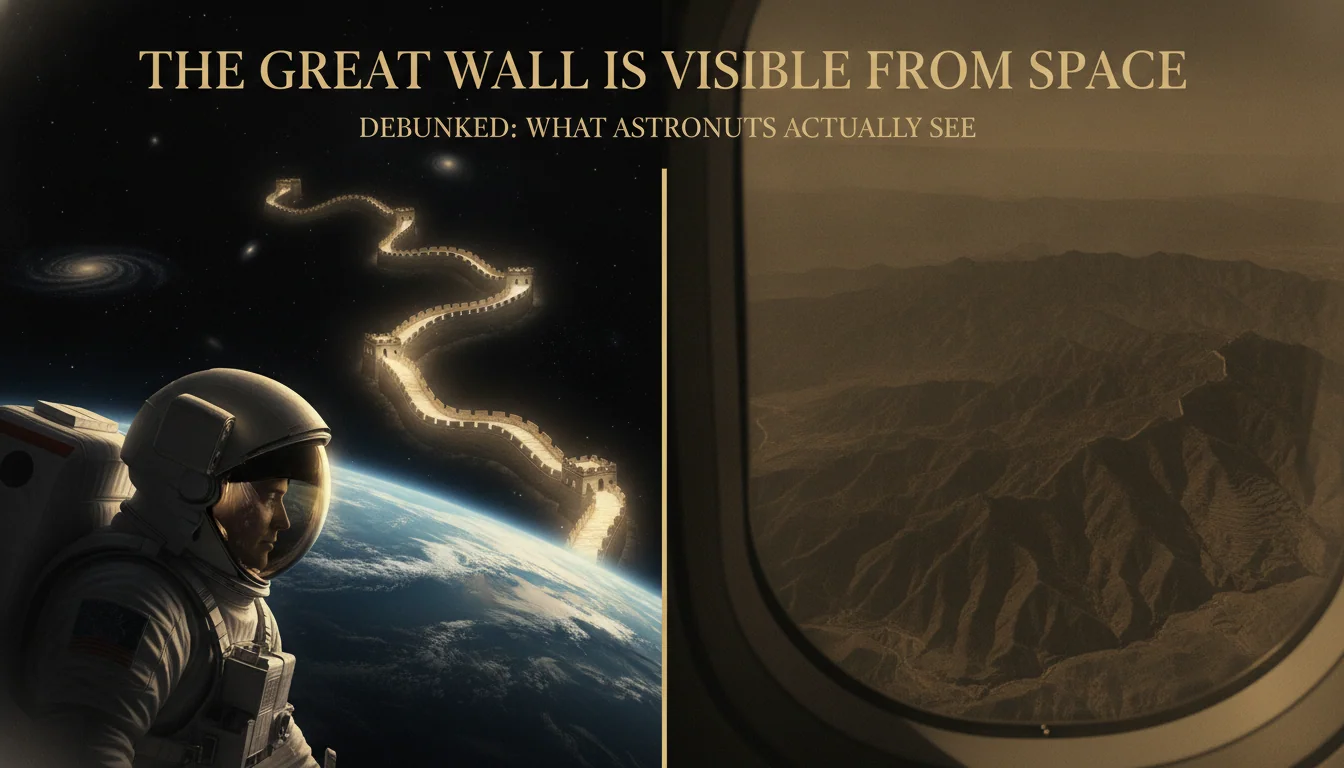
Ask a classroom of schoolchildren to name one fact about the Great Wall of China and a good number of them will tell you it is the only man-made structure visible from space. It is a satisfying piece of trivia, repeated in textbooks, trivia nights, and tour guide scripts for generations. It is also something that every person who has actually been to space and looked has said, on the record, is not true.
The myth, stated fairly
Is the Great Wall of China visible from space? The claim is not a stupid one on its face, and it deserves to be taken seriously before it gets taken apart. The Great Wall is, after all, the longest structure ever built by human beings, its various sections and branches stretching, by the most comprehensive Chinese government survey completed in 2012, over 21,000 kilometers when every wall, trench, and natural barrier incorporated into the defensive system is counted. A structure of that length, snaking across mountains and deserts for thousands of kilometers, sounds like exactly the kind of thing that ought to stand out against a planet viewed from far enough away. Human intuition about scale breaks down badly at orbital distances, and it is an entirely reasonable mistake to assume that "extremely long" and "visible from very far away" are the same kind of impressive.
It also helps that the claim has the ring of authority. It is not phrased as "some people believe" but as a settled fact, often with a specific and confident detail attached: visible from the Moon, or the only man-made object you can see from space. Confident, specific claims spread faster and get challenged less than vague ones, and this myth has both going for it.
Why it is so believable
Part of the staying power comes from a basic confusion between length and width. A structure can be enormously long and still be, from directly overhead, a very thin line, and thin lines are exactly what the human eye and even most cameras struggle to resolve against a cluttered, textured background at long distances. Most of the surviving and best-known Ming dynasty sections of the wall run somewhere around 4 to 9 meters wide at the base, narrower higher up, a scale that gets lost entirely once you are looking down from an altitude where whole mountain ranges start to look like wrinkles in a bedsheet.
The myth also survives because it flatters both the wall and the claimant repeating it. It is a nice thing to say about a civilization's engineering, and repeating it costs nothing and signals a bit of worldly knowledge, the kind of fact people like to have in their back pocket. Nobody fact-checks trivia that makes everyone look good.
Where it actually came from
The myth's traceable roots go back further than most people assume, and further than space travel itself by roughly two centuries. The English antiquarian William Stukeley, writing in 1754 in a letter about a very different subject, the Roman-era Dyke Hills earthworks in Oxfordshire, made an aside comparing them to the Great Wall of China, speculating that the Chinese wall was of such magnitude that it "might likely be seen from the moon." Stukeley had never been anywhere near China, let alone the Moon, and the remark was closer to a rhetorical flourish about scale than a scientific claim, but it is the earliest documented version historians have traced.
The idea resurfaced in scattered 19th and early 20th century writing, but its real popularization came from the American travel writer and adventurer Richard Halliburton, whose bestselling 1938 book Second Book of Marvels repeated the claim that the Great Wall was the only man-made structure visible from the Moon, presented with the same breezy confidence Halliburton brought to his other tales of derring-do. Halliburton had, obviously, no more been to the Moon than Stukeley had, and no human being would leave Earth's atmosphere for another two decades. The claim was pure speculation dressed as established fact, but Halliburton's books sold in the millions, and the line stuck.
How it spread
Once a claim like this lodges itself in popular science writing, textbooks tend to repeat it uncritically, since it is a vivid, quotable fact rather than a dry statistic, and generations of teachers looking for a memorable detail about the wall picked it up and passed it along without checking Halliburton's sourcing, which did not exist in any testable form to begin with. It sits alongside other stubborn classroom myths that spread the same way, including the enduring medieval flat earth belief and the equally persistent idea that Columbus proved the earth was round. The claim survived the actual dawn of spaceflight remarkably well, partly because early accounts were sometimes vague or got compressed in translation and retelling, and partly because by the time astronauts started directly contradicting it, the myth already had a multi-generational head start in schoolbooks and quiz shows.
Chinese state media and tourism material occasionally repeated versions of the claim as well, for understandable reasons of national pride, which added another institutional voice reinforcing something that individual astronauts were simultaneously trying to correct.
What the primary sources say
The most direct and often-cited correction came in 2003, when Yang Liwei became the first Chinese astronaut to fly in space, aboard the Shenzhou 5 mission. Chinese media and members of the public reportedly asked him afterward whether he had seen the Great Wall from orbit, given the strong national association between the wall and the claim, and Yang stated plainly that he had not been able to see it. His comments were widely reported in Chinese press at the time and prompted a public conversation in China itself about correcting the textbook version of the story, including revisions to some school materials that had repeated the myth.
Yang was far from the first to say so. American astronauts had been making the same point for decades. Apollo astronaut Eugene Cernan, one of the few people to see Earth from lunar distance, stated flatly that the Great Wall was not visible to the naked eye even from low Earth orbit, let alone from the Moon, a view echoed by numerous other astronauts across the Space Shuttle and International Space Station programs. NASA's own public statements on the subject have repeatedly noted that under exceptionally clear conditions and with foreknowledge of exactly where to look, some observers report a very faint, hard-to-distinguish line from low Earth orbit, but this is a marginal, favorable-conditions claim wildly different from the "clearly visible, even from the Moon" version that circulates as trivia.
The physical case against visibility from the Moon in particular is straightforward. At a Moon-to-Earth distance of roughly 384,000 kilometers, resolving a 4 to 9 meter wide line with the unaided human eye is not a matter of atmospheric haze or a bad day. It falls far outside the basic angular resolution limits of human vision, the same reason you cannot read a highway sign from forty miles away no matter how clear the air is. No astronaut has ever claimed otherwise.
What is true instead
The real story of what is visible from orbit is arguably more interesting than the myth, because it says something true about what actually stands out from space: not length, but contrast and area. Astronauts on the International Space Station and earlier missions have consistently reported that city lights at night are strikingly visible, along with major highway systems, large-scale agricultural field patterns with sharp geometric boundaries, dams, and reservoirs, and, famously, the sprawling grid of Las Vegas or the wake patterns of large ships at sea. These stand out not because they are long but because they create a strong visual contrast, in brightness, color, or geometric regularity, against a wide surrounding area.
The Great Wall, for all its genuine length and its status as one of the great engineering achievements of the pre-modern world, was built from materials, rammed earth, brick, and stone that closely match the color and texture of the terrain it runs through, precisely because its builders were working with what the local landscape provided rather than importing bright, contrasting material for visibility from a vantage point nobody in the Ming dynasty could have imagined existed. It disappears into its surroundings from altitude for the same reason a hiking trail vanishes into a hillside from a passing airplane: it was never built to be looked at from above, only to be walked along and defended from the ground. That is not a mark against the wall's achievement. If anything, a defensive structure blending seamlessly into the very mountains and deserts it was built to guard is a better testament to Ming dynasty engineering than a myth invented two centuries before anyone could check it.
Quick Answers
Common questions about this topic
Is it true that the Great Wall of China is visible from space?
Not with the naked eye, and not from the Moon. Multiple astronauts, including the Chinese astronaut Yang Liwei in 2003, have stated directly that the wall is not visible unaided from low Earth orbit, roughly 400 kilometers up, let alone from the Moon's distance of about 384,000 kilometers.
Where did the Great Wall space myth come from?
The earliest known version traces to an English antiquarian, William Stukeley, who wrote in 1754 that the wall might be visible from the Moon. The claim resurfaced and spread widely after the American travel writer Richard Halliburton repeated a version of it in his bestselling 1938 book Second Book of Marvels, decades before any human had actually been to space to check.
Can astronauts see anything from space?
Yes, but not thin linear structures like the Great Wall. From low Earth orbit, astronauts can identify large-scale human features with strong contrast against their surroundings, such as city lights at night, major highway networks, agricultural field patterns, and large reservoirs or dams, none of which resemble a wall only a few meters wide.
How wide is the Great Wall of China?
It varies considerably by section and era, but most of the surviving Ming dynasty wall, the best-preserved and most visited portion, measures roughly 4 to 9 meters wide at its base, narrowing higher up, a scale that is a rounding error against the resolution needed to distinguish anything from orbit with the unaided eye.

Ask What Really Happened
Chat with the figures behind the myths everyone still believes.
Create your free account →No card required. Some figures and features require a paid plan.
Join the HistorIQly Club
Get smarter about the past.
Weekly stories, deep dives, and exclusive content straight to your inbox.