Debunked: Medieval Scholars Never Believed the Earth Was Flat
The flat-earth Middle Ages never happened. Bede, Aquinas, and a required university textbook all taught a sphere, centuries before Columbus sailed.
Read Wikipedia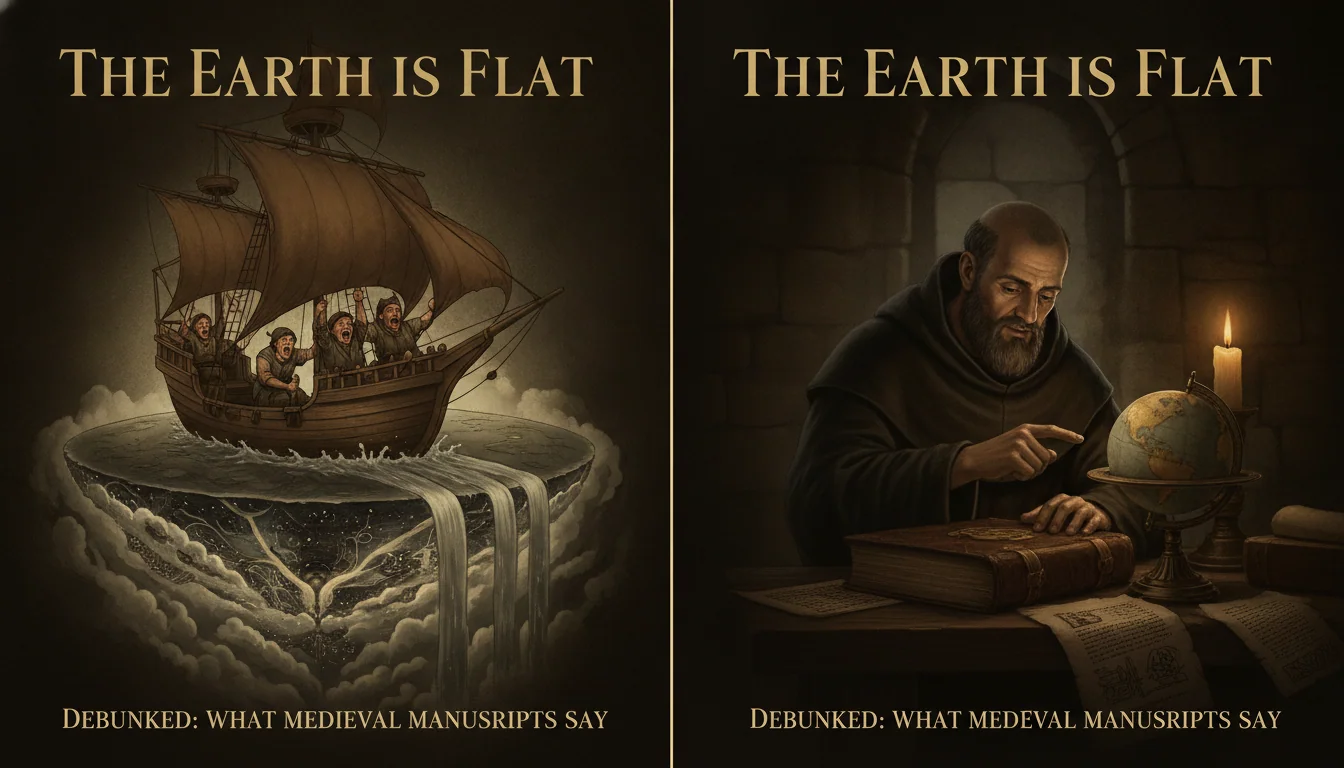
Picture the scene: a monk in a candlelit scriptorium, hunched over a manuscript, sincerely convinced that if a ship sailed far enough west it would tip over the rim of the world and plunge into darkness. Around him, a Church that treats the round Earth as heresy, ready to burn anyone who says otherwise. Then along comes Christopher Columbus, a lone rational man armed with geometry, who has to argue down a room of terrified clergymen before he can get funding for his voyage. It is a wonderful story about the triumph of reason over superstition, and it has been taught in one form or another for well over a century. It is also almost entirely fabricated.
Medieval scholars did not think the Earth was flat. Not the theologians, not the astronomers, not the university students required to sit through lectures on the subject. The sphericity of the Earth was settled science by the time Rome fell, and it stayed settled straight through the period people still like to call the Dark Ages.
The Myth, Stated Fairly
The story deserves to be stated at full strength, because it is genuinely persuasive. In this version, the fall of the Roman Empire also meant the collapse of classical learning, and Europe spent nearly a thousand years in intellectual retreat, dominated by a Church suspicious of pagan science. Flat-earth belief becomes shorthand for that retreat: if medieval people could not even get the shape of the planet right, how sophisticated could their astronomy, medicine, or philosophy possibly have been? Columbus then arrives as a Renaissance man ahead of his time, facing down a tribunal of monks who quote scripture at him and warn that his sailors will fall off the edge of the world. He wins the argument, sails anyway, and proves the Earth is round. It is a tidy morality tale, with ignorance on one side and reason on the other, and it flatters exactly the story a modern, secular, scientific culture likes to tell about its own progress.
Why It Is So Believable
A few real things give the myth its traction. The period does get called the "Dark Ages," a label that invites the assumption of general ignorance even though most historians now consider it misleading and largely avoid it. Medieval maps do not help either. The famous T-O maps found in manuscripts, showing the known continents arranged inside a circle divided by a T shape of rivers and seas, look to modern eyes like a picture of a flat disc. They are not. They are schematic diagrams of the inhabited landmass, the orbis terrarum or "circle of lands," in the same way a subway map schematizes a city without claiming the city is actually a straight line. There was also a real conflict between the Catholic Church and astronomers, but it was over heliocentrism, the idea that the Earth orbits the sun, and it happened in the 1600s with Galileo, not over the shape of the planet in the medieval period. The two controversies get conflated in popular memory until "the Church fought scientists about the solar system" becomes "the Church denied the Earth was round," which is a different claim entirely and one the record does not support.
Where the Myth Actually Came From
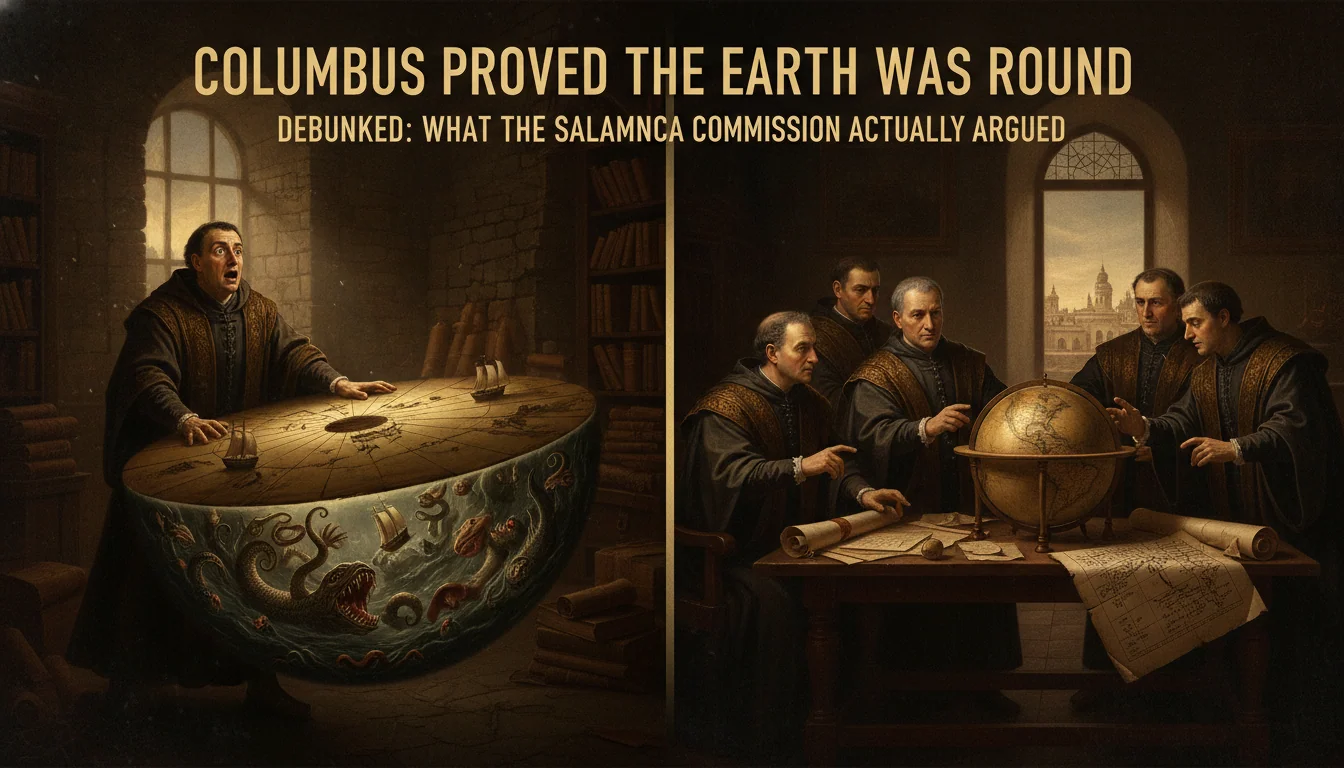
The traceable origin is a work of historical fiction dressed up as biography. In 1828 the American writer Washington Irving published "A History of the Life and Voyages of Christopher Columbus," a bestselling account that took real liberties with its subject. Irving invented a vivid scene in which Columbus appears before a council of Spanish churchmen and scholars, who cite scripture to insist the Earth is flat and mock him for proposing to sail off its edge. It is a gripping scene. It is also fiction. The real body that reviewed Columbus's proposal, a commission convened under the Spanish crown in the late 1480s, did reject his plan, but on entirely different grounds. Every scholar in that room agreed the Earth was a sphere. Their objection was about its size. Columbus, working from a chain of flawed calculations built on Ptolemy, the geographer Marinus of Tyre, and an overly generous reading of Marco Polo's account of Asia, believed the ocean crossing to Japan was survivable. The commission's astronomers thought his estimate of the Earth's circumference was too small and the true distance far greater than his ships could manage. On that point, it turned out, they were right and he was lucky: there was an unexpected continent in the way.
Who Spread It
Irving's invented scene might have stayed a colorful anecdote if it had not been picked up by a specific historiographical project later in the 19th century. Two influential writers, the chemist John William Draper in his 1874 "History of the Conflict Between Religion and Science" and the historian Andrew Dickson White in his 1896 "A History of the Warfare of Science with Theology in Christendom," built a sweeping narrative in which organized religion had been science's enemy throughout Western history. A flat, church-enforced medieval cosmology made a perfect illustration for that thesis, so both authors repeated and amplified Irving's fictional council scene as though it were documented history. From there it filtered into schoolbooks. Generations of students in the 20th century learned a version of the Columbus story built directly on Irving's invention, complete with terrified sailors and a triumphant explorer proving the skeptics wrong. The story was clean, dramatic, and completely suited to a classroom hour, which is a large part of why it outlived the evidence against it.
What the Primary Sources Say
The demolition rests on documents that were never hidden or obscure. The English monk Bede, writing around 725 in "The Reckoning of Time," describes the Earth as round like a ball, not merely circular like a shield, and uses that shape to explain why day length changes with latitude and why the Earth's curved shadow falls across the moon during a lunar eclipse. Centuries later, university students across Europe were required to study "Tractatus de Sphaera," a textbook by the scholar John of Sacrobosco written in the early 1200s, which spent its opening pages proving the Earth is a sphere using the same evidence Aristotle had already assembled centuries earlier: a ship's hull disappears below the horizon before its mast does, different stars become visible as a traveler moves north or south, and the Earth's shadow on the moon during an eclipse is always curved. Thomas Aquinas assumed a spherical Earth without comment in the "Summa Theologica," treating it as too obvious to argue. Dante Alighieri built the entire geography of the "Divine Comedy," written in the early 1300s, around a spherical planet, descending through a globe-shaped Hell and emerging in the southern hemisphere on the far side. And across medieval Europe, kings and emperors were crowned holding a ceremonial orb, a sphere topped with a cross, a piece of regalia whose entire symbolism depends on the Earth being a globe a ruler could be said to hold dominion over. None of this reads like a civilization arguing about whether the planet is round.
What Is True Instead
The genuinely interesting medieval debates were about size and habitability, not shape. Scholars argued over how large the Earth actually was, drawing on and revising Eratosthenes's ancient calculation, which had used the angle of shadows at two different locations to estimate the circumference with real precision. They also argued over the antipodes, the hypothetical people who might live on the unreachable far side of the globe, a question that worried theologians like Augustine of Hippo centuries earlier not because the globe itself was in doubt, but because an isolated population descended from no known ancestor posed an awkward theological puzzle. There was, to be fair to the myth's true believers, one genuine flat-earther worth naming: Cosmas Indicopleustes, a 6th century Byzantine monk and former merchant, who argued in his "Christian Topography" that the Earth was a flat rectangle shaped like the biblical tabernacle, covered by a vaulted sky. His work survived in only a small number of manuscripts, was written in Greek rather than the Latin of Western scholarship, and appears to have been treated even by contemporaries as an eccentric outlier rather than a serious cosmological rival. He is not evidence of what medieval Europe believed. He is evidence that almost nobody did.
The real medieval achievement was not doubting the ancients but keeping them. Monasteries copied Greek and Roman astronomical texts by hand for a thousand years, universities built required curricula around them, and by the time Columbus set sail, the shape of the Earth was one of the least controversial facts in Europe. The interesting question was never whether the world was round. It was how big, and what might be waiting on the other side.
Quick Answers
Common questions about this topic
Is it true that medieval people believed the Earth was flat?
No. Educated Europeans throughout the medieval period accepted a spherical Earth, a fact inherited from Greek astronomy. University students studied it from a required textbook, and church scholars like the Venerable Bede described it in writing centuries before Columbus sailed.
Where did the flat-earth myth come from?
Mostly from a 19th century American writer. Washington Irving invented a dramatic scene of Columbus battling flat-earth churchmen in his 1828 biography of the explorer, and later historians folded it into a broader story about science versus religion.
Did Columbus have to convince people the Earth was round?
No. The Spanish commission that reviewed his proposal debated the size of the ocean and the distance to Asia, not the shape of the planet. Every scholar at the table already agreed the Earth was a sphere.
Did anyone in the medieval period actually think the Earth was flat?
A handful of fringe writers did, most notably the 6th century Byzantine monk Cosmas Indicopleustes, but his work survived in only a few manuscripts and had negligible influence on medieval scholarship in Western Europe.

Ask What Really Happened
Chat with the figures behind the myths everyone still believes.
Create your free account →No card required. Some figures and features require a paid plan.
Join the HistorIQly Club
Get smarter about the past.
Weekly stories, deep dives, and exclusive content straight to your inbox.