Declassified: Acoustic Kitty, the CIA's Spy Cat
The CIA reportedly spent millions surgically wiring a cat into a listening device. Here is what the declassified record actually documents about Acoustic Kitty.
Read Wikipedia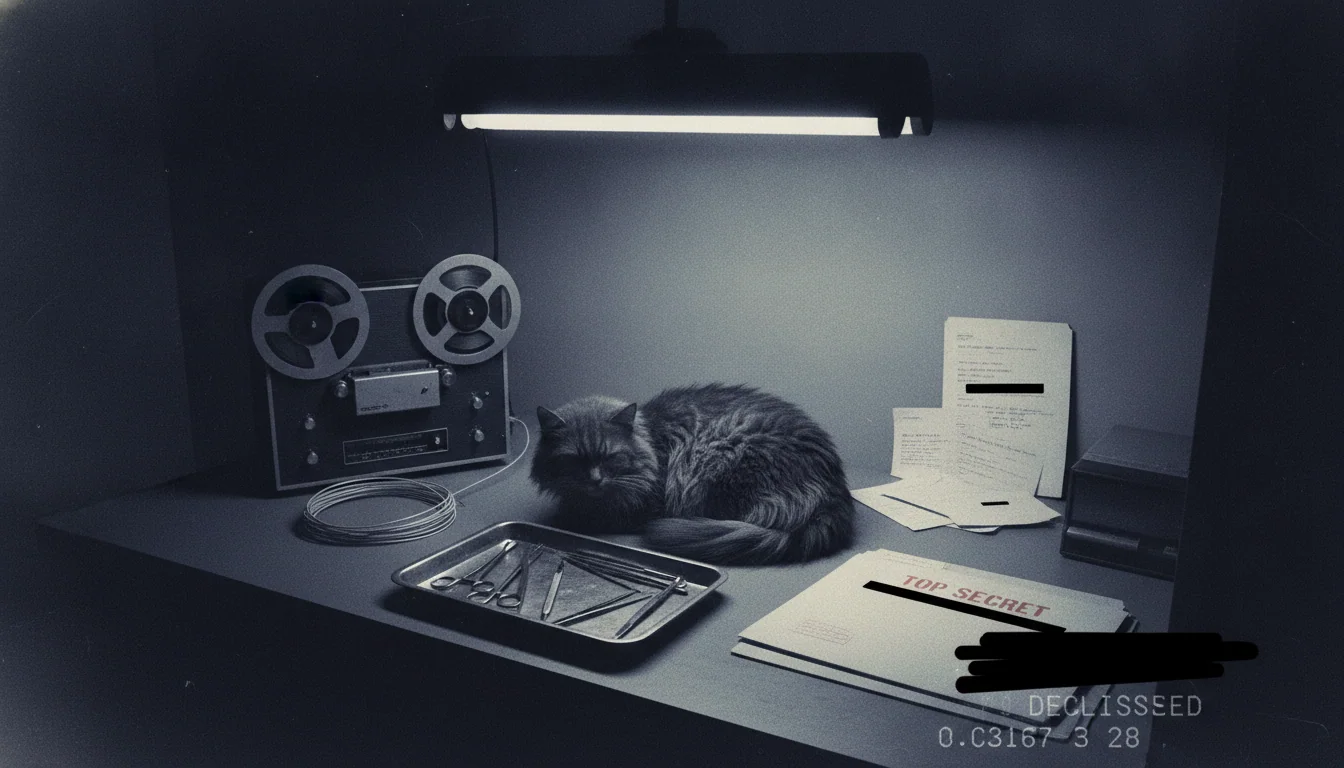
Somewhere in the CIA's Directorate of Science and Technology, in the years when the agency was also dosing unwitting subjects with LSD and testing exploding cigars, a team of engineers decided the ideal covert listening device was a house cat. Not a device disguised as a cat. An actual cat, surgically modified to carry one.
The program was reportedly called Acoustic Kitty, and for a story with such a well-worn punchline, the declassified record behind it is thinner, stranger, and considerably more bureaucratic than the popular version suggests.
The secret
Acoustic Kitty belonged to a broader current running through the CIA's technical services in the 1960s: an appetite for exotic, animal-based surveillance concepts that today reads as equal parts inventive and unhinged. The agency's declassified files describe other efforts from the same era, including work on trained pigeons and, separately, the small robotic "insectothopter" dragonfly later put on public display at the CIA Museum. Cats fit an obvious operational fantasy: an animal that already loiters near windows, doorways, and outdoor cafes without arousing suspicion, effectively invisible surveillance in a species people already ignore.
The surviving copy is heavily redacted. It does not provide a full classification history or establish why particular details were withheld; explanations about counterintelligence and institutional embarrassment remain interpretations.
Origins
The National Security Archive's 2001 commentary attributes its vivid animal-wiring and taxi anecdote to Victor Marchetti. Its footnote points to John Ranelagh's 1986 book, not a documented 2001 interview. That account is distinct from the March 1967 memo. 2
The March 1967 memo survives as two heavily redacted pages. Its copy bears a September 1983 release stamp; the National Security Archive published it online in 2001. Those are different events, and the surviving text does not provide a five-year programme chronology. 1
The operation
The Archive editor recounts an animal fitted with transmitting devices; the Marchetti passage describes batteries, wiring and a tail antenna. These are reported recollections. The released memo does not supply a surgical schematic or independently confirm the popular ear-canal and skull-base component layout. 2 1
The memo acknowledges that cats could be trained to move short distances. It judges the technique impractical for foreign operational use because of environmental and security factors. It does not say that cats were universally untrainable or describe hunger as the decisive cause. 1
The Archive's commentary attributes the taxi story to Victor Marchetti's later account. It is a recollection reported by the editor, not a finding in the two-page memo; the released document does not independently confirm it. 2
Exposure
The Archive's exhibit makes the distinction between documentary evidence and later storytelling inspectable: readers can open the two-page memo and separately read the editor's account and its footnote. The latter is not a verbatim account of the memo. 2
The Archive published the document online in 2001, whereas its copy carries a September 1983 release stamp. The publication date should not be presented as the first declassification date. The surviving pages support a limited conclusion about trained cats and operational practicality, without establishing how many years or how much money the programme consumed. 1
What the files say
The memo acknowledges that cats could be trained to move short distances. It judges the technique impractical for foreign operational use because of environmental and security factors. It does not say that cats were universally untrainable or describe hunger as the decisive cause. 1
The released memo does not specify a total budget, an exact programme duration, a taxi accident, or a single outdoor test. These missing details cannot be supplied by treating redactions as evidence. 1 The Archive's commentary attributes the taxi story to Victor Marchetti's later account. It is a recollection reported by the editor, not a finding in the two-page memo; the released document does not independently confirm it. 2
Acoustic Kitty remains a striking surveillance story, but the original memo and later anecdotes must be read separately. The documented conclusion concerns operational practicality; the familiar punchline is not established by that record.
References
The linked sources are in English; citations support the nearby claims, not every statement in this article.
Quick Answers
Common questions about this topic
Was Acoustic Kitty a real CIA project?
The March 1967 memo survives as two heavily redacted pages. Its copy bears a September 1983 release stamp; the National Security Archive published it online in 2001. Those are different events, and the surviving text does not provide a five-year programme chronology.
Did the cat really get hit by a car on its first mission?
The Archive's commentary attributes the taxi story to Victor Marchetti's later account. It is a recollection reported by the editor, not a finding in the two-page memo; the released document does not independently confirm it.
How much did Acoustic Kitty cost?
The released memo does not specify a total budget, an exact programme duration, a taxi accident, or a single outdoor test. These missing details cannot be supplied by treating redactions as evidence.
Why did the CIA give up on the project?
The memo acknowledges that cats could be trained to move short distances. It judges the technique impractical for foreign operational use because of environmental and security factors. It does not say that cats were universally untrainable or describe hunger as the decisive cause.

Interrogate the Spymasters
Chat with the agents and analysts the files were about.
Create your free account →No card required. Talk to anyone in history with 8 free credits a day. Some features require a paid plan.
Join the HistorIQly Club
Get smarter about the past.
Weekly stories, deep dives, and exclusive content straight to your inbox.