Declassified: What the CIA Actually Admitted About Area 51
In 2013 the CIA released a U-2 program history that named Area 51 outright, after decades of refusing to confirm the base existed at all.
Read Wikipedia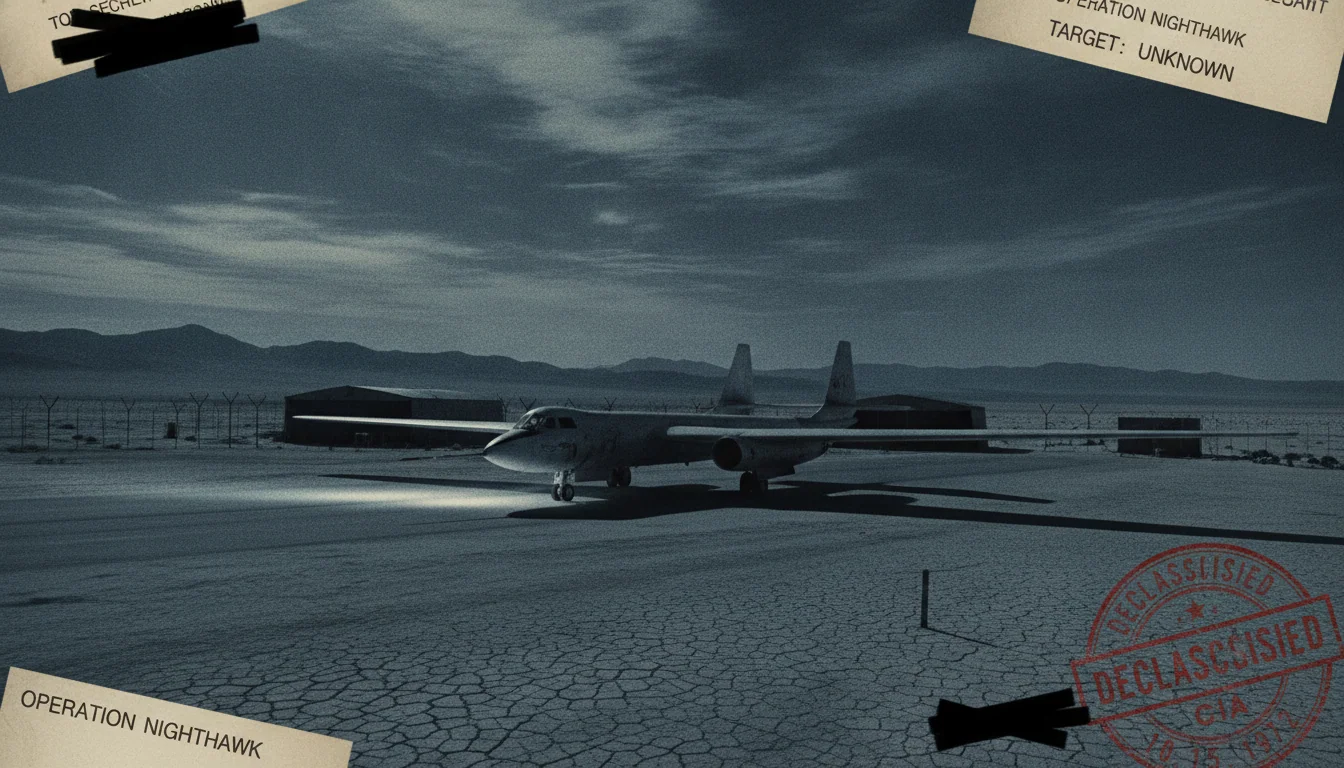
For decades, the standard federal answer to any question about Area 51 was silence. Not denial, not confirmation, just a flat refusal to use the name at all. Then, in 2013, a heavily redacted CIA history of a Cold War spy plane program was released under a Freedom of Information Act request, and buried inside it, unredacted for the first time, were the words "Area 51." It was a small, dry sentence in a decades-old bureaucratic document. It also ended one of the longest-running non-denials in American government history.
The secret
What made Area 51 sensitive was never really the base itself. It was what the base was built to hide: that the United States was flying aircraft directly over the Soviet Union and other nations to photograph military installations, a practice that violated other countries' airspace and, if acknowledged, would have been a serious diplomatic embarrassment during the Cold War. The CIA needed a place to build and test that aircraft where no one, foreign intelligence services included, could watch it happen.
So the government's posture was not "there is nothing here," which would have been an obvious lie to anyone flying over the Nevada desert. It was closer to "we will neither confirm nor deny that anything is here," a formulation that let officials avoid perjury while giving away almost nothing. That posture held for decades, reinforced by employees who signed strict nondisclosure agreements and by a base that appeared on no public map under its own name.
Origins: a dry lakebed and a spy plane
According to the CIA's own declassified account, the site was selected in 1955 by a small team that included Lockheed's chief engineer, Kelly Johnson, and CIA officer Richard Bissell, who was running the agency's new high-altitude reconnaissance program. They needed a remote location with a natural landing surface, good weather, and enough existing government control over the surrounding land to keep outsiders out. A dry lakebed called Groom Lake, tucked against the edge of the Nevada Test Site where the Atomic Energy Commission was already detonating nuclear weapons, fit the requirements.
The area was carved out of existing federal land and placed under the same blanket of secrecy that covered the nuclear testing program next door. Workers and pilots came to know it by a rotating set of nicknames, among them Paradise Ranch, Watertown, Dreamland, and the Ranch, all meant to sound bland enough to attract nothing. "Area 51" itself appears to derive from a simple grid designation used on the maps of the nearby test site, one more numbered rectangle in a landscape full of them.
The operation
The CIA built the base to flight test the Lockheed U-2, a glider-like aircraft designed to cruise above 60,000 feet, well above the reach of contemporary Soviet fighters and most air defenses. Test pilots flew there in near-total isolation, supported by a workforce that shuttled in on unmarked planes and told friends and family they worked somewhere else entirely.
The program's early success, and the demand for something faster and stealthier once Soviet radar and missile technology caught up with the U-2, led the CIA to develop a successor at the same site: the OXCART program, which produced the A-12, a Mach 3 aircraft that would eventually be adapted by the Air Force into the SR-71 Blackbird. Groom Lake's runway was extended and its facilities expanded to support these faster, more demanding aircraft.
Secrecy was built into the base's daily routine, not just its perimeter fence. Workers reportedly commuted in on unmarked contractor flights out of Las Vegas rather than driving in through a public gate, and need-to-know compartmentalization meant that engineers working on one part of an aircraft often could not discuss it with colleagues working on another. Employees signed nondisclosure agreements that outlasted their careers, which is part of why so little leaked from the inside for so long. What eventually gave the site away was not a whistleblower but geography: a landscape this empty is hard to hide a runway in, and aviation spotters and hikers on the surrounding public ridgelines had been photographing distant test flights since at least the 1970s.
One detail buried in the declassified history turned out to matter far beyond the aviation world. CIA officials wrote that secret U-2 and OXCART test flights, visible from the ground as strange, fast, high-altitude objects that did not match any aircraft the public knew about, likely explained a substantial share of the UFO reports filed with the Air Force's Project Blue Book during the late 1950s and 1960s, the same pattern of mundane secrecy behind the Roswell incident a decade earlier. Rather than correct the record, the agency treated the confusion as useful cover, since any explanation would have required revealing the very programs it was trying to protect.
Exposure
The base's existence leaked in pieces long before 2013. Aviation enthusiasts and later UFO researchers tracked its runway from public land in the surrounding mountains through the 1970s and 1980s. In 1989, a man named Bob Lazar gave a television interview claiming he had worked on recovered alien spacecraft at a facility near Groom Lake, and the claim, unverified and disputed by most researchers who have examined it, is largely responsible for cementing Area 51 in popular culture as a byword for extraterrestrial secrecy.
The government's legal posture, however, held firm for years afterward. In the mid-1990s, a group of former Area 51 workers sued over alleged exposure to toxic chemicals from the burning of classified waste on site. The Justice Department fought the case in part by invoking the state secrets privilege and declining to confirm the facility existed at all, and President Bill Clinton signed an exemption keeping the location's environmental records outside normal disclosure law. Reporters covering the case had to refer to it as "the operating location near Groom Lake" because the government would not accept filings that used the name Area 51.
The real crack came from a slower process: a Freedom of Information Act request, pursued for years by a researcher affiliated with the National Security Archive at George Washington University, for the CIA's internal history of the U-2 and OXCART programs. An earlier, more heavily redacted version of that history had circulated since the late 1990s, and it discussed the U-2 program in detail without ever printing the name of the test site itself. The 2013 release was less redacted, and in it, on maps and in the narrative text describing where the aircraft were tested, the name Area 51 was printed openly rather than blacked out.
The change was easy to miss on the page and hard to miss in what it meant. Nothing about the underlying facts had changed. The base had existed since 1955, generations of pilots and engineers had worked there, and outside researchers had been publishing maps and photographs of it for decades. What changed was that the government's own paperwork now matched what everyone outside the fence already knew, closing a gap between public knowledge and official acknowledgment that had lasted the better part of sixty years.
What the files say
What the declassified history confirms is fairly narrow, and worth stating precisely. It confirms that a classified Air Force and CIA test facility exists at Groom Lake, Nevada. It confirms the site was selected in 1955 to test the U-2, and later expanded to test the OXCART program's A-12 aircraft. It confirms the government's internal awareness that its own secret test flights fed the UFO reports pouring into the Air Force during the Cold War, and that officials saw no upside in correcting the public record at the time.
What it does not confirm, and what breathless headlines sometimes implied it did, is anything about extraterrestrial visitors, recovered spacecraft, or alien technology. The document is an aviation history, not a confession about UFOs. Its authors were describing supersonic reconnaissance jets, not saucers.
What remains classified is almost everything about the base's activity after the mid-1970s, since the released history stops there. Area 51 has continued to serve as a testing ground for classified aircraft in the decades since, reportedly including early stealth technology in the 1970s and 1980s, though the government has never released a comparable history covering that later period, the way it eventually did for Project Stargate, its remote-viewing program. The base remains an active, restricted military installation today, and its current programs are simply not part of the public record.
The 2013 release did not solve any mystery that conspiracy theorists cared about. What it did was quietly close a much narrower one: whether the government would ever put the words "Area 51" in an official document and let them stand. After decades of careful non-denial, it finally did.
Quick Answers
Common questions about this topic
Did the CIA ever officially admit Area 51 is real?
Yes. In 2013 the CIA released an internal history of the U-2 program in response to a Freedom of Information Act request, and for the first time the document used the name Area 51 without redacting it. Before that release, the government would not confirm the site existed under any name.
What was Area 51 actually built for?
According to the declassified history, the site on the Groom Lake dry lakebed in Nevada was chosen in 1955 to flight test the Lockheed U-2 spy plane for the CIA. It was later used to test the OXCART program's A-12 aircraft and other classified reconnaissance projects.
Does the declassified file say anything about aliens or UFOs?
No. The document describes aircraft testing and notes that secret high-altitude test flights likely accounted for a large share of UFO reports filed with the Air Force in the late 1950s and 1960s. It does not mention extraterrestrial technology.
Is Area 51 still classified today?
The site remains an active, restricted military installation, and its current programs are not covered by the declassified history, which only runs through the mid-1970s. The government still does not disclose what is being tested there now.

Interrogate the Spymasters
Chat with the agents and analysts the files were about.
Create your free account →No card required. Some figures and features require a paid plan.
Join the HistorIQly Club
Get smarter about the past.
Weekly stories, deep dives, and exclusive content straight to your inbox.